


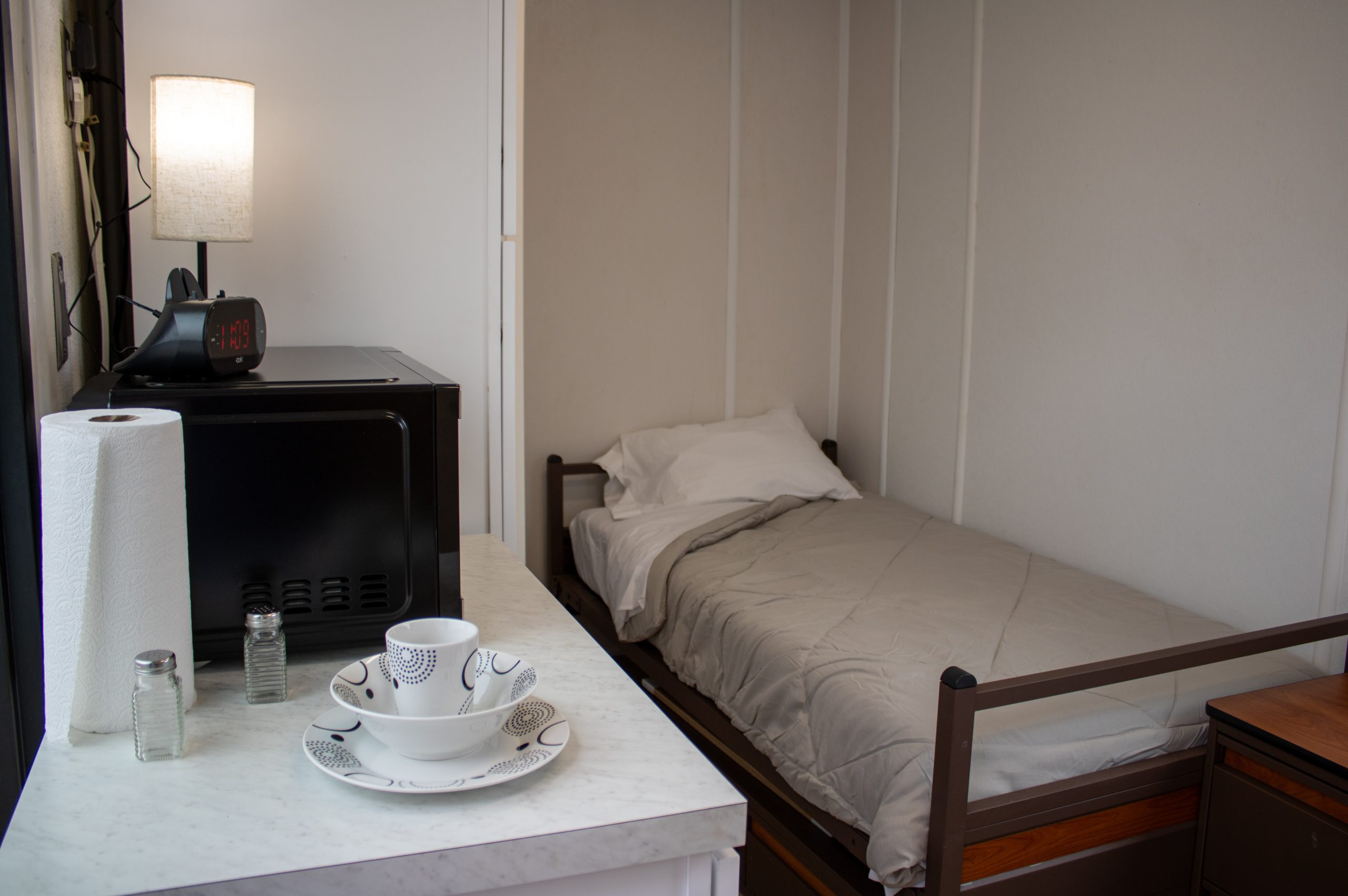

The city of Atlanta has just opened its pilot shipping container village downtown to rapidly rehouse 40 people who were previously homeless—and Mayor Andre Dickens says that’s just the beginning.
Before the end of 2025, Dickens said last week during a ribbon-cutting ceremony for The Melody rental complex, his administration intends to create 500 new residences for unhoused people out of converted cargo containers. Atlanta Housing, the city’s public housing authority, is expected to subsidize their rents.
But that’s all much easier said than done.
The city constructed The Melody, its first shipping container apartment project, at 184 Forsyth Street, just north of the Greyhound bus station, the Garnett MARTA station, and Magic City strip club on a stretch lined with bail bonds shops. It’s located just a few blocks from the Atlanta City Detention Center and Gateway Center homeless shelter.
The complex replaced a city-owned parking lot with 40 small apartments resembling college dorm rooms. Residents will have access to a number of supportive services, including job training and help with mental health and substance use issues.

“We’re not adding new residents to your neighborhood,” Dickens said of the downtown development. “They’re actually already there: They’re just living in tents, or in cars, or in extended-stay hotels. They’re staying with friends or family, or under underpasses, desperately looking for permanent homes.”
While most of Atlanta’s homeless population is concentrated in the city’s urban core, many also live in more residential neighborhoods, where homeowners are more likely to take issue with the development of cargo container communities to rehouse homeless Atlantans.
Already, residents of Mechanicsville, located about a mile south of The Melody, have pushed back against a city plan to plop the hefty metal tiny homes on a publicly owned property on Cooper Street. Neighbors have protested that the city seems eager to house people experiencing homelessness in a lower-income, Black neighborhood—but not in more affluent, whiter areas.
“This is an issue between Black and white families and the haves and the have-nots,” Mechanicsville resident Renee Giles told Capitol B News. “It’s not fair that the city is trying to push this down our throat.”
Last year, Reynoldstown neighborhood leaders unsuccessfully contested private developer Stryant Investments’ proposal to build 42 apartments for unhoused people at 111 Moreland Avenue. Concerned neighbors claimed the project was too dense to be safe for residents, but supporters blamed the backlash on a prevailing NIMBY (not-in-my-backyard) mindset.
Dickens announced during the ribbon-cutting for the new shipping container complex that the city has identified a site on Northside Drive, east of the Westside Reservoir Park, as the next possible location to expand the rapid housing initiative.

The $5 million Melody project took three months to assemble, including sewage and utility lines, which was much faster and cheaper than the 18 months it would take to build a regular 40-unit apartment building.
“We are excited about the potential of replicating the success of this project,” the mayor said. “We’ll begin engaging local residents, businesses, and community stakeholders in the next few weeks.”
Cathryn Vassell, who heads Partners For Home, the city’s nonprofit homeless services agency, said the city will have to approach each community differently as it works to grow the shipping container housing model.
“It’s going to have to be neighborhood-by-neighborhood,” she said of the engagement effort in an interview last week. “We’re trying to get input and insight from each neighborhood of what they’d like to see. But it’s also an educational process, to make sure people are aware of what supportive housing is, and what it isn’t, because there’s a lot of stigma associated with [homelessness].”
The Melody, and whatever similar development could follow, Vassell added, is not a homeless shelter, nor will it be run like one. Rather, it’s permanent affordable housing that will extend year-long leases to people who would otherwise be without a paddle in Atlanta’s expensive residential market.
“There’s a lot of misconceptions and unfounded fears, just because of what people don’t know,” she said.

What style are the cars going to be, will they be a studio style or more bedrooms with facilities.
I am for housing the homeless in neighbor as long as they fit the areas.
This is a great start to combat the homeless population in Atlanta, GA. I’m looking forward to this happening in every city and state nationwide. It’s time to give affordable housing to everyone regardless of neighborhood. Yes, Buckhead, Marietta etc. this needs to happen in your areas as well. NO community should be off limits. I for one would like to help with donating clothes, food, toiletries etc. to the cause. Atlanta housing market is out of control for EVERYONE. The rents are to high, gas is too high taxes are too high, who can really afford to live here anymore. People are being forced to live on the streets daily. Apartment rentals are sky high and you need to make 3x’s the rent. The average person would need two jobs to maintain an apartment. One-bedroom apartments are 1200 and up and are 800 sq ft or less. Most of these apartments were built over 30 years ago and are small and the rent is constantly going up to match the newer apartments rents which go for 1500 and up. The newer apartments are 1500 and up with bigger square footage, new appliances, bigger rooms etc. they are pushing everyone out.
I hope the Mayer would step in and help those who are on a fixed income living in apartment that have rents going up over 200.00 a year without improving the apartments. I know of some people who have stayed in their apartments for over 12 years and are forced to move out because of high rents and became homeless. Its time to do better Atlanta, we are better that that.
I would love to volunteer in this effort, who can i reach out to for information?
Do residents need housewares? I’m willing to donate items.
How can I apply for this type of housing?
Asking for a family member!
I’m happy this mayor is trying to do something positive and helpful! A far cry from the last 2…
This is a great thing. We need more of this. I am working with a group of individuals that are looking into with a pallet home neighborhood for the homeless or shipping container neighborhood. I would love to know how you were able to do this to see what is needed for us to begin the process of comparing the two and decide what one would be best. If you have any information that we could get to help with starting this it would be greatly appreciated.