


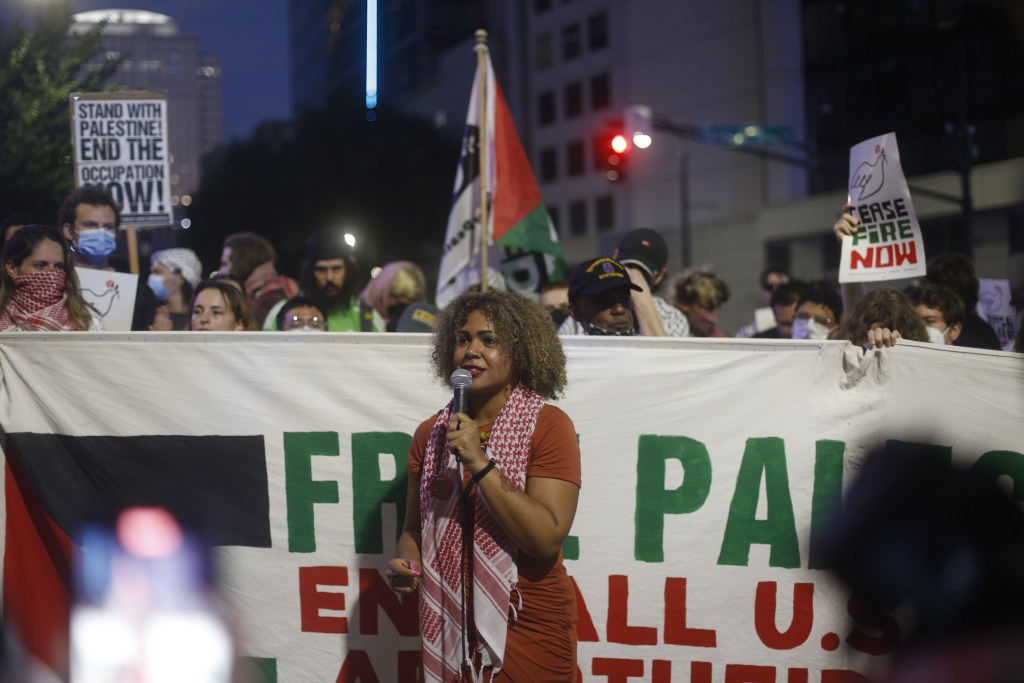
During CNN’s Trump-Biden presidential debate in Atlanta last month, protestors of various stripes gathered at a nearby Midtown intersection to express their discontent with the American political system. One Texas man capitalized on the mood by gathering signatures to get on the ballot in Georgia as an independent presidential candidate.
His name: Literally Anybody Else.
Both ex-President Donald Trump and President Joe Biden have higher unfavorable than favorable ratings among voters, so Mr. Else is counting on people being willing to take a chance on, well, literally anybody else.
Campaigning under the banner of general dissatisfaction, Mr. Else — who has legally changed his name for his presidential campaign — needs 7,500 signatures to have Literally Anybody Else listed at the top of the ticket in Georgia on Nov. 5, alongside Biden, Trump, and — for now — Green Party candidate Jill Stein and Libertarian Party candidate Chase Oliver.
“I get the attention under the banner of general dissatisfaction, but I am presenting myself as a viable candidate — I like to think I have a good head on my shoulders,” said Mr. Else, a former public school teacher who also served six years in the U.S. Army.
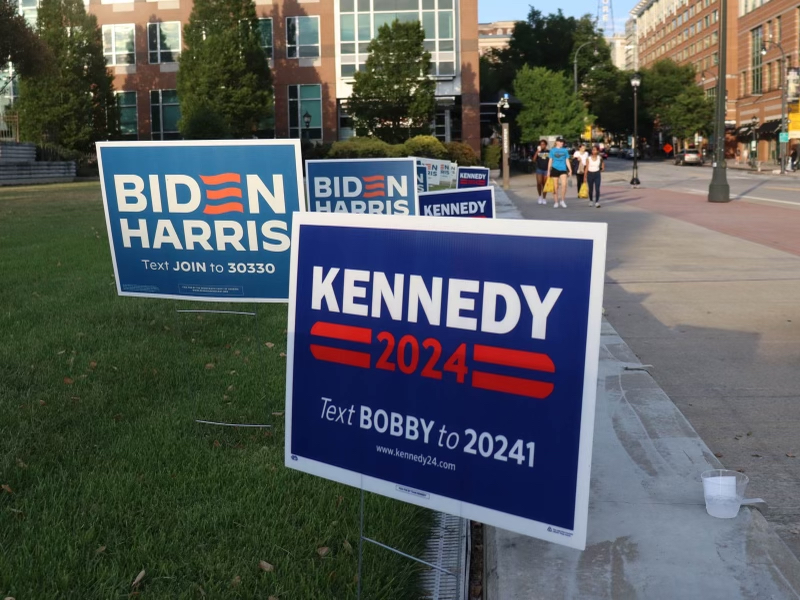
Perhaps a dozen third party and independent candidates run for the presidency each year, but they usually are only able to get on the ballot in a few states. Cornel West and Robert F. Kennedy Jr. are also petitioning to get on the Georgia ballot as independent presidential candidates, while Claudia De la Cruz is petitioning for access as the Party for Socialism and Liberation’s candidate. But in Georgia, no presidential candidate has gotten on the ballot by petition since 2000, according to Ballot Access News.
Since winning the election is generally mathematically impossible, for these campaigns, the discussion around them — if any — is relegated to political symbolism, spoiler candidates, or performance art — as with perennial Pirate Party candidate Vermin Supreme, or, as some may see him, Literally Anybody Else.
“Most of it is that people are really unhappy with the options that we have. We know we can do better,” Mr. Else said of what motivated him to run for president against all odds. “The general consensus is, if you were to draw a person at random, you’d likely get somebody better than who we have. That’s kind of what the sentiment is.”
So why are Americans’ options so restricted when it comes to choosing their leaders? That fundamentally comes down to ballot access.
The process
“Georgia, historically, has been one of the hardest states to get on the ballot,” said University of Georgia political science professor Charles Bullock. Only Republican, Democratic and Libertarian candidates have been listed on the presidential ballot since 1988, with the exception of independent candidate Ross Perot in 1996 and 1992. Until now, Green Party candidates have been write-ins.
The Green Party is on the Georgia presidential ballot for the first time this year, thanks to a new state law that allows automatic ballot access for political parties that are already on the ballot in at least 20 other states. However, that doesn’t apply to independent candidates, who must still petition for ballot access by collecting the requisite number of signatures, which varies by office.
In Georgia the deadline for independent and third-party presidential candidates to submit a petition with 7,500 verified voter signatures was July 9. West, Kennedy and De la Cruz are still waiting to hear if they made the cut.
For Mr. Else, 7,500 signatures was too high a threshold, but Georgia’s requirements are “middle of the pack,” in his view. His home state of Texas requires 113,151 signatures for presidential candidates, for instance. So he’s hit the road for Tennessee where just 275 signatures are required.
“One of the biggest struggles of collecting signatures,” Mr. Else said, are the validation requirements from the various states. “That requires petitioners to ask for a lot of personal information,” he explained. “If somebody approaches you and you’re an unknown, you have to talk to them to earn their signature … You have to make these cases on an individual level.”
In his view, the biggest obstacles for independent candidates comes down to the inability to get media attention and the current campaign finance landscape, which can be prohibitively expensive for any candidate who’s not backed by a major party. The $3,300 federal cap on individual contributions to candidates per election is irrelevant, Mr. Else said, when super PACs have essentially unlimited fundraising and spending power.
“That’s not a furtherance of the democratic process. It’s a hijacking of it,” he said.

Candidates for federal office must also pay a filing fee equivalent to 3% of the salary for the office they are seeking — or provide a financial affidavit showing they cannot. For the U.S. Presidency, which pays $400,000 per year, that works out to a $12,000 filing fee.
Presidential aspirants still have time to get certified as a write-in candidate in Georgia. They won’t appear on the ballot, but the tally will be counted from voters who write in their names. Write-in candidates have until Sept. 3 to file a notice of intent with the Secretary of State’s Office, along with an affidavit showing that their intention to seek office was published in a general-circulation publication in the state.
Better options or spoilers?
Plenty of voters this year say they don’t like either the Democratic or Republican option for president, but many also express reluctance to vote third-party, for fear of throwing away their vote or having a spoiler effect.
In the American political system, third-party candidates are often perceived as spoilers, Bullock said, such as Green Party candidate Ralph Nader in the 2000 presidential race between George Bush (R) and Al Gore (D) in Florida, or Libertarian candidate Shane Hazel, who forced the 2020 Georgia Senate race between David Perdue (R) and Jon Ossoff (D) to a runoff after garnering 2.3% of the vote in the general election.
“My hunch is the reason they made it easier this last year for third parties to qualify is [because of] an expectation on the part of Republicans — who, of course control the state [legislature] — that doing so would disadvantage the Democrats,” the veteran political observer said.
But even with easier access, Bullock said, it’s rare for third-party or independent candidates to be competitive.
“The experience is — even in states where it’s easy to get on the ballot — as the time of the election draws near, the share of the voters who say they might vote for a third or fourth party tends to go down. That’s because anybody who’s paid any attention at all recognizes that third parties don’t usually get elected,” he said.
The notable exceptions in Congress, he added, are Senators Bernie Sanders in Vermont and Angus King in Maine, both independents who caucus with the Democrats. But otherwise, running as an independent is a tough row to hoe.
“In most of the rest of the nation it certainly doesn’t get you elected,” Bullock said.
Qualifying for other races
Oddly enough, it can be harder to run for Congress in Georgia as an independent or third-party candidate than for president. State law requires these candidates to collect valid signatures from 5% of the registered voters in their congressional district to gain ballot access. For the House of Representatives, that ranges from 25,000 to 32,000 signatures. That means the presidency has a lower signature requirement than any congressional district in the state.
For state and local offices, the rules are different for running as a third-party or independent candidate.
To run for the Georgia legislature, aspiring candidates must collect signatures totalling 1% of the number of registered voters who participated in the prior election. For the state senate, this ranges from 4,800 signatures in District 5 in Gwinnett County to 7,749 signatures in District 51 in North Georgia. The Secretary of State’s Office publishes the signature requirement for each district.
Legislative candidates must also pay a $400 filing fee. Filing fees vary by state office – and to run in any state race, an independent candidate cannot have run in a political party’s primary for that election cycle.
For county and municipal offices, the rules are set by local election authorities. So candidates seeking to run independently for those offices must check with their county election office to navigate the requirements to appear on the ballot.