


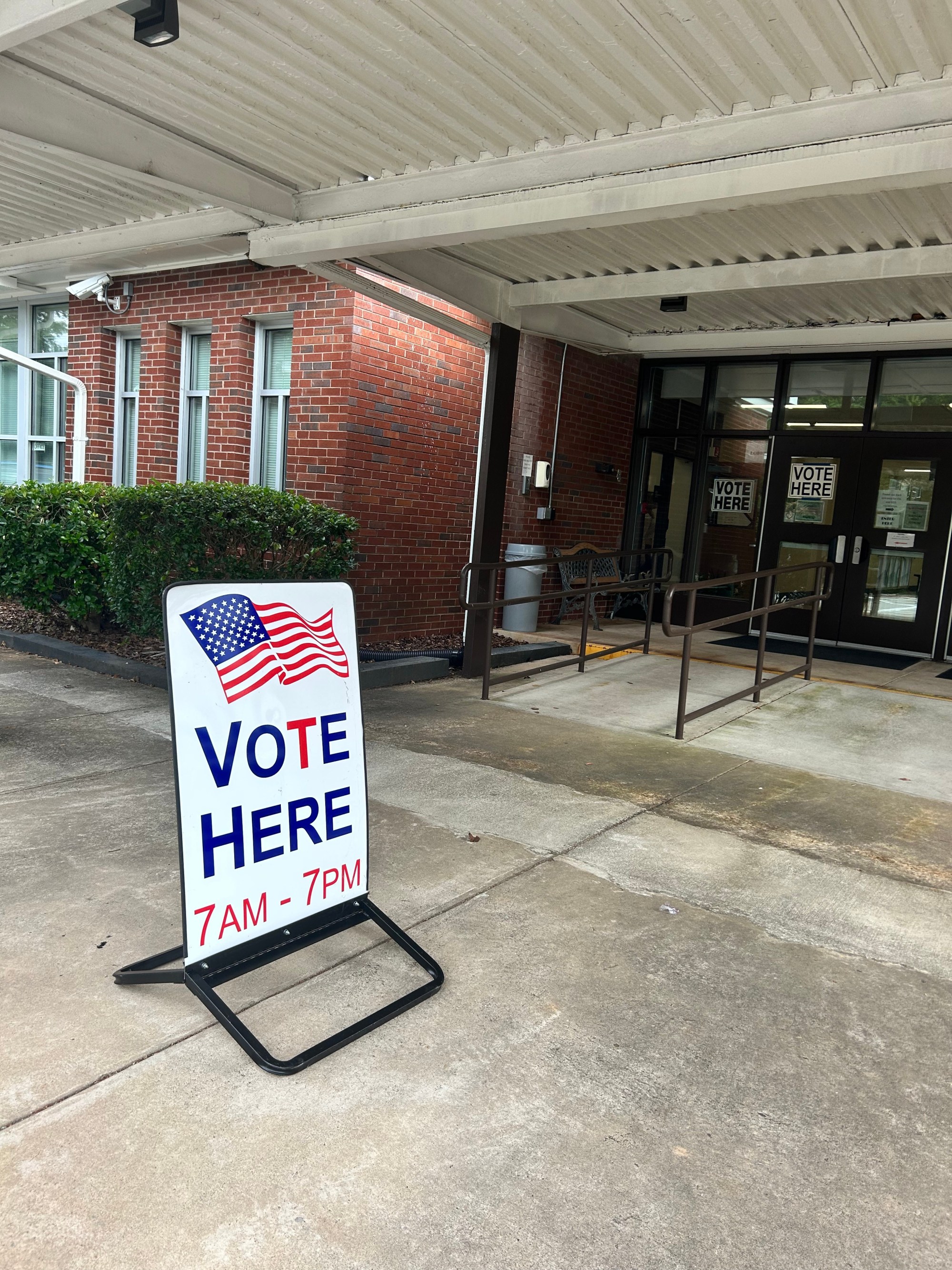

When Canopy Atlanta looked at 2020 voting data, the precincts with the lowest voter turnout in metro Atlanta were all in Fulton County, concentrated in the west of the city and southern Fulton. But why?
According to voting rights and redistricting experts, the way Georgia has drawn its legislative maps may be a contributing factor.
The precincts are all in predominantly communities of color and lower income, and particularly those in south Fulton straddle the divides between legislative districts. The way district lines carve up voters in places like South Fulton, Union City and College Park, means that people in the same community may have different legislators at the state level, breaking up their representation, causing confusion and leading to a sense of apathy, experts say.
Successive rounds of redistricting have also led to less competitive elections, with the most recent Georgia maps leaving only five out of 236 combined state House and Senate seats competitive, according to Fair Districts GA, a redistricting advocacy group. This, says Stephanie Jackson Ali, Policy Director at The New Georgia Project, drives voter apathy.
“There’s just a lot of non contested races, and that discourages people from wanting to go turn out, because they’re like: ‘why would I go and get very involved in this when so many races are uncontested?’,” she said, adding that “because of the lack of competitiveness, people just aren’t as excited, because they don’t feel like their vote is going to matter.”
Another factor, Ali said, is that redistricting in certain areas, including South and West Fulton, but also areas such as Macon, Henry and Clayton counties, has radically changed which legislators are representing whom.
“They are very often seeing completely new names running, not seeing familiar names, and that means that they are, again, kind of less invested, because it’s people that they may not know from their community that they may not recognize,” she said.
In fact, the redistricting changes that affected South Fulton in particular, were a key focal point of the American Civil Liberties Union’s (ACLU) legal challenge to Georgia’s legislative maps that is ongoing in federal court.
“The southern metro Atlanta area is one of the areas where the district court found in our statewide redistricting case that the votes — the voices of black voters in particular — were diluted and that’s something that I think has a downstream effect on turnout,” said Caitlin May, a voting rights staff attorney for the ACLU.
District Judge Steve Jones, following an eight day trial in September 2023, ruled that Georgia’s maps had to be redrawn for violating the Voting Rights Act. In particular, the judge found that in metro Atlanta and around Macon, the district lines “fragmented” the growing Black populations of those areas.
In December, the Republican-controlled state legislature passed new maps to address the issue, but the ACLU contends that these maps do not adequately comply with Judge Jones’ ruling, and the state has filed an appeal to the U.S. Court of Appeals for the 11th circuit in Atlanta, which has yet to schedule a hearing. Practically, it’s unlikely that the court will make any ruling before the Nov. 5 general election, May said.
“When communities see that their voices are not being heard and that they’re not able to elect candidates of their choice, the incentive to get out and vote just goes down,” May said.
Bridgemon Bolger, a political consultant who is also the public advocate for the City of South Fulton, said that particularly in areas that are working class neighborhoods, voters are attuned to issues that will affect their day-to-day lives, and that successive political scandals and polarized nature of politics these days is also likely contributing to voter apathy.
“All that, I think, creates a lot of apathy and distrust,” he said.
Georgia’s legislative maps, critics say, are heavily gerrymandered using practices known as packing and cracking.
The Princeton Gerrymandering project, a group that does non-partisan mathematical analysis for activists and legislators to advocate for fairer legislative maps, explains the processes as follows:
“Packing” occurs when many supporters of the victim party are jammed into a small number of districts, giving them a few overwhelming wins. The remaining members of the victim party are then “cracked,” spread across a large number of districts, so that they consistently win just under 50% of the vote.
This packing and cracking, says May, is exactly what’s going on in the Atlanta areas where turnout was lowest in 2020.
“This is an area of the state where we have shown that there is vote dilution, and communities have been packed and cracked, and that over a period of years that is going to have an impact on voter turnout,” she said.
Even so, Judge Jones’ order demanded the creation of more majority Black districts, but that does not necessarily resolve the issue of districts being drawn in ways that break up communities.
Looking at the shapes of legislative districts in metro Atlanta, especially in Fulton and DeKalb counties, they are most often long strips running north-south, like ribbons, or “bacon strips,” that aren’t centered around any one neighborhood, says Ali with the New Georgia Project.
“Having these strip districts, which we have now in Fulton, we have in DeKalb, really makes it hard to have a cohesive district that is focused on a community of interest, or a community of any given kind …. And so what you end up seeing is candidates who are running for one side of the district or the other,” she said.
This is the case of those lowest turnout precincts in Union City, College Park and South Fulton identified by Canopy Atlanta. Those cities are carved up by strip districts in the state Senate between Senate districts 36, 38 and 39.

In the state House district maps, these areas are split between house districts 59, 62, 63, 68. All are so-called “strip” districts.

Even if the ACLU’s legal action results in fairer maps, that may not help in restoring voters’ faith in the system, May added.
“Once a community has seen that their legislature has tried to dilute and drown out their voices, it’s hard to regain that trust or that incentive to turn out and vote,” she said.
How we reported this story:
This story, by Atlanta Civic Circle democracy reporter Alessandro Marazzi Sassoon, is a part of ACC’s editorial partnership with Canopy Atlanta’s Barriers and Bridges Election Project. Learn more about the series and the project here. This story was edited by Stephanie Toone and fact-checked by Julianna Bragg.
Leave a comment