



As campaigning heats up for the presidential election, it can be tough to keep track of what the office that everyone’s vying for actually does. For labor rights, does the president decide what job protections you have and whether you can unionize – or does that authority come from somewhere else?
It turns out that the president has less direct influence over labor rights than you might think. That said, the nation’s chief executive exerts a lot of power by appointing the leaders of federal agencies like the Department of Labor (DOL) and the National Labor Relations Board (NLRB), issuing executive orders, and setting their party’s strategic direction on labor policy.
Beyond that, much of the day-to-day labor rights governance comes down to state and local governments. Before giving you a rundown on the president’s role for labor rights, here’s a quick recap of how the top contenders stack up.
President Joe Biden, who just decided not to pursue reelection, has called himself the most pro-labor president in decades, and he’s got the credentials to back it up.
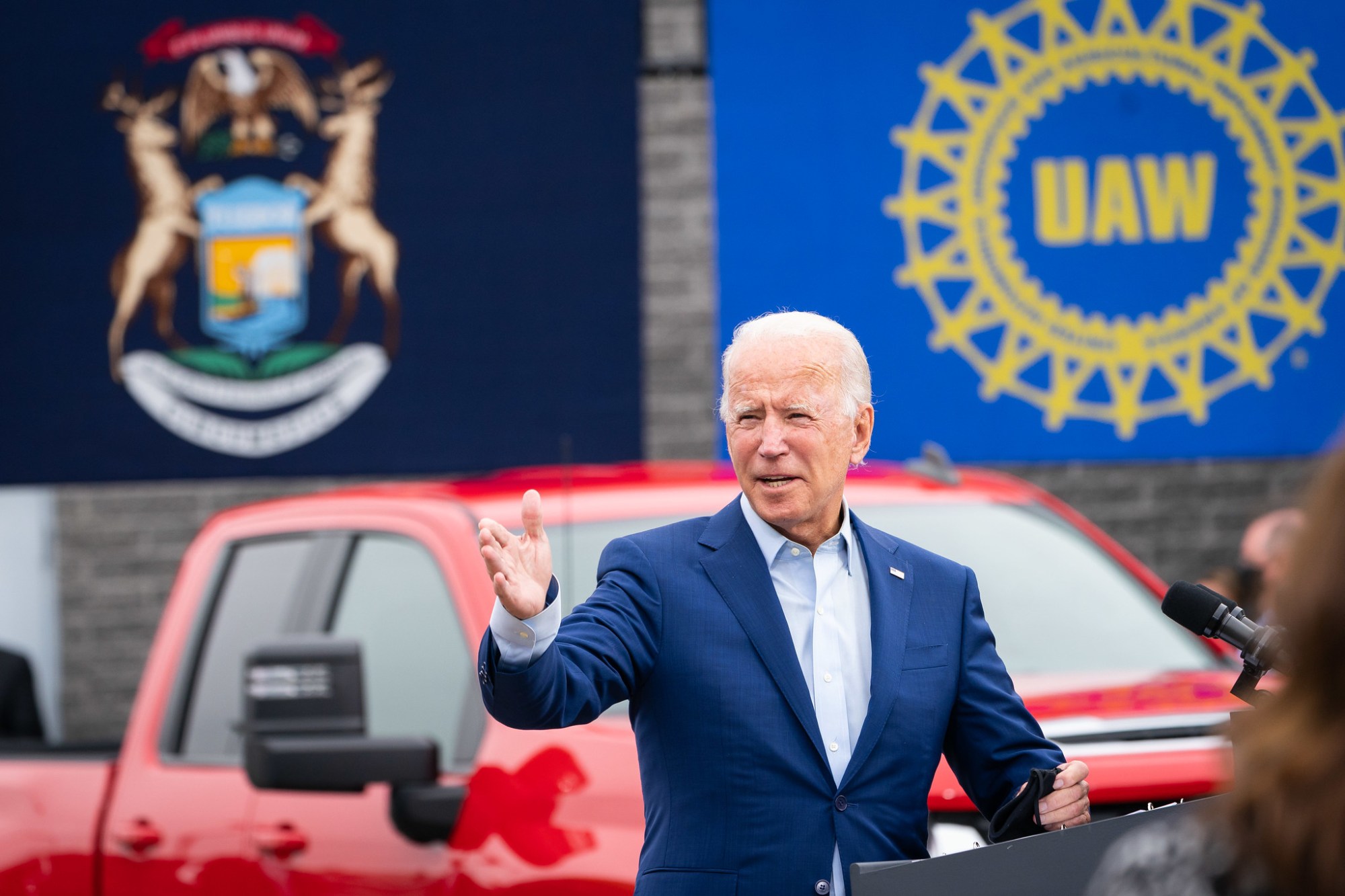
Last fall he hit the road with the United Auto Workers (UAW) as they drummed up support during contract negotiations with the Big Three automakers. He also created a federal worker empowerment task force and directed more funding to the NLRB, which referees union elections and labor disputes between workers and management.
However, Biden also took a hand in stopping railroad worker unions from striking in late 2022, as they fought for more favorable contracts.
Now that Biden has stepped aside as a candidate, he has endorsed Vice President Kamala Harris, who is the current front-runner as the Democratic presidential nominee. Harris has just received endorsements from a number of high-powered labor unions, including the AFL-CIO, a 12.5 million-member union federation. She also heads Biden’s worker empowerment task force.
The Republican presidential nominee, former President Donald Trump, is likewise trying to win support from labor unions. Notably, Teamsters head Sean O’Brien gave a speech at the Republican National Convention in Milwaukee last week, calling on all political parties to support unions. (O’Brien said he’s also requested speaking time at the Democratic National Convention in Chicago next month.)
But Trump doesn’t have a stellar reputation with other big labor unions. He has been panned by the AFL-CIO on multiple occasions for weakening unions and the NLRB, while UAW chief Sean Fain blasted him earlier this month as “a disaster for the working class.” Many union advocates say the former president’s Supreme Court and NLRB picks show he favors corporations over workers.
Read on for the answers to a few key questions that shed light on the president’s role in labor organizing and workers’ rights – and how the next president could move the needle.
What power does the president have over federal labor rights?
The president exercises considerable power over labor rights by picking agency heads. He or she appoints the Secretary of Labor to run the Department of Labor, which determines working conditions, rights and work-related benefits for American workers.
The president also appoints the National Labor Relations Board’s five members, each serving a five-year term, and the NLRB’s general counsel. The board members act as a judicial panel to authorize and certify union elections and rule on disputes over unfair labor practice charges brought by workers or management.
Since the NLRB requires funding and staff to oversee labor relations across the country, the president can also exert power by increasing or decreasing its funding recommendation in the draft budget he or she sends to Congress.
For example, President Biden worked with Congress in 2022 to pass the largest NLRB funding increase in over a decade. The $25 million in additional funding allowed the federal agency to avoid cutbacks and furloughs.
Where do the president’s powers over labor rights come from?
The president’s federal powers over labor rights primarily come from the National Labor Relations Act of 1935, also known as the Wagner Act. This law established workers’ right to organize unions and, then, to bargain as a collective unit with their employers over pay, benefits and working conditions.
The Wagner Act also established the NLRB to referee union relations between workers and their employers. Workers must petition the NLRB to approve which employees make up the voting group for union elections and collective bargaining rights. What’s more, it bars employers from refusing to bargain with any group of workers certified by the NLRB.
This law established most of the federal government’s power over labor rights. It is enforced by the president, along with the judicial branch.
Beyond the NLRA, how can the President affect labor rights?
The president can exercise a lot of power through executive orders and soft power. It’s the president’s prerogative to issue executive orders, which carry the force of law without requiring Congressional approval. However, they only apply to executive branch employees.
Biden issued an executive order in 2021 to establish the Task Force on Worker Organizing and Empowerment, headed by the vice president and the labor secretary, with over 20 cabinet members and federal agency heads. The president charged the task force with identifying executive-branch policies and programs that he could use to push his worker empowerment agenda forward.
What power do the states have over labor rights?
The states likely have more power over labor rights than the federal government as far as the day-to-day treatment of workers. That is because labor rights aren’t explicitly addressed in the Constitution, and the Tenth Amendment reserves any power not expressly granted to the federal government for the states.
Consequently, the states basically govern all labor rights for workers beyond what’s covered in the National Labor Relations Act, NLRB rulings, or executive orders for federal employees.
States also determine minimum wage laws. Congress sets the federal minimum wage, which overrides any state minimum wage that is lower, but it has not increased the federal minimum wage of $7.25 an hour since 2009. Georgia and Wyoming are the only states with lower minimum wages: In Georgia, it’s just $5.15 an hour.
As for labor rights, the states decide whether public sector unions made up of state employees like teachers, have collective bargaining rights. Georgia allows public sector unions, but they do not have collective bargaining power. That means you can be a unionized state government employee, but your union doesn’t have the power to negotiate for pay raises and other benefits on your behalf.
States also decide whether their citizens have “right-to-work” employment. “Right-to-work” laws discourage union membership by allowing workers in a unionized shop to avoid joining the union and paying dues, while still benefitting from the union contract that their co-workers have won.
Georgia is a right-to-work state and, unsurprisingly, the vast majority of Georgians are not union members. Only 4.4% of the state’s workers belonged to unions in 2023, compared with 10% nationally, according to the Bureau of Labor Statistics’ annual labor report.
Here are a few more ways that the state government of Georgia affects your labor rights:
- States decide whether workers who aren’t covered under the National Labor Relations Act can unionize. That includes farm workers and independent contractors.
- States also establish protections for non-traditional workers in general, including gig workers, temps and on-call employees.
- States decide what worker protections exist for whistleblowers in a workplace.
Leave a comment