


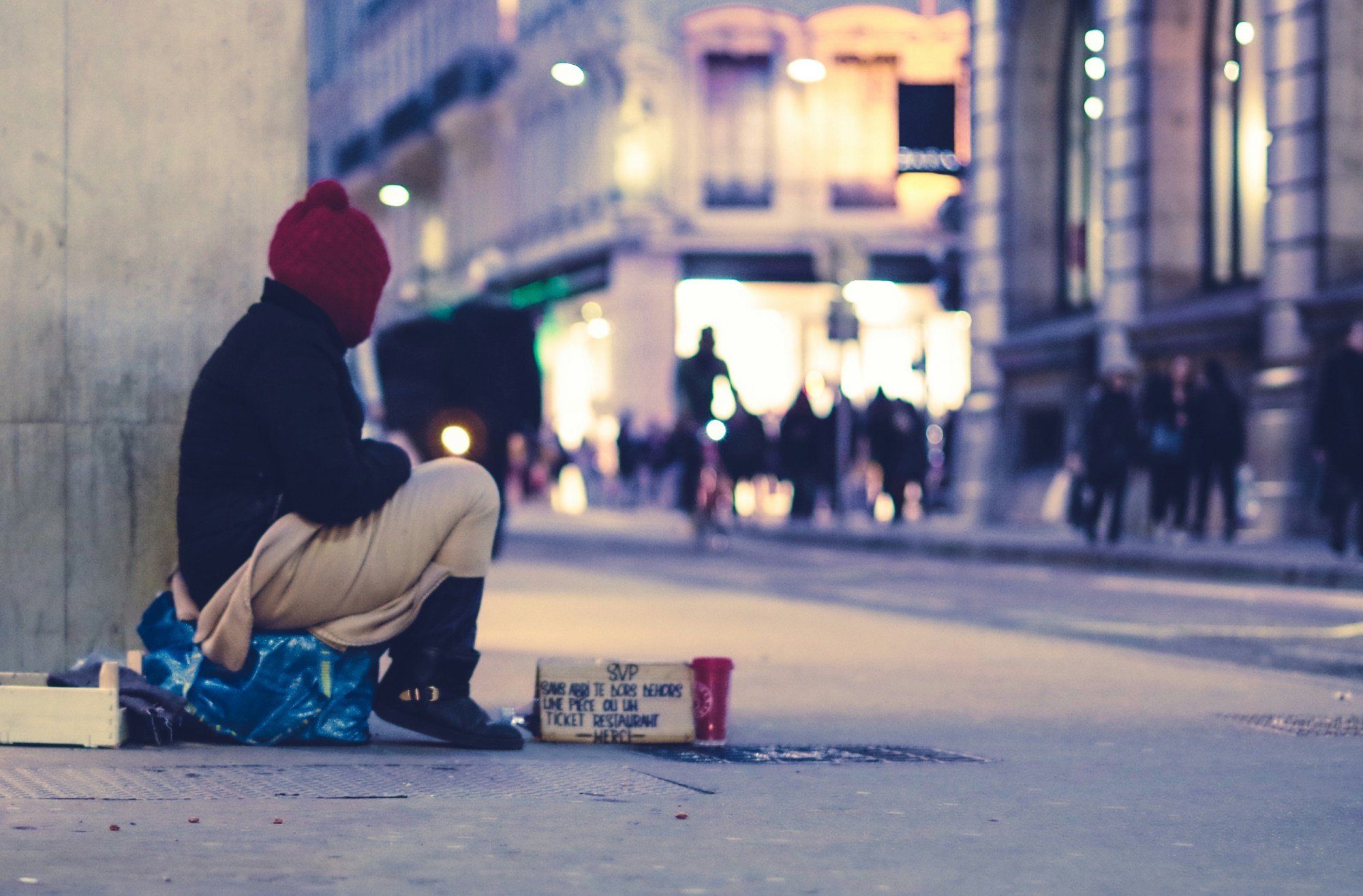

If an average public school classroom has 30 students, it would take nearly 400 classrooms to hold all of the students experiencing homelessness in metro Atlanta.
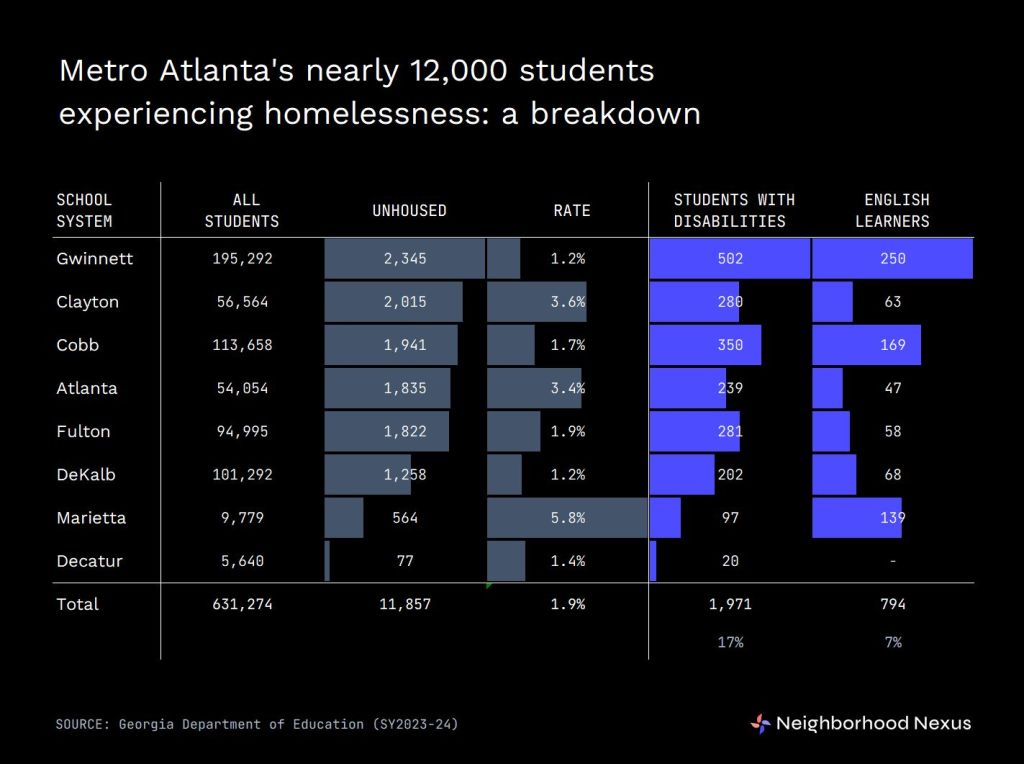
Across Cobb, Clayton, DeKalb, Fulton, and Gwinnett counties, 11,857 students are living without stable housing — more than enough to fill every seat in Georgia Tech’s basketball stadium and nearly enough to pack Duluth’s Gas South Arena — according to Georgia Department of Education data compiled by Neighborhood Nexus.
That means nearly 2% of the 631,274 public school students in the five-county metro area are living on the streets, in shelters or extended-stay motels, doubled up with other families, or couch-surfing.
That number reflects the challenges posed by a dire housing shortage, the expiration of pandemic-era eviction-prevention programs, and a foster care system underserving many young people and families in need of housing assistance.
The dearth of housing in metro Atlanta, as in other big U.S. cities, is by far the biggest problem, said Cathryn Vassell, the head of Atlanta’s primary homeless services nonprofit, Partners For Home. Academic Gregg Colburn best articulates the problem in his book “Homelessness is a Housing Problem,” she said.
“He describes a game of musical chairs,” Vassell recalled in an interview. “There are 10 people and there are nine chairs, and one of the people in the game is walking on crutches with a cast on their leg. The problem is not that they have a cast on their leg and they’re on crutches. The problem is that there are not 10 chairs.”
Across the metro region, the city of Atlanta has one of the highest rates of student homelessness, with 3.4 out of every 100 Atlanta Public Schools (APS) students — 1,835 students out of 54,054 total — deprived of stable housing during the 2024 school year.
That’s an uptick from 2023, when 3.1% of APS students (1,672 of 54,544 kids) identified as unhoused.
Only Clayton County and the city of Marietta have higher numbers of unhoused students, with 3.6% and 5.8% of their student bodies experiencing homelessness, respectively.
A problem hard to measure
What’s more, the actual number of unhoused students is likely higher. Government agencies inevitably undercount the true number, because their data mostly relies on self-reporting by parents or guardians, according to Joy Moses, a researcher at the National Alliance to End Homelessness.
Some public school systems, including APS, employ homeless liaison staff to identify students in precarious living situations. But some parents opt not to identify as unhoused when enrolling their kids in schools, out of fear that they could lose custody, Moses said.
“Some people are reluctant to self-identify, but there are some people that don’t know or don’t make the connection that they should be identifying themselves [as homeless], and that there might be services available to them if they do,” she added.
Limited school resources play a big role, too.
“Many school systems are under-resourced,” Moses said. “Often the people who are focused on homeless services within a school district or even in a school, it’s one of many responsibilities that they have. They’re trying to execute the best way that they can, but it’s rare to see a targeted person where that’s the focus of their job and they’re not doing anything else.”
Absenteeism spikes
Housing challenges have also contributed to a sharp rise in student absenteeism statewide, according to the Governor’s Office of Student Achievement.
Chronic absenteeism — when a student misses more than 15 days in a school year — has spiked since 2019, when the COVID-19 pandemic began. Last year, 29% of Georgia preschoolers missed more than 15 school days, up from 18% five years ago. For 12th graders, chronic absenteeism shot up to 35% last year, compared with 22% pre-pandemic.

Even for students able to attend class regularly, housing instability often inhibits their education and development, said Monica Johnson, an organizer with the nonprofit Housing Justice League.
“It makes it a whole lot harder — nigh impossible — for a child to be able to learn at school,” she said. “The issues that we face in our community flow from the lack of resources. When you don’t have a regular place to sleep, when you don’t have good food to eat, when you don’t have your healthcare taken care of, you are unable to grow as a human being and fulfill your needs and make good decisions and set yourself up for success.”
Johnson added: “If you’re constantly on alert — if you don’t feel safe and warm and content — then trying to learn something or build critical thinking skills or improve your reading or understand math concepts, it’s not going to happen.”
Building more housing could help, but the real problem is affordability, she said.
“We not only have a housing shortage; we also have a crisis of affordability,” Johnson explained. “If we build millions upon millions of units, but they are still at prices that the average person or the working person cannot afford, then we just end up in the same position that we’re in. We need to build more subsidized housing. We need to build public housing. We cannot rely on private developers to do that for us.”
It’s really sad that we are in 2024 still dealing with homelessness. I thi.k if every billionaire in there city should make it possible for affordable housing and so forth especially these kids who’s trying to go to school so that they can get out of the situation that they are in. I really wish I had some money. But soon and very soon our heavenly father is going to do away with it all. There will be no more death, sickness,or hunger.
They aren’t “unhoused” they’re f****** homeless. Loose the euphemisms.
Homeless doesn’t always mean they don’t have a roof over their head. In fact, regarding children it rarely does. It means they don’t have a permanent residence and an address that is permanent.
Wow this is a huge issue and I’m sure the numbers are actually higher . Me and my siblings would’ve definitely been a part of these numbers a few years ago when we were still in school . It’s hands down an affordability issue and an outdated system when it comes to evictions ! They say evictions after 5-7 yrs shouldn’t impact you when applying for housing but that is not the truth !!
Some people who reside with family members don’t consider their selves homeless and some people who choose to reside in extended stay motels don’t consider their selves homeless because you have to pay the motels.
The truth of the matter it is extremely hard for a single income household to remain housed paying rent especially with children in the household.
There should be more conversations with families of the importance of residing together, choosing households that are large enough for larger families, (you can’t force 8 people in a 2 bedroom house and expect comfort) Families need to choose activities and enrichment activities that are beneficial to the family, family have to value and support each other in order to thrive.
Once this happens then generations can be more empowered to work on policies and understand the value of civic engagement.
I’m sorry for the confusion with the children in Atlanta. I hope some people who are doing well in their life could help with these children.
Sad sad world we are in…even us working people living like we don’t even have a job,,, go to work everyday to still remain hungry and staying in hotels and rooming houses n shit..not fair at all to nobody
The truth is these schools and programs make it harder for us. It’s never no help or funding or an extra long waiting list. Also the schools require so much to enroll a homeless child. I understand now y it’s so many homeless older ppl on the streets because after 2 yrs of trying you kinda lose hope and get used to it. I’m a single homeless mother of 4.
Why are they comparing extended stays to homelessness. They have kitchens, are big enough to be a studio in a “normal” apartment complex, and cost as much if not more then many “normal” apartment buildings.
Your lease at an extended stay counts as a home for a week, or month, whatever way you pay. It’s not being homeless at all and makes a way for people who have money, but may not be included and clicking or popular enough to get their application past the front desk at an apartment that listens to there special friends about who is allowed or not to have a full year lease. If you want to report it, keep it 100. Nobody has time for your half truth. The cancel culture is very alive and you lie and ignore them for their support. Make not right to work states a right to work states and hold these secretaries without degrees or
License to higher integrity and enforce the issue of discrimination they pursue with punishment for their need to leave half the country they don’t like without a way to get a year lease. Which helps them prove that although a family is cool and hard working. You wanted them to look incompetent over personal opinion and don’t want them to be successful. It is what it is and anyone know that. Thanks to the extended stays. Many people who have been subject to the cancel culture and there need to discriminate without it being able to be proven and get away with it by people who act deaf mute and dumb are the problem. Thank god for extended stays or many single mothers would be a hoe or homeless just because in high school the lady who now an adult and runs the front desk still don’t like her and thinks it’s funny for people to be homeless. Thanks to the extended stay not the welfare system or reporters. Many people feel normal and can be a part of a neighborhood. Being in an extended stay is not homelessness honey and I resent this article and the representation is being used and didn’t do their research well before they thought they knew what it was to walk in another shoes. Your wrong, your article may help to end long term stays, and that makes you part of the problem and a sucker for it.
So why aren’t the parents charged with a crime? It’s called vagrancy, not homeless or unhoused. These are parasites living off society.
Joe, there are many reasons some people cannot get stable housing. Let’s list them:
#1. Completely unexpected job loss due to business closings.
#2. Federal, State, and Local government mandates that shut down ability to get stable housing by affecting lending institutions.
#3. Local banks (that is, those that are not part of a national or international chain) dying due to injurious Federal laws or being gobbled up by national bank chains.
I’m sure there are more; however, these three are major things out of their control. To criminalize victims is wrong.