




Atlanta Civic Circle last month reported that the Centennial Yards Company had decided against providing 61 affordable housing units in a new 304-unit apartment tower, The Mitchell, at its downtown “Gulch” development.
Instead, Centennial Yards chose to pay the city of Atlanta roughly $8 million — or about $132,000 per unit — in what are called “in-lieu fees,” as is permitted by its development deal with the city and the city’s inclusionary zoning guidelines. The problem is, that money, deposited in a new housing trust fund managed by the city, isn’t nearly enough to create 61 affordable apartments somewhere else.
The city appears to have missed out on at least another $3 million that could have gone toward delivering affordable housing elsewhere, because the Atlanta Planning Department has failed to annually update the in-lieu fees for inclusionary zones to account for rising construction costs and other market factors.
Providing affordable housing is a condition for the up to $1.9 billion tax incentive rebate package that Centennial Yards’ owner, California-based developer CIM Group, received from the city of Atlanta in the Gulch development deal. In exchange for making 20% of housing units there affordable for renters earning 80% of the area median income or less, CIM Group received a 20-year property tax break and the ability to collect the city and state sales taxes at the Centennial Yards site for 30 years.
But when Centennial Yards wrote an $8,046,205 check to the city late last year to pay in-lieu fees, rather than provide 61 affordable units at The Mitchell, the city charged a fee per unit that was far less than what it would cost to build housing elsewhere.
The city charged the company only $131,905 per unit — the in-lieu fee for the Westside inclusionary zone — because the city planning department calculated the fee amount based on the 2017 housing market, when Atlanta created its first inclusionary zones. It has not updated its figures since then to reflect more recent data.
Had the city accounted for rising national construction costs and other market variables, it could have charged Centennial Yards at least 40% more — or about $196,000 per unit — for the in-lieu fees. That adds up to $11.76 million for 61 units — more than $3.7 million over the actual amount the city collected.
Georgia State University urban studies professor Dan Immergluck said that billing the company some $132,000 for each affordable unit it declined to create “was probably too low of an in-lieu fee, even when the contract was initially signed [in 2018].”
“That was probably half the per-unit construction cost — or less — at the time, which gave [Centennial Yards] a built-in incentive to take the in-lieu option,” he told Atlanta Civic Circle in an email. “Now, five years or so later, and after the COVID-era cost hikes … an appropriate per-unit in-lieu fee is probably over $400,000 per unit — maybe more.”
If that were the case, the city could have charged Centennial Yards $24.4 million for the 61 units’ in-lieu fees — or almost $16.4 million more than the $8 million that it actually collected.
In-lieu fees should be “calculated yearly to reflect the current market,” according to the city ordinance that created the Westside inclusionary zone. The ordinance adds that the rates will be published on the Atlanta Planning Department website by June 1 and take effect on July 1 of each year. “The in-lieu fees plus administrative costs are based on the approximate cost of construction of replacement affordable workforce housing units not built on site,” it says.
A city planning department spokesperson said the department “regularly evaluates the in-lieu fee,” but the latest in-lieu fee schedule on its website is for 2019-2020 — and those numbers haven’t been updated since 2017, either.
Gulch deal’s affordable housing opt-out
CIM Group formed the Centennial Yards Company to reimagine the nearly 50-acre pit of parking lots and railroad tracks downtown, known as the Gulch, into a dazzling mini-city slated to cost $5 billion. The mixed-use district is also called Centennial Yards.
According to the development contract that CIM Group signed with the city in 2018, it agreed then — and again in 2021 — to earmark at least 20%, or 200 of the 1,000 residences it aimed to build, for households earning less than 80% of the area median income. That was one of the conditions for the up to $1.9 billion in public subsidies.
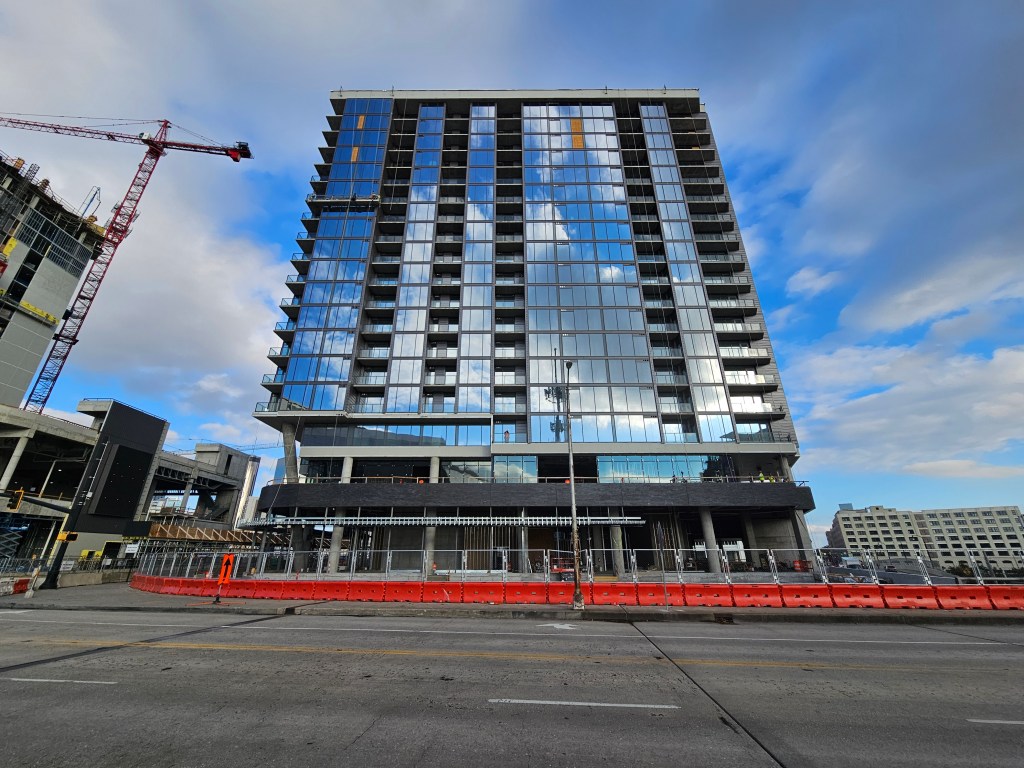
But the contract included an opt-out clause that allows Centennial Yards to skirt its affordable housing commitment for The Mitchell, a glassy, 19-story high-rise materializing at the corner of Mitchell Street and Centennial Olympic Park Drive.
The opt-out clause stems from the inclusionary zoning policies the city adopted in 2017, which give developers in targeted zones the option to pay in-lieu fees instead of supplying affordable housing to receive tax breaks and incentives. The fees go into a municipal housing trust fund dedicated to creating and preserving affordable housing.
Consequently, Centennial Yards was afforded the option to pay a $131,905 fee for each of the affordable units it chose not to offer at The Mitchell.
“After close consideration of the multiple variables impacting the developer, the Centennial Yards Company made the decision to pay the in-lieu fee for the new apartment tower at Centennial Yards,” company spokesperson Jami Schlicher told Atlanta Civic Circle in an email. “We are dedicated to ensuring that Centennial Yards is an inclusive and diverse community and that we meet or exceed the workforce/affordable housing requirements set forth in the development agreement.”

To its credit, Centennial Yards added 25 affordable apartment units downtown when it transformed the former Norfolk Southern office building on Ted Turner Drive into The Lofts in 2022. The company also paid the city an initial $33.5 million toward affordable housing in 2021, in accordance with the development contract. The city used $28 million of that fee to create its first-ever affordable housing trust fund.
The in-lieu fee issue hasn’t arisen before, because most developers opt to deliver the requisite percentage of affordable residential units in Atlanta’s inclusionary zones. In fact, Centennial Yards is one of only two developers that have paid in-lieu fees since Atlanta’s inclusionary zoning policies took effect in 2017, according to a planning department spokesperson. Capital City Real Estate also did so when it built The Indie, a 91-unit apartment complex on Edgewood Avenue in Old Fourth Ward, near the Beltline’s Eastside Trail.
As a city councilmember in 2018, Atlanta Mayor Andre Dickens voted against the Gulch redevelopment deal and supported a city council proposal for a third-party audit of the city’s contract with CIM Group. But that legislation failed, just before the Gulch agreement passed.
“While the Gulch agreement was executed under the previous administration and opposed by Mayor Dickens while he was a city councilmember, the steps we have taken over the last two-plus years will increase our affordable housing production, protect legacy residents, and accelerate our ability to revitalize downtown,” the mayor’s office said in a statement.
Although the statement touted Atlanta’s progress adding affordable housing since Dickens became mayor in 2022, it did not address why the city assessed below-market in-lieu fees for The Mitchell.
Nevertheless, this in-lieu fee revelation underscores why critics of the Gulch deal have called it a “giveaway” to the deep-pocketed developer. It puts into sharp focus how the city shortchanged itself by neglecting its due diligence to ensure developers pay adequate in-lieu fees when they sidestep their on-site affordable housing commitments.
Essentially, the city may have stiffed itself out of precious funding for much-needed affordable housing in its deal with Centennial Yards, real estate attorney Eric Teusink of Williams Teusink and other legal experts told Atlanta Civic Circle. “The sections [of the Gulch development agreement] surrounding housing and affordable housing delivery are poorly written,” Teusink said. “If the city really wanted to make sure these affordable housing units got built, this should have been done better.”
More Centennial Yards opt-outs?
Centennial Yards recently announced it would build 3,000 housing units at the Gulch, instead of the initially planned 1,000. In theory, that would drive up its affordable housing commitment from 200 units to 600. But Gulch deal critics and some city councilmembers, including Post 2 At-Large representative Matt Westmoreland, worry the developer has set a concerning precedent by choosing the in-lieu fee option for The Mitchell.
Westmoreland said in an October interview that Centennial Yards’ decision not to create affordable units at the new apartment tower could indicate the developer is “deciding not to build any [more] affordable units.”
Centennial Yards did not respond to Atlanta Civic Circle’s questions about whether it might pay an in-lieu fee instead of providing affordable housing at future Gulch residential projects. While its spokesperson’s email said the developer will “meet or exceed the workforce/affordable housing requirements set forth in the development agreement,” it did not say whether Centennial Yards might do that via in-lieu fees.
At the very least, the way the city has crafted its in-lieu fee policies undermines the intent of their creation, according to Sherman Golden, a public finance lawyer at Thompson Hine who’s an expert on government subsidy programs for affordable housing.
“When you create an in-lieu fee, there are two policy objectives,” said Golden. “One is to get the affordable units built, and the second is to create mixed-income communities. So when you allow developers to pay the in-lieu fee, one of your policy objectives is already now gone.”
Plus, there’s nothing in the contract to prevent Centennial Yards from choosing the in-lieu fee option for every one of its residential projects — a major “policy oversight,” Golden said. To discourage such opt-outs, he added, “The in-lieu fee ought to be set prohibitively high.”
Local advocacy group Housing Justice League denounced Centennial Yards’ decision not to include affordable housing at The Mitchell, and sharply criticized the city for making the developer’s choice so easy.
“As housing continues to become more and more unaffordable across the city, disappointment does not begin to describe how we feel about the recent decision to not provide any affordable units in the [new residential] development at Centennial Yards,” Housing Justice League executive director Alison Johnson said in an email. “What we see here is what we continue to see from city leadership: providing preference to corporations and billionaires over the people of Atlanta.”
“What many fail to see is how the redevelopment of this area has affected people who are historically and continually let down and left aside by the city government,” Johnson added. “The fact that this property will receive property tax breaks for 20 years essentially tells us that this development will be a funnel that takes wealth and hard-earned income away from Atlanta to outside investors like CIM Group, with little benefit to the people of Atlanta.”
A questionable solution proposed
Westmoreland, the city councilmember, on Monday introduced legislation to pressure the planning department to routinely update its in-lieu fee calculations.
“The Atlanta City Council requests the Department of City Planning to [calculate] and publish an in-lieu fee, reflecting the current market, for the Affordable Housing Workforce Beltline Overlay District, Westside Affordable Housing Workforce District, and Westside Park Affordable Housing Workforce District, as directed in [previous ordinances],” the resolution says, according to an advance copy obtained by Atlanta Civic Circle.
But if the new resolution passes, it will only reiterate once again a legal requirement that’s been on the city’s books for some seven years. It remains unclear whether the legislation will go any further to force the planning department to establish appropriate in-lieu fees.

MORE FROM SEAN KEENAN ON THE GULCH PROJECT
Gulch developers punt on affordable housing
But the penalty paid on their $2 billion tax break could create (some) low-income units elsewhere.

New legislation would guarantee Gulch deal’s affordable housing promises
Following an executive order by Mayor Keisha Lance Bottoms, Atlanta City Council members proposed an ordinance this week that would set in stone the community benefits promises to come from the Gulch redevelopment.
Legislation will promise Gulch money for affordable housing initiatives
Forthcoming Atlanta City Council legislation will guarantee that the controversial Gulch redevelopment will propel affordable housing initiatives across town, Mayor Keisha Lance Bottoms said during a Thursday press conference.
Leave a comment