

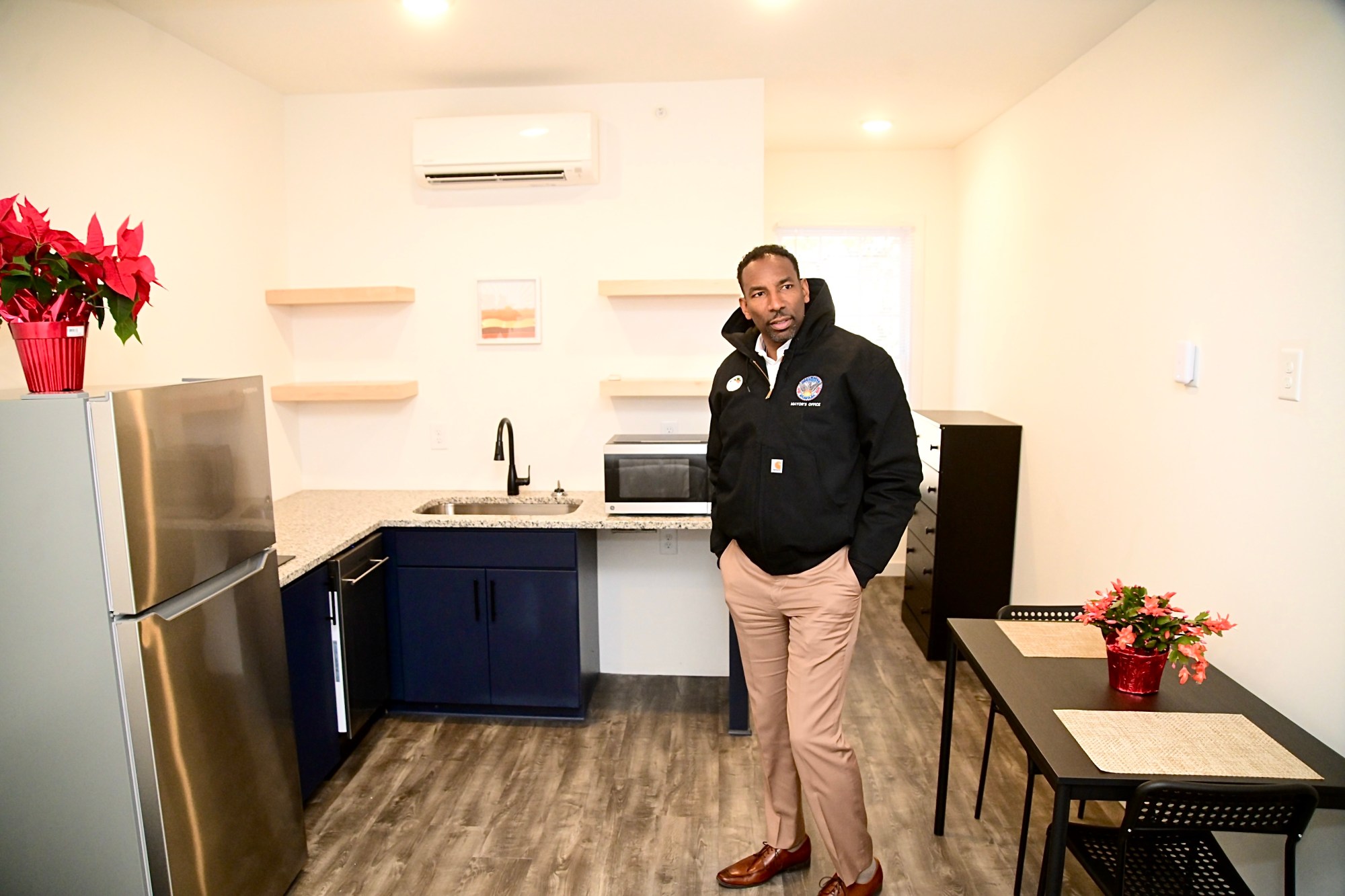

One year after the city of Atlanta’s new rapid rehousing initiative kicked off with The Melody, a shipping-container village downtown, the effort has produced 63 affordable apartments for people experiencing homelessness, with another 200 on the way.
But is the city on track to deliver its goal of 500 units by the end of 2025? Mayor Andre Dickens’ top policy advisor, Joshua Humphries, thinks so — but he said the city must still figure out where the 237 units for the next phase will go.
After starting 2024 by opening The Melody’s 40 shipping-container apartments at 184 Forsyth Street, the city closed out the year by cutting the ribbon on Bonaventure, a refurbished 23-unit apartment building in Virginia-Highland. Like The Melody, it offers fully furnished studio units for people who have been homeless for extended periods.
Up next: One-hundred apartments for unhoused people are under construction at a city-owned parcel near the corner of 17th Street and Northside Drive, just west of Atlantic Station.
The last concrete part of the rapid rehousing plan is to add 100 units for unhoused people within a mixed-use, mixed-income development planned at 405 Cooper Street in Mechanicsville. For years, the cul-de-sac property has been used as a homeless encampment.
Humphries couldn’t give a date yet for when the Cooper Street project will break ground, but he said time is of the essence. “Every single night that a resident sleeps outside, under a bridge, or in a car, it is a precarious night,” he said. “So we’re working around the clock to deliver these units as fast as we can.”
Humphries said the city is shopping around for properties that could host the remaining 237 rapid rehousing units that the city aims to produce this year. Some properties, like the apartment building at 729 Bonaventure Avenue, just need to be renovated, while others require ground-up construction, he explained.
“We’re looking everywhere,” Humphries said. “We’re looking at sites that we already own, and on the buying side, we’re really focused on properties that have existing housing that could easily be made available for this initiative.”
“If anybody has a site they think would be a good fit, feel free to give me a call,” he added.
Tricky to find sites
Finding a suitable property for rapid rehousing is trickier than just identifying a vacant plot of land or an old fixer-upper; it must also be located near public transportation, fresh food, and jobs, since many unhoused people don’t have cars.
It also helps if the community is welcoming. When the city first announced the Cooper Street project, it caught Mechanicsville residents off guard. Some neighborhood leaders complained the city was foisting a glorified homeless shelter on them while disregarding other needs, like street and sidewalk repairs and blight remediation.
When the city tweaked its proposal to include some market-rate apartments, homeownership units, and restaurants and retail options, many neighbors warmed up to the idea.
David Holder, the Mechanicsville Civic Association president, initially was skeptical about adding a rapid-rehousing development for unhoused people to the neighborhood. He’s more amenable to the city’s mixed-use ambitions.
“The community is saying, ‘Hey, if this is what you promised us — some for-sale homes, some market-rate apartments to mix in with the units for the unhoused, so we have some teachers, lawyers, firefighters, city workers — that’s something we can get behind,’” he said. “I hope the city lives up to its promise.”

Each of the rapid rehousing projects looks different. The Melody is comprised of cargo containers repurposed as apartments; Bonaventure is an adaptive-reuse project using the bones of an early 1900s apartment building; and the Northside Drive development is modular construction — prefabricated houses built in a factory and then assembled on site, like a gingerbread house. It’s still too soon to say how the 100 Mechanicsville units will materialize.
Zoning laws, building codes, and community preferences all factor into how and where the city produces these 500 units. While a shipping-container community like The Melody works in a downtown area amid parking lots and the Greyhound bus station, the Mechanicsville project’s neighbors resisted the prospect of cargo crates — nor would it likely work in other residential neighborhoods like Old Fourth Ward or Virginia-Highland.
Covering the rent
Once these units come online, they fill up fast, said Cathryn Vassell, the head of the city’s homeless services nonprofit Partners For Home. Her organization selects the tenants for the city’s rapid-rehousing properties.
“We have a housing queue with many people waiting,” Vassell said in a text message. “We prioritize people who are chronically homeless.”
The city is covering their housing costs, at least for now. Humphries said the mayor’s office is working with the U.S. Department of Housing and Urban Development to secure rent vouchers for these chronically unhoused tenants. If they’re successful, the tenants will pay no more than 30% of their monthly income on rent — or nothing, if they don’t make any money.
“Our goal is to create housing stability for residents that may not have a dependable income for the foreseeable future,” Humphries said. “So voucher subsidy or otherwise, we want them to know that our goal is to ensure that we’ve got units that residents can live in without the fear of rapid rent escalation.”
I’m disabled I’m looking for low income housing i really need help it’s been almost three years now that I’ve been homeless
Hello my Name is Michael Cox I am homeless been since 2018. But I receive disability for congestive heart failure. I have been on the waiting list with hope Atlanta for over 4 years. I do receive SSI.