

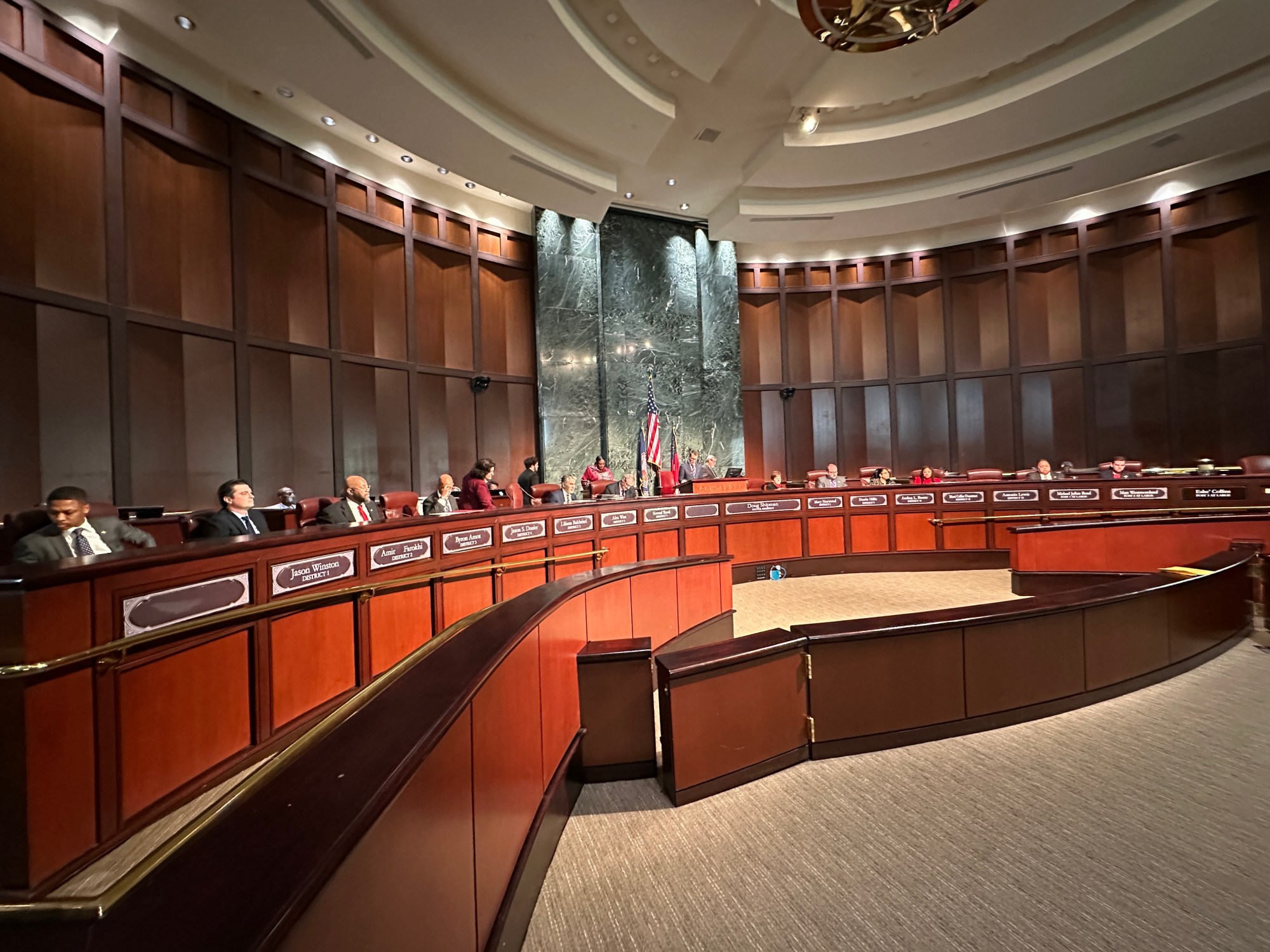


When Atlantans mark their ballots next fall for the 2025 municipal elections, they’ll have five city-wide offices to vote for: the mayor, three at-large city council members — and a city council president.
Notably, Atlanta is the only city in Georgia with a city council president. “It is pretty unique,” says Rusi Patel, the general counsel for the Georgia Municipal Association, adding he can’t immediately name another Georgia city with one, out of 537 statewide.
Right now, Atlanta’s city council president seat is wide open for the Nov. 4 municipal elections, since the current president, Doug Shipman, is stepping down at the end of his term this year. So far, only Councilmember Marci Collier Overstreet has cast her hat in the ring.
So why does Atlanta have a council president, and what do they do? To find out, Atlanta Civic Circle spoke with Patel, Shipman, and Shipman’s predecessor as city council president, Felicia Moore.
The basics
The Atlanta City Council president serves a four-year term, draws an annual salary of $103,250, and is responsible for the city council’s administration.
That is a “behind the scenes” role, Shipman explains. His job is to make sure the council’s administrative offices and the clerk’s office function well. However, actual hiring and firing powers for city council staff are up to the council as a whole.

What’s more, if the mayor is — for whatever reason — incapacitated or otherwise unable to perform their duties, the city council president assumes the mayor’s responsibilities. In some ways, says Shipman, “it’s similar to the role of the [US] vice president.”
The council’s main job is to make the laws that govern the city of Atlanta. While Shipman presides over city council meetings, he can’t vote on any legislation unless there’s a tie — just as the vice president presides over the US Senate, but can only cast a tie-breaking vote.
This situation rarely arises for the Atlanta City Council, however, because there are 15 voting council members, meaning there would have to be an absence to create a potential split.
Policy influence?
It may seem like Atlanta’s city council president doesn’t have all that much power, or ability to influence policy, but Shipman points to the president’s role running the actual city council.
The council president’s most substantial power is picking which council members serve on and chair city council committees, he says.“That is probably the most direct influence over the legislative process.”
The council president can also exercise influence by participating in committees, although they can’t vote, says Moore, who served as a council member for 20 years before she was elected council president in 2018.
It’s up to each council president how active they decide to be, Moore adds. “They can be active and involved, engaged, setting positions — [can] say, ‘Hey, I’m for this, I’m not for that,’ [and] participate in committee meetings and questioning — or they can not. They can sit back and just preside, and maybe offer an opinion or ask a question.”
“It depends on the person and how they want to use the position,” she says, noting that as council president, she pushed the council to pass legislation to create Atlanta’s Office of Inspector General — a position the council recently overhauled, to her chagrin.
Moore says that if she would change anything about the position, it would be to give the council president the power to introduce legislation directly, even if they can’t vote on it.

How we got here
Atlanta didn’t always have a city council president, or even a city council. Instead, it had a board of aldermen, presided over by a vice-mayor. In that system, the 18 aldermen oversaw the city’s day-to-day operations.
But in 1974, the city amended its charter, replacing the board of aldermen with the city council and the vice-mayor with a council president. The charter amendment also transferred authority for running city departments from the council into the hands of the mayor.
This, Patel with the Georgia Municipal Association explains, is what’s called a “strong mayor” system of municipal government, where the mayor assumes the primary executive role, while the city council takes the primary policy role. The other two basic setups for Georgia city governments are a “weak mayor” system, where the mayor shares policymaking and executive roles with the city council, but has little actual executive power and a council-manager system.
The council-manager form of government is where the city council is the primary policymaker and an appointed city manager runs the city’s operations. It’s most common in mid-sized cities like Newton or Griffin, Patel says.
The weak-mayor system is most common in smaller cities, he adds.The mayor will typically sit on the city council, but their only voting power is to break a tie or veto legislation, and they share executive responsibilities with the council members. This is what Atlanta had before 1974.
That said, when Patel works with local elected officials, he tells them: “You, as a city, are not going to fit cleanly into any of those categories.”
“Most [city] charters I have read take a little bit from one, take a little bit from another, and blend to fit whatever the needs are of that community,” he says. This could be how Atlanta, the state’s largest city, ended up with a city council president, Patel said.
So what are you voting for?
Unlike the US vice president, who is elected based on the presidential vote, the council president post isn’t tied to your vote for mayor: It is a truly independent elected office. So what should a voter keep in mind?
“You’re voting for someone to lead the council … and to be the one that can work together with different coalitions within that council, to bring them to some sort of consensus on big-ticket items. In a lot of other cities, that’s the role of the mayor,” Patel says.
In that respect, it’s a role that requires diplomacy skills, since the council president can be a dealmaker between council members.
Moore, on the other hand, stresses the independence of the office. “They certainly can be a voice that doesn’t have to worry about whether the mayor or some of the council people like them,” she says.
Interesting, informative and important. Thank you ACC and Mr. Sassoon.
Js
https://bbi2018.com/
https://wkcdogshowinfo.com/
https://ingenieriamultillaves.com/
https://showconcerts.com/
toto slot