



This story is part of #ATLBudget, a civic engagement project in collaboration with the Center for Civic Innovation and other organizations. Together, we’re breaking down Atlanta’s budget process to show where your tax dollars go—and how you can help shape the city’s priorities. Follow #ATLBudget on Instagram and Bluesky for updates.
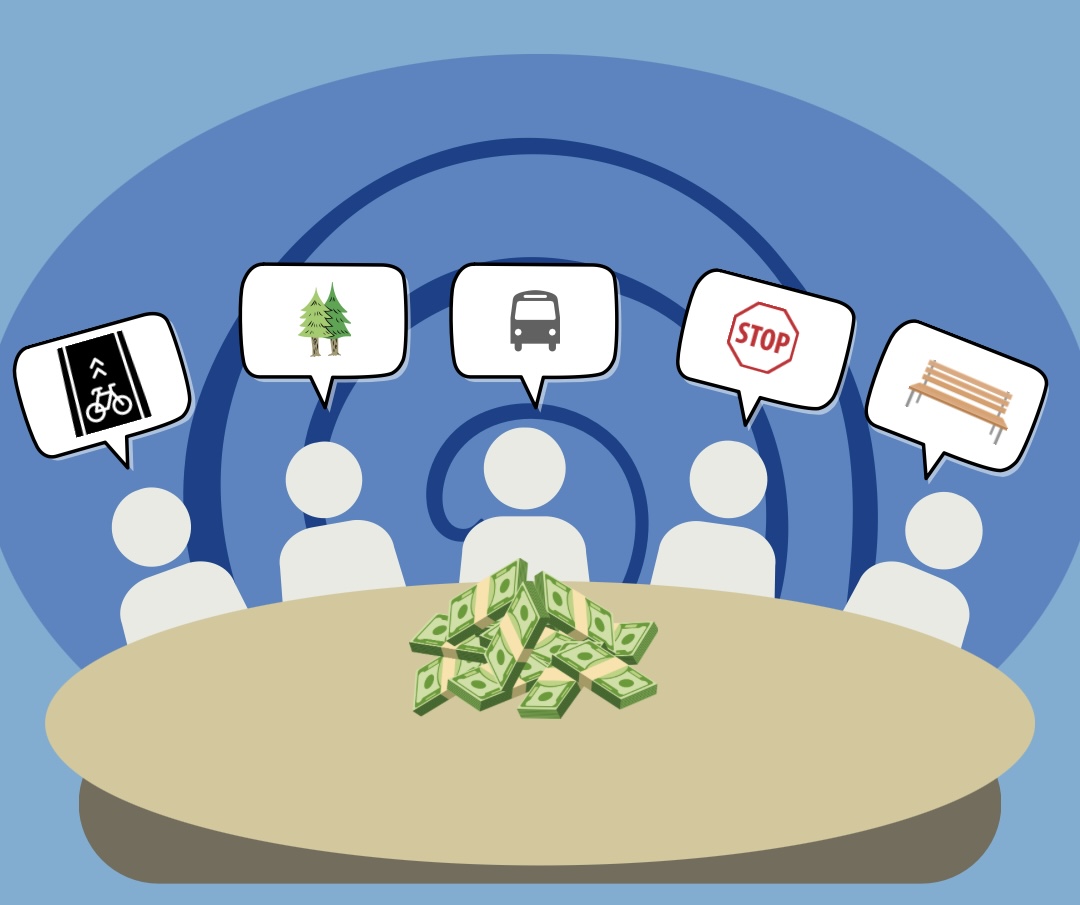
Cities like Chicago, Boston and Providence, Rhode Island are using participatory budgeting to increase civic engagement at a time when trust in government is near an all-time low. Participatory budgeting, which has caught on with over 7,000 cities worldwide, gives local residents a voice in spending a set amount of city funds, usually around $1 million. What can Atlanta learn from their example?
Only 22% of Americans say they trust the government to do what is right, according to a recent Pew Research poll. Relatedly, the United States has one of the lowest voter-participation rates among developed countries. But these cities have found that participatory budgeting can engage even unlikely voters in local governance.
Atlanta has already experimented with participatory budgeting. Five years ago, City Councilmember Amir Farokhi launched Downtown Decides!, which allowed District 2 residents to decide how to spend $1 million in transportation funds. The following year, he expanded the program to include park projects, calling it “one of the easiest ways to increase civic engagement and build trust in government.”
But other council members resisted Farokhi’s effort to expand the initiative. They favored distributing the funds evenly across all 12 council districts, instead of allowing residents to set spending priorities.
Still, participatory budgeting remains highly relevant for Atlanta, where residents have little influence over the city’s $854 million annual general fund. To find out how it could work on a larger scale, Atlanta Civic Circle spoke to civic leaders in Chicago, Boston, and Providence, Rhode Island – three cities with successful, yet very different models.
Chicago: Parks and bike racks
Chicago’s 49th Ward pioneered participatory budgeting in the United States in 2009, launching a model that has since expanded citywide for residents to directly influence how public funds are spent.
Over the years, the city’s participatory budgeting projects have ranged from installing outdoor exercise equipment in parks and upgrading soccer fields to green infrastructure, like planting trees. Notably, the city has hired local artists to design bike racks, blending public art with functional city planning.
Here’s how it works: Every year, Chicago’s 50 wards receive $1.5 million each in infrastructure funding, with $1 million dedicated to participatory budgeting. Residents suggest ideas for how to spend the money, then community representatives collaborate with city staff to develop project proposals, and the public votes on the final selections. Anyone who lives, works, or has children in school in the ward can participate, with voting open to residents as young as 14.
Alderwoman Maria Hadden of the 49th Ward emphasized that cities don’t implement participatory budgeting because they need help spending money. (In fact, Chicago issues municipal bonds to fund its initiatives.) Instead, it’s a way to engage citizens, enhance civic education, and improve trust in government.
Hadden first became involved in the 49th Ward’s participatory budgeting as a volunteer in the aftermath of the 2008 housing crisis. “It made me feel like I was part of a community during a difficult time,” she said.
“People care about the thing happening down the block from them, and I think that’s where we have the real opportunity to engage people right now,” Hadden said, explaining that participatory budgeting is a way that people can connect with their elected officials about “things that aren’t political.”
“If the city of Atlanta is interested in building relationships with constituents that aren’t just about elections – if they’re looking to build trust in government, if they’re interested in the civic education of its constituents – then participatory budgeting is a great tool,” she said.
Transparency, Hadden added, is key to maintaining trust in the process. She acknowledged that not every idea can be implemented, but said that being up front about budget limitations and exploring alternative solutions helps keep residents engaged.
Boston: Fresh food and youth programs
Boston just launched its first citywide participatory budgeting initiative, Ideas in Action, allocating $2 million from its general fund for six projects that Bostonians chose, such as expanding access to fresh food, creating programs for formerly incarcerated youth, and installing benches at high-traffic transit stops.
Last summer, residents submitted about 1,500 project ideas, then 100 volunteers worked with city departments to refine those into a shortlist of project proposals. A total of 4,462 Bostonians voted on the projects from Jan. 15 to Feb. 15.
Many cities, like Chicago, use participatory budgeting funds exclusively for infrastructure projects, but Boston’s approach is unique. Its initiative can also fund programs and services, because the funding comes from the city’s operating budget, not bond issues, said Renato Castelo, the director of Boston’s Office of Participatory Budgeting.
Recognizing that government outreach can be met with mistrust or apathy, Castelo said the city made a concerted effort to build trust, especially since participatory budgeting is a fairly new idea for Bostonians. (Boston started a youth-focused participatory budgeting initiative in 2014, allocating $1 million in capital funds annually that people ages 12 to 25 decide how to spend.)
To get the word out to underrepresented residents, the city partnered with community organizations and conducted outreach in seven languages. “It’s a tough time to do community engagement, especially with government,” Castelo said. He emphasized that one-on-one interactions between city employees and residents helped demystify the budget process.
The impact was clear, when nearly 4,500 residents cast their votes. “We were very happy with these numbers as our pilot,” Castelo said. “We started with 1,500 ideas, and, at the end, we tripled that in terms of voting engagement, which was great.”
Central Providence, RI: Health and wellness
Rhode Island kicked off a participatory budgeting pilot in 2022, giving residents of nine central Providence neighborhoods a say in how to spend $1 million to improve their communities’ health and wellbeing.
The top-voted project was making park bathrooms more accessible ($368,000), followed by providing lead-free water filters to 2,000 households ($330,000), launching a peer mental-health training program for youth ($50,000), and improving bus stops ($253,000 – partially funded). Smaller initiatives ($30,000 each) included a bike repair program, life skills classes for young people, and planting fruit and nut trees around central Providence.
Outreach efforts started with word of mouth and mailers — then expanded to Spanish-language radio and community partnerships. “We had people show up saying, ‘I heard you on the radio. I’m here to vote,’” said Dominique Resendes from One Neighborhood Builders.
To fund the pilot, One Neighborhood Builders, a community development nonprofit, secured $450,000 from the Rhode Island Department of Health and Executive Office of Health and Human Services, plus another $550,000 in private grant funding.
One Neighborhood Builders collected over 300 ideas from residents, ranging from cleaner air initiatives to mental health services. A 17-resident steering committee helped narrow the proposals to 20.
Just over 280 people living in the nine Providence neighborhoods cast their votes over two weeks in June 2023 at libraries, community health centers, food pantries, schools, churches, and online. That included residents as young as 13 and noncitizens. Of those eligible to vote in traditional local elections, almost a quarter (22.7%) of voters for the participatory budget projects said they never, rarely, or only sometimes voted.
Resendes said the participatory budgeting pilot has strengthened relationships between residents and government entities, emphasizing that it helps people understand the bigger picture of how municipal decisions get made.
Despite strong community and government buy-in, organizers from One Neighborhood Builders said it can take a lot of initiative to implement participatory budgeting within traditional government structures. “There’s a momentum in government to keep doing things the way they always do things, which can be challenging to interrupt,” said Anusha Venkataraman.
It also requires significant resources beyond the funding, such as staff time and coordination. Without full commitment, Venkataraman warned, participatory budgeting risks being a half-measure, rather than a true shift in decision-making power to the people.
Venkataraman and Resendes both stressed that participatory budgeting shouldn’t be a one-off event, but an ongoing process embedded within local governance. That requires sustained support beyond the initial funding cycle.
To maintain momentum, they suggested allocating annual funding, creating dedicated staff positions, and integrating participatory budgeting into broader city-planning efforts.
I don’t live in the City of Atlanta, but I am in Metro Atlanta and visit the City very often. I think all cities or counties should have participatory budgeting solely because we need to raise the public’s faith in government and this is a great way to start. So many of our elected representatives at all levels feel no obligation to find out what their constituents think. And the frustrating part is that there is very little reaction from voters.