


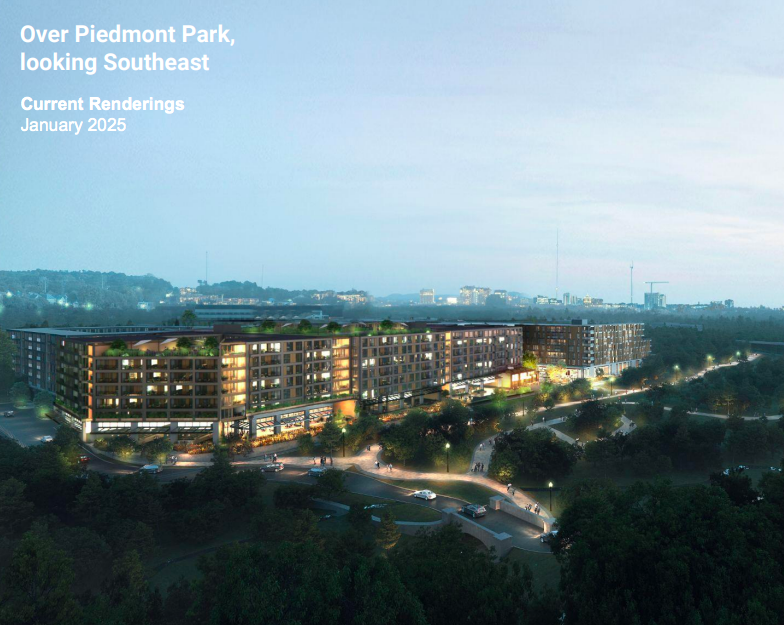

A plan to transform a low-rise retail strip just east of Piedmont Park into a dense, mixed-use complex with 1,100 apartments and about 150,000 square feet of new shops and offices has become the latest flashpoint in Atlanta’s ongoing debate over growth, transit, and housing affordability.
Tensions came to a head last week, when the Atlanta City Council, by a narrow 8-6 vote, approved Portman Holding’s application to rezone the Amsterdam Walk property at 501 Amsterdam Ave from a mostly commercial district to one allowing large-scale mixed-use development. That enables Portman to build big and dense at the 11-acre shopping center in a cul-de-sac off Monroe Drive that’s adjacent to the Atlanta Botanical Garden on the Beltline’s popular Eastside Trail.
Portman’s proposed redevelopment of the aging Amsterdam Walk shopping district underscores an ideological rift over how Atlanta should grow to accommodate its exploding population. At the heart of the dispute are contrasting views about how to confront Atlanta’s mounting housing crisis, and whether car-centric or transit-oriented development will define the city’s future.
Urban planners and housing advocates argue that increasing residential density in single-family neighborhoods by building more homes on less land is key to housing more people and reversing decades of exclusionary zoning. That means putting apartments, townhomes, duplexes, and accessory dwelling units where, historically, only single-family homes have been allowed.
But many longtime residents resist more housing density, fearing massive multifamily developments will blight their quiet single-family neighborhoods, drive down property values, and further congest already traffic-choked streets.
Portman’s development plan for the nearly 1.2 million-square-foot project includes 1,100 apartments — of which at least 20%, or 220 units, will rent at below-market rates in exchange for density allowances. They will be earmarked for renters earning 80% of the area median income, or about $63,000. Rents for the below-market one-bedroom units will cost more than $1,600 monthly, and two-bedrooms will go for nearly $2,000. The plan also includes 150,000 square feet of commercial and retail space. All of that will be flanked by 1,435 parking spaces.
Local pushback
The adjacent Morningside Lenox Park Association and Ansley Park Neighborhood Association opposed the development, saying it will significantly worsen an already dangerous traffic bottleneck at the intersection of Monroe Drive and Amsterdam Ave., which is the only road out of the shopping center cul de sac. Opposition group A Better Amsterdam Walk said Portman’s traffic study shows the development will add 3,800 daily car trips.
NPU-F, which is the Neighborhood Planning Unit for Amsterdam Walk, also opposed the rezoning, as did the Atlanta Zoning Review Board, which rejected the rezoning application last June for factors including its car-centric design, lack of mass-transit integration, and deviation from the Atlanta Beltline Master Plan.
“The city council’s approval is disheartening for those who believe in the power of neighborhood associations, the NPU system, the Zoning Review Board, and the Beltline Master Plan’s recommendations for land use,” Marla Johnson, the president of the Morningside Lenox Park Association, said in an email.
The rezoning approval by the city council flies in the face of a vocal community activist movement that has fought the project for two years, propelled by a desire to protect residents and visitors, Johnson said.
“Listening to the feelings of the community, being warned about the traffic impact in the area” prompted At-Large Councilmember Michael Julian Bond to vote against the rezoning proposal, he told Atlanta Civic Circle. “It’s an okay project, but the traffic concerns are real.”
The other five council members who voted against the rezoning on April 21 were Matt Westmoreland, Liliana Bakhtiari, Mary Norwood, Marci Collier Overstreet, Eshé Collins, and Alex Wan, who represents the district where Amsterdam Walk is located.
The mammoth redevelopment might be more palatable, Bond said, if there were adjacent transit, so it’s not so car-centric. However, a long-planned stretch of streetcar tracks on the Beltline’s Eastside Trail is off the table. Instead, Atlanta Mayor Andre Dickens announced in March that the city will build the first segment of light rail for the Beltline, initially conceived as a transit project, along the less developed, less wealthy Southside Trail.
“Everybody is caught up in the beauty of the trail, but they overlook the need for rail,” Bond said of the Beltline rail opposition movement that cropped up in 2023. “We can share the trail, but there needs to be transit.”
Portman however, has staunchly opposed a streetcar line adjacent to the Eastside Trail, suggesting it would hurt nearby businesses by cutting them off from the pedestrians and cyclists who use the trail, according to Rough Draft Atlanta.
Amsterdam Walk’s proposed rebirth is hardly an urbanist’s dream, especially with Beltline rail plans dashed for the adjacent trail. Urbanist nonprofit ThreadATL co-founder Darin Givens said the 1,435 parking spaces in Portman’s plan come across as an affront, given that the property is right next to the Beltline and there are MARTA bus lines within walking distance. (Amsterdam Walk is also located 1.6 miles from MARTA’s Midtown train station.)
“I love the new housing, but I hate the parking,” Givens said in text messages. “I also hate the way we as a city think about parking, unquestioningly accepting large quantities of it as if there’s no room for expecting progressively low amounts with new developments in the center of the city near transportation alternatives.”
Abundant parking translates into increased car trips and decreased transit use, Givens added, “Both have a public cost — one we shouldn’t ignore, especially in the center of the city.”
But one housing advocacy group, Abundant Housing Atlanta, sees the neighborhood opposition’s focus on additional car congestion and pedestrian safety as a distractor issue to thwart dense housing development. The surrounding Morningside-Lenox Park, Ansley Park, and Virginia-Highland neighborhoods are predominantly single-family — a sharp contrast to Portman’s new vision for Amsterdam Walk, which has nine-story apartment stacks rising above the vast tree canopy.
“This is not an area that has enough rental units to meet the demand,” said Jennifer Borrero, the state organizing director for YIMBY Action, Abundant Housing’s parent group. “This would ease some of that burden, providing units for renters who would not otherwise have the opportunity to live in Virginia Highlands [or surrounding neighborhoods].”
As Atlanta rents continue to rise, Borrero said, the city needs more dense residential developments.
Portman expects to break ground on the renewed Amsterdam Walk complex in 2028 and be ready for move-ins in 2029.
Many events at Piedmont Park, even just weekend enjoyment of the Park’s green space, cause Monroe Drive to become a parking lot as traffic is bumper—bumper. There can be no city ‘traffic calming plans’ for Monroe when too many cars show up.
know the Commercial Real Estate Group Chat is going crazy right now.
“Can you believe we were able to bypass the local NPU, both neighborhood associations (MLPA, VHCA), the Beltline Master plan, both local Council Representatives, and a 77% vote against by the residents who will be affected?”
“We get to put in $3k/month luxury apartments! All while publicly lobbying against Beltline Rail? We found the cheat code–all we have to do is say “NIMBY” and we will get blind support from around the city thinking they are RobinHood creating homes and fighting against the rich!”
I live locally, I want Beltline Rail, I want mass transit, I want more density. This doesn’t pass the common sense test here, I don’t want to inject 1k+ apartments and parking spots into a one-way street on what is arguably the most dangerous road in Midtown. (It has officially been 8 days since the last vehicular death on Monroe.) All while holding water for the most anti-beltline rail Developer…I just don’t get it.
Developers were smart because they pitched they pitched this as a Liberal/Urbanization cause and got blind support from people deadset on “teaching those rich people in Virginia Highland about lowering housing costs” when really the main issue is always around the lack of infrastructure to support this.
Thank you Atlanta City Council! It’s too early for Atlanta to become the calcified, dying metros of California and the Northeast.
Midtown/VaHi are wonderful neighborhoods, I hope more people get to live here.