

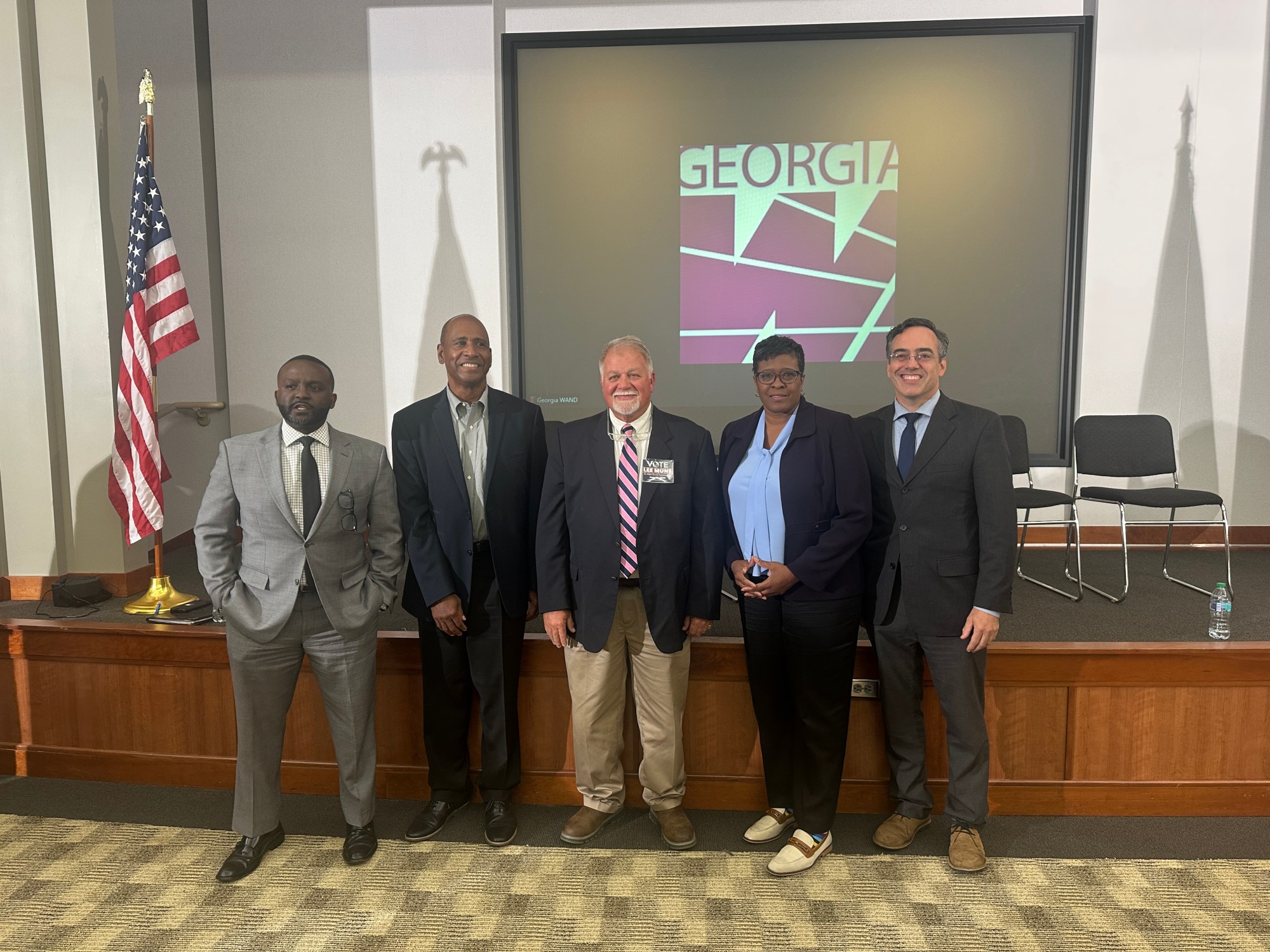


All candidates at Tuesday night’s Georgia Public Service Commission forum agreed: Georgia Power has too much power.
Five of eight PSC candidates—a Republican and four Democrats—attended the forum to share their vision for the state’s utility regulator. Speaking to the few dozen Georgians who attended—and to hundreds more via live stream—all five roundly criticized Georgia Power and other utilities’ influence over the body tasked with regulating them.
“Remove their ability to give campaign contributions,” said Lee Muns, the sole Republican primary challenger this year, who is facing District 2 incumbent Tim Echols in the GOP primary. “Take it off the table, and then you bring everybody to the same playing field,” he said. “That’s a Republican that just told you to take away campaign contributions, but it’s the right thing to do.”
The sentiment was shared by the four Democrats competing in the District 3 primary: Daniel Blackman, Peter Hubbard, Robert Jones, and Keisha Waites.
Not in attendance were Echols; District 3 incumbent Fitz Johnson, a Republican running unopposed in the primary; and Alicia Johnson, the sole Democrat running for District 2. Fitz Johnson and Echols, along with other sitting commissioners, have been criticized for accepting campaign contributions from Georgia Power executives and other special interests.
“It is tremendously disheartening to know that each of the current five public service commissioners have all openly taken money from the organizations the [PSC] regulates,” said District 3 candidate Blackman.
Blackman also addressed a ruling from a judge deeming his candidacy ineligible for failing to meet the residency requirement of residing in Fulton County a year prior to the November general election. The judge’s ruling went to Secretary of State Brad Raffensperger who upheld the ruling on Wednesday afternoon. “We have all the evidence and everything that is needed to prove the qualification,” Blackman said, indicating he was prepared to appeal should Raffensperger uphold the judge’s decision.
The June 17 Public Service Commission primary election marks the first time in five years that Georgians will be able to vote for the PSC. After years of voting rights lawsuits and delayed elections, voters will select commissioners for districts 2 and 3. While those districts represent geographic areas of the state, voters statewide elect them.
The five-member PSC has a wide range of responsibilities, but chief among them is regulating Georgia Power and other utilities; that includes approving rate increases, a hot-button issue this election cycle after years of repeated increases to Georgians’ power bills.
It’s an issue that matters to Sharman Southall, who, at 75 years old, is retired and on a fixed income. “I care about lower rates,” she said. Southall also hoped the forum would help her get a better understanding of what the PSC can do. “It’s such a complicated office,” she said.
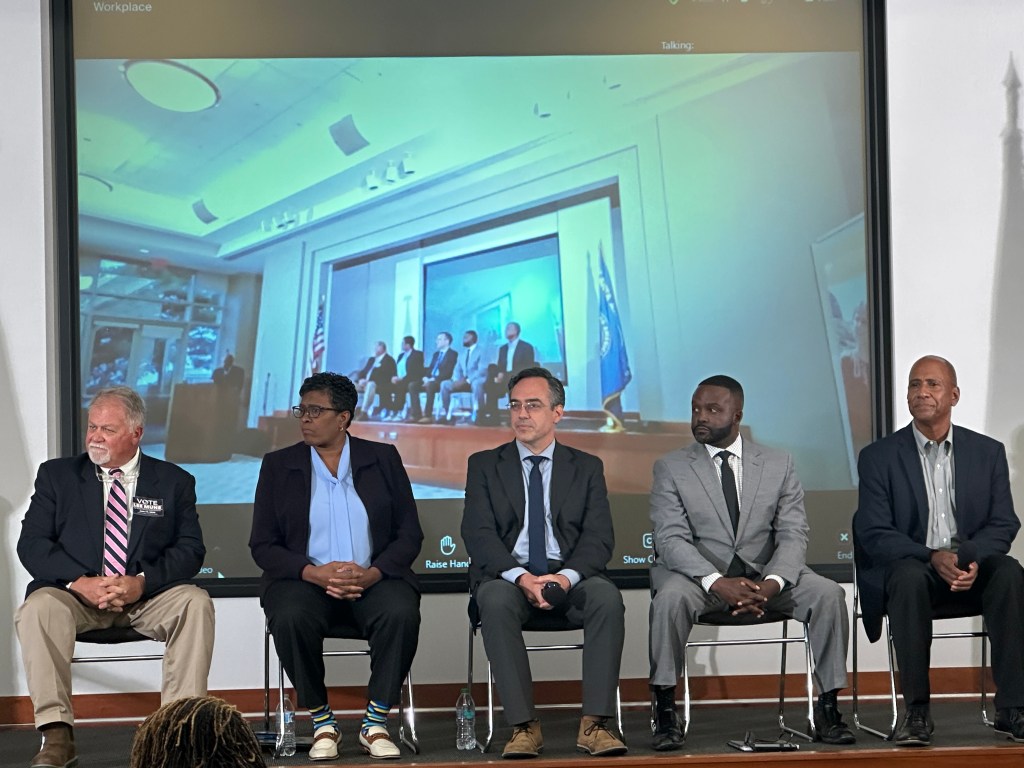
Candidates criticized the inaccessibility of the PSC, which is based in Atlanta, making it cumbersome for someone in Savannah to deliver a public comment, which is limited to in-person only and just three minutes. Jones, one of the Democrats, suggested allowing public comment via video calls to improve access.
The PSC also has the power to set the agenda for energy development, including renewable energy, and will determine how to manage the demands and costs of the energy-intensive data centers that have begun to move into the state. That’s top of mind for 60-year-old Patrick Thompson, who wants to know why so many Georgians felt surprised by data center costs.

District 3 candidate Peter Hubbard also spoke about the centers. “Those data centers are being offered a sweetheart deal of five cents a kilowatt hour, while you and me, residential customers, we pay 21 cents a kilowatt hour,” said Hubbard. “That’s why they’re coming to Georgia, because we give them sweetheart deals and tax abatements and other things like that. That’s costing you. That’s why we have to fight at the PSC.”
A common thread among all candidates was for the PSC to shift to “performance-based regulation” or ratemaking. The PSC must ensure Georgia Power turns a profit—or a return on equity—by a margin determined by the PSC. However, this can create incentives that don’t benefit the consumer because Georgia Power has to make a return based on its costs, rather than achieving performance goals like more efficient power generation.
“The more they build, the more they earn,” Hubbard said. “That’s the paradigm right now.”
All the candidates on stage criticized the construction of Plant Vogtle’s nuclear reactors 3 and 4, a project that was beset by years of delays and more than $10 billion in cost overruns, $7.6 billion of which was passed on to consumers as rate hikes.
“They actually earn a profit on those cost overruns, and it’s just really bad policy,” Hubbard said.
Note: This story was updated to reflect the Secretary of State’s decision disqualifying Blackman.
Watch Tuesday night’s candidate forum here.
Early voting for the PSC primary runs through June 13. Election Day is June 17. For early voting locations, check with your county elections office. Verify your voter registration with the Georgia Secretary of State’s My Voter Page.
Leave a comment