


Community Impact Survey on Federal Actions
Federal policy changes—such as funding freezes, tariffs, executive orders, firings, and other actions—are directly impacting metro Atlanta organizations and households.
Atlanta Civic Circle is here to listen. That’s why we launched two surveys to gather objective, fact-based insights across the five-county metro ––Clayton, Cobb, DeKalb, Fulton, and Gwinnett counties.
Our goal is to compile a comprehensive picture that will empower local philanthropy, policymakers, researchers, civic organizations, and community leaders to make informed decisions.
Take the survey and share your story.
UPDATE: This story has been updated to clarify that the Hand, Heart + Soul Project’s budget was roughly $730,000 in 2023, according to its form 990 filed with the IRS.
After this story published, Hand, Heart + Soul Project received word that a contract for FY 2026 to replace federal SNAP-Ed grant funding that was cut for FY 26 using Georgia’s unspent federal SNAP-Ed funds would be forthcoming. “While this is encouraging, it is not a long-term solution and does not support the level of funding we received in FY 2025, resulting in programmatic and staffing shifts,” said executive director Wande Okunoren-Meadows. “Most of all, it raises the need and urgency that non-profits cannot do ‘this’ alone when we are already wearing multiple hats and barely getting by.”
Georgia nonprofit leaders said the Trump administration’s federal grant cuts are already affecting their operations – and they are bracing for more – at a forum convened by Independent Sector, a national consortium of nonprofits and philanthropies, with the Southern Poverty Law Center.
“A lot of those foundational things that have gotten people over the hill to make it every day, they’ll be losing. Everything from housing to food to wealth-building initiatives to actual jobs,” said Yterenickia Bell, the Southern Poverty Law Center’s Georgia director.
The Independent Sector hosted the Sept. 17 forum on how metro-Atlanta nonprofits and philanthropy can build collective power ahead of its 2025 summit in Atlanta next month.
At the event, four grassroots nonprofit leaders shared how federal funding cuts are affecting their services for low-income Atlantans, ranging from food and nutritional education to housing people with HIV – and warned that Congress’s 2026 budget cuts will tighten the squeeze.
Hand, Heart + Soul Project
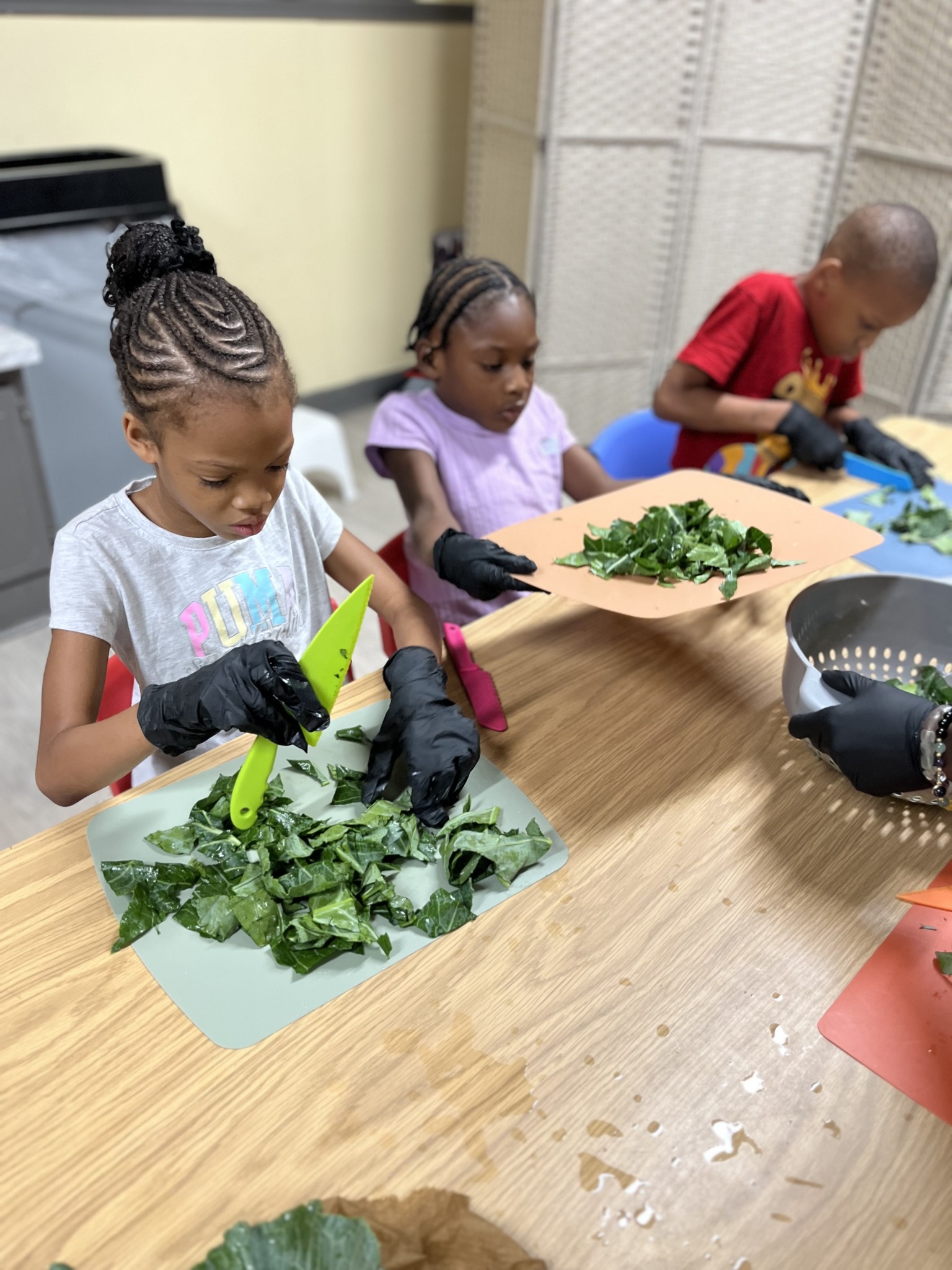
The Hand, Heart + Soul Project provides nutritious food to families through community gardens and develops nutritional education programs. It will lose all of its federal SNAP-Ed grant funding when the new federal budget year starts Oct. 1, said executive director Wande Okunoren-Meadows. These funds make up half of its budget, which was roughly $730,000 in 2023, according to its form 990 filing with the IRS.
Congress cut all SNAP-Ed funding for the 2026 federal fiscal year, which funded nutrition education and obesity prevention, as part of a massive $186 billion in cuts to the Supplemental Nutrition Assistance Program (SNAP) through 2034.
Okunoren-Meadows, hopes that the state of Georgia can tap into its general fund so the program can “continue at least for one more year.”
There is an “invisible cost” to the drastic funding cuts, Okunoren-Meadows added, because of the emotional toll. “Where’s the data that talks about the invisible grief of loss to communities, to relationships?” she asked. “I don’t want to be strong. I want to be human.”
She said that she can only push herself and her staff so far. “If we’re getting 50% less, we’re going to do 50% less work. That’s just how it works,” she said.
Latino Community Fund Georgia
Atlanta Civic Circle reported in May that the Latino Community Fund Georgia was facing a $500,000 loss of federal grant funding. At that point, a grant to develop a hate-crime-prevention curriculum for DeKalb and Gwinnett County public schools had already been canceled.
Now, the community fund’s budget is in the red, due to the loss of additional federal funding, said Jean-Luc Rivera, its deputy executive director.
The budget shortfall jeopardizes the Latino Community Fund’s ability to support 41 member nonprofits through both direct services and grants that promote civic participation, legislative advocacy, and the health and well-being of Latino communities in Georgia.
“We didn’t want to lay off any of our staff, so we just trimmed down our program budget,” Rivera said at last week’s forum. The $500,000 in federal grant cuts covered salaries for nine staff members, plus longstanding services to Latino Georgians, the community fund’s founder, GiGi Pedraza, told Atlantic Civic Circle in May.
Rivera said the group has intensified its fundraising efforts from private donors, particularly for unrestricted grants that support the general operating budget. “We’re in a day and age where we need more unrestricted operational dollars, because we need to pay our employees a living wage – and that is getting harder and harder as inflation gets higher,” he said.
Status: Home
Status: Home is Atlanta’s oldest and largest provider of permanent supportive housing for homeless and low-income people affected by HIV/AIDS.
The housing nonprofit’s primary funding source is a federal HOPWA (Housing Opportunities Program for People with AIDS) grant through the U.S. Department of Housing and Urban Development. Despite the Trump administration’s vow to cut HOPWA funding entirely, it survived in Congress’s 2026 spending bill.
“As of right now, we haven’t experienced any funding cuts. However, there’s still a lot that’s unknown on the horizon,” said CEO Maryum Phillips. When applying for federal grants, she added, she’s definitely seen an increase in responses directing her to “make sure that you comply with all federal guidelines and executive orders.”
Supportive housing for people with HIV keeps them stabilized and in treatment, so targeting this funding would increase the likelihood of HIV infections, she warned. That is a particular concern for Atlanta, since the greater metro area has the third-highest rate of new HIV diagnoses of cities nationally.
“A person living with diabetes and unhoused is in a very bad situation, but it’s not necessarily going to impact others,” Phillips said. But if low-income people with HIV lose their housing, she added, “You could see HIV rates beginning to go up, which would be catastrophic.”
What’s more, Black people are disproportionately affected by HIV, Phillips said, accounting for 38% of new HIV diagnoses nationally, according to the most recent data from the Centers for Disease Control and Prevention.
“What does it mean when you’re targeting a community that’s most impacted?” she asked, referring to the ongoing uncertainty over federal funding cuts. “It’s just the group that needs it.”
Ready Set Push
From her work as a nurse, Kiana Mayers saw that prenatal education, including breastfeeding support, was often out of reach for low-income parents. That inspired her to start Ready Set Push.
Her nonprofit started out offering childbirth and breastfeeding classes. That has expanded to diaper drives for new families and postpartum blood pressure monitoring to spot any complications from giving birth.
Ready Set Push has also formed the Metro Atlanta Mother’s Milk Alliance with other community-based organizations. Pasteurized donor milk at hospitals is reserved for medically fragile babies, Mayers explained, so the local alliance is a way for new moms who can’t produce their own milk to safely access breast milk through informal sharing networks. The alliance screens the donated breast milk to make sure it’s safe to feed to their babies.
Despite the growth in services, Ready Set Push is operating on a shoestring – and the federal grant cuts don’t help. The group received a large grant from the state of Georgia last year, but it wasn’t renewed, Mayers said. And competition is increasing for the limited amount of state and local grant funding that’s available, she added, because so many local nonprofits have lost their federal funding. “Now the other bigger, more established nonprofits are going to go after the grants. It makes it way harder to fund a smaller one like me.”
Mayers said she still works fulltime as a nurse, and doesn’t get paid to run Ready Set Push. Her goal is to raise enough money to make it her fulltime job.
Great article. And thanks for introducing my wife and I to Ready, Set, Push. We have some breastmilk storage bags and pumps we are going to see if we can donate to them.