


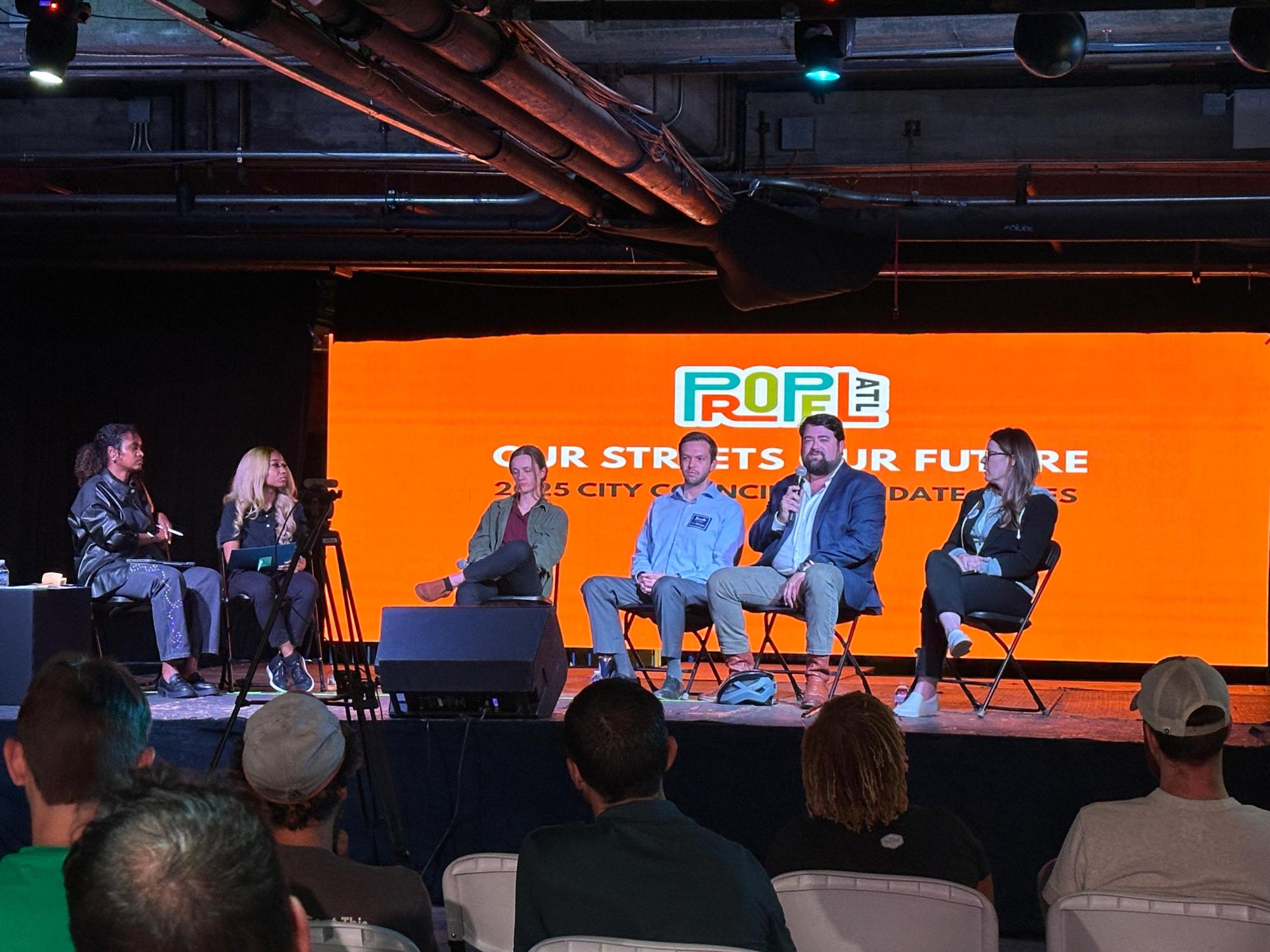

The Atlanta City Council is the most powerful body in town when it comes to green-lighting – or red-lighting – affordable housing development. Atlanta Civic Circle asked the candidates for six contested seats what policies they’d embrace to foster housing affordability for lower-income people. Here’s what they said:
Candidate responses have been edited for length and clarity.
District 2 (Midtown)
Kelsea Bond: I see housing as a human right, and I think the city should redefine “affordability” to target renters below 60% of the area median income (AMI). To produce affordable housing, Atlanta must embrace social housing, community land trusts, and upzoning to allow more dense housing types near transit. The city should expand tenant protections through an Office of the Tenant Advocate.
Jacob Chambers: Atlanta must prioritize “deeply affordable housing” – units priced as affordable for households earning below 50% AMI. The city should also build more housing on the land it owns, harness inclusionary zoning policies, and strengthen and expand nonprofit partnerships to produce more dense “missing middle” housing, such as accessory dwelling units (ADUs), duplexes, and triplexes. We must also do better to hold government-subsidized landlords accountable for housing-code compliance and transparency.
Alex Bevel Jones: I want to use public land near transit for mixed-income, permanently affordable housing, and cut parking-space mandates to reduce costs. I’m pro-density, especially near transit, and I support data-driven enforcement of U.S. Department of Housing and Urban Development (HUD) housing standards.
Courtney Smith: I plan to streamline permitting, update zoning for mixed-income development near transit, and I’ll use tax breaks and other public incentives to foster housing affordability. Atlanta needs more “missing middle” housing and stricter code enforcement centered on blight.
James White: I intend to expand housing options for families earning up to 50% of the AMI by building out city-owned land and bolstering nonprofit partnerships. I also believe increasing housing inclusivity means embracing “missing middle” offerings.
District 3 (West Atlanta)
Byron Amos (incumbent): Atlanta should expand subsidies for developers willing to produce deeply affordable housing, and we should make it easier to build “missing middle” housing in certain neighborhoods. What’s more, I believe the city should play a stronger role in ensuring that HUD-subsidized properties abide by municipal and federal fair-housing laws.
Perrin Bostic: I want to use public land, zoning incentives, and nonprofit partnerships to build units for Atlantans earning less than 50% AMI. “Missing middle” housing will be key, as long as resulting developments are sensitive to a neighborhood’s character. Moreover, the city should play a greater role in ensuring that HUD-subsidized properties are thoroughly inspected.
District 7 (Buckhead)
Jamie Christy: Atlanta’s permitting process needs a boost, and I plan to streamline that system to fast-track affordable housing construction. I support the creation of ADUs and other “missing middle” housing, as long as it doesn’t adversely affect a neighborhood’s character. And I want to beef up the city’s crackdown on negligent and predatory landlords.
Allen Daly: Atlanta’s housing affordability crisis is a supply and demand issue, and we need to cut bureaucratic red tape to confront it. I plan to incentivize the development of “missing middle” housing, including ADUs and tiny homes. I will embrace tech-driven, tenant-reporting systems and random city inspections to keep government-subsidized landlords honest.
Rebecca King: Atlanta should expand its community land trusts and urge them to prioritize deeply affordable housing production. I want to see more ADUs and micro-homes, where zoning allows and the community agrees.
Thomas Worthy: I want to see more mixed-income developments that create housing affordable to people earning 50% AMI or less. We should have a dedicated revenue stream for this effort that encourages “missing middle” housing development, and we should create a centralized tracker for housing-code complaints to hold landlords accountable.
Thad Flowers: I support using city-owned land, modular construction, and public-private partnerships to create deeply affordable housing and repurpose vacant properties. Atlanta should build more “missing middle” housing, when supported by neighborhood groups. We should also make housing code enforcement more stringent to help hold HUD-backed landlords accountable.
District 9 (Northwest Atlanta)
Charles Bourgeois: I want to take advantage of community land trusts and federal grants to create deeply affordable housing. Those efforts should expand “missing middle” housing offerings, and should supplement increased oversight of HUD-backed landlords.
Dustin Hillis (incumbent): I’ve facilitated the development of affordable housing, and I plan to use Atlanta’s public land portfolio and municipal housing bonds to produce units for families earning up to 50% AMI. We need more “missing middle” housing — with NPU approval — and strict enforcement against negligent landlords.
District 11 (Southwest Atlanta)
Note: District 11 candidates Keith Lewis and Sherry Williams were disqualified. Candidates Steven Dingle, Harold Hardnett and Reginald Rushin did not respond.
Toni Belin-Ingram: I plan to rely on inclusionary zoning, public-private partnerships, and an expanded Affordable Housing Trust Fund to provide Atlantans making under 50% AMI with deeply affordable housing. We also need to increase the number of ADUs and smaller apartment complexes, reinforce anti-displacement safeguards, and crack down on negligent landlords.
Curt Collier : As someone who’s experienced housing insecurity, I will advocate for public-land development and preserving naturally occurring affordable housing. I intend to support “missing middle” housing construction along parts of the Campbellton Road corridor. I will also create a Safe Housing Scorecard for private landlords.
Andre Burgin: I’ll channel the city of Atlanta’s Tax Allocation District (TAD) property-tax funding toward deeply affordable housing projects and I’ll expand “missing middle” housing through zoning reform. I also hope to increase the city’s transparency around housing development by making the relevant data available to the public through online dashboards.
Nate Jester: To foster deeply affordable housing production, I’ll expand the city’s Affordable Housing Trust Fund, and grow our relationships with nonprofit developers and service providers. I also support ADU creation and small apartment development. I’ll coordinate with city departments and HUD to improve accountability and transparency for government-subsidized landlords.
Wayne Martin: Expanding the housing options for families earning 50% AMI or less requires bolstering project-based rental assistance programs. I also want to see more “missing middle” housing built.
District 12
Delvin Davis: Developing city-owned land, growing nonprofit partnerships, and expanding inclusionary zoning are critical steps to create deeply affordable housing. I’ll support “missing middle” development and boosting existing anti-displacement measures at City Hall.
Stephanie Flowers: We should expand the city’s Affordable Housing Trust Fund and look to community land trusts to foster affordable housing for families earning up to 50% AMI. Meanwhile, Atlanta should grow its inventory of ADUs and tiny homes, and increase property-tax protections for legacy homeowners.
Post 1 At-Large
Note: Post-1, At-Large Councilmember Michael Julian Bond did not respond to the questionnaire.
Juan Mendoza: Atlanta should eliminate parking-space minimums for new housing developments and rethink its zoning policies to boost residential density and produce housing priced for people earning less than 50% AMI. Expanding “missing middle” housing is a way to provide starter homes for new homeowners, and establishing an Office of the Tenant Advocate will help to hold government-subsidized landlords accountable.
Matthew Rinker: We need to measure area median income based on specific ZIP codes, instead of for the greater Atlanta region, and dedicate Affordable Housing Trust Fund money to housing construction, not paying city salaries. I also plan to support the development of ADUs and small- and mid-sized apartment complexes near transit.
Early voting for Atlanta municipal elections runs through Oct. 31. Election Day is Nov. 4. To find out more about the candidates and their responses to Atlanta Civic Circle’s candidate questionnaire, visit our Election Hub.