

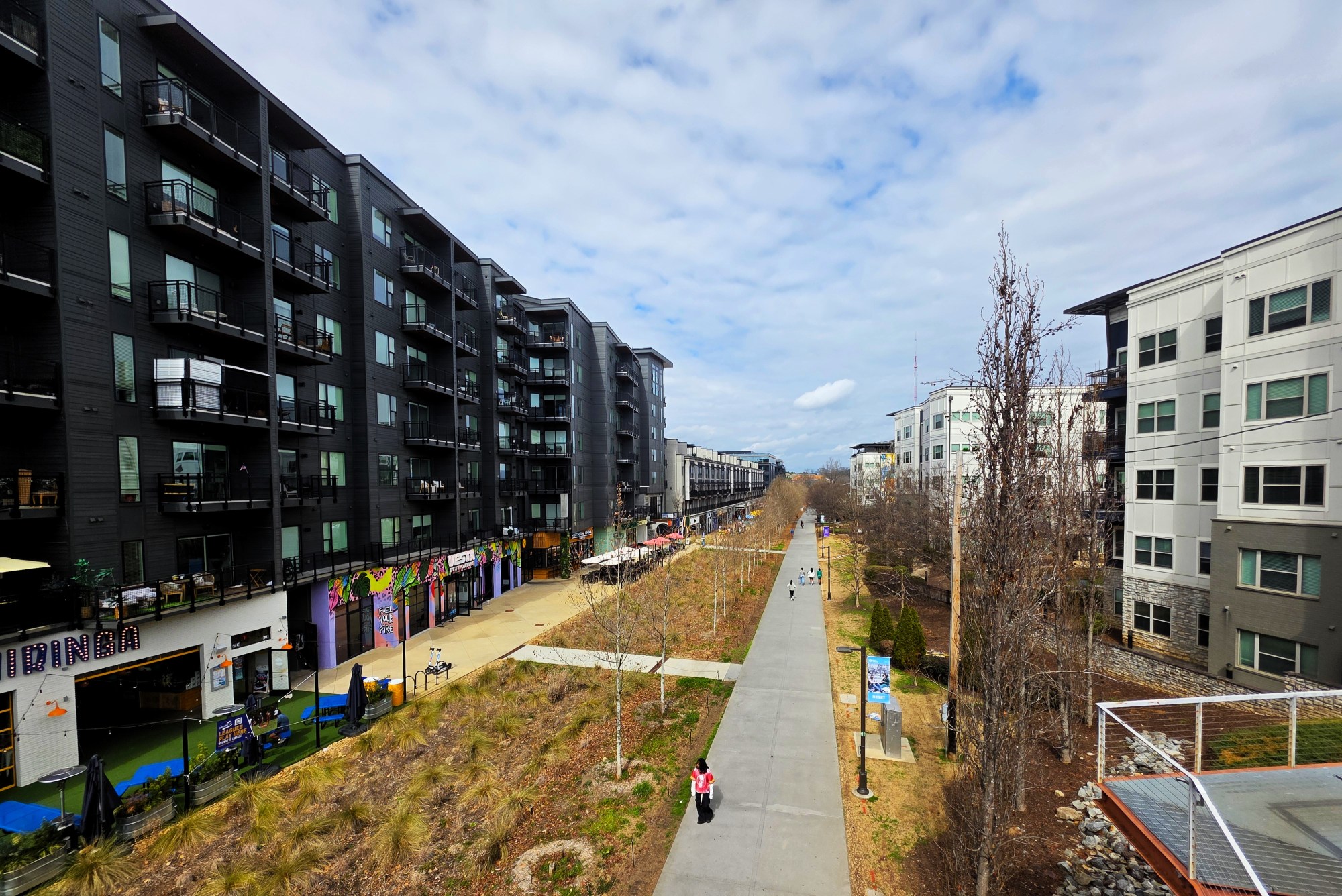

Mayor Andre Dickens’ push to extend the timelines of the city’s eight tax allocation districts (TADs) to fund his proposed multi-billion Neighborhood Reinvestment Initiative (NRI) advanced on Tuesday.
An oversight board appointed by the Atlanta City Council in January issued guidelines on March 31 for the mayor’s plan to spend $10 billion over 30 years to revitalize high-poverty Atlanta neighborhoods. That includes funding for affordable housing, parks, transit expansions, expanded social services, and early childhood education programs.
Unsurprisingly, over half of the Neighborhood Reinvestment Initiative Commission’s 13 recommendations dealt with how to fund the initiative. One core oversight mandate for the 13-member commission was to assess the mayor’s proposal to extend the timelines of all eight Atlanta TADs until 2055 to serve as the NRI’s primary funding source.
The commission, made up of government officials, civic and philanthropic leaders, and a developer, broadly endorsed negotiating to extend the TADs — but with important caveats. It recommended that the city consider each TAD on a case-by-case basis. It also urged finding additional public funding sources to catalyze initial projects and attract philanthropic support for the seven pilot areas targeted for revitalization — West Hollowell, Grove Park/Bankhead, English Avenue/Vine City, Downtown Atlanta, Thomasville Heights, East Campbellton, and West Campbellton.
However, two key commission members — Atlanta Public Schools (APS) board member Ken Zeff and Fulton County Commissioner Dana Barrett — balked at the recommendation to negotiate extending some or all of the TAD timelines. Zeff voted “no” and Barrett abstained from voting on any of the three recommendations dealing with TADs.
Each TAD diverts increases in property tax revenue (above an initial baseline) from APS, Fulton, and the city to fund infrastructure and development projects within the TAD. Since APS contributes half of the tax increment revenue to the eight TADs and Fulton contributes one quarter, their buy-in is key to extending the TAD timelines until 2055. The city of Atlanta contributes the other quarter.
How Atlanta’s property taxes get split––and what TADs change
Without a TAD
With a TAD
Property tax revenue above the baseline set when the TAD was created gets diverted to fund TAD projects — instead of going to APS, Fulton, and the city.
This is why APS and Fulton County’s participation matters. Without their buy-in, the mayor’s $5.5 billion plan drops to $1.375 billion.
Source: Atlanta Civic Circle reporting · atlantaciviccircle.org ACC
In the report’s comment section, Barrett said of the TAD extension recommendation: “I do not feel this recommendation recognizes that each contributing jurisdiction has different legal mandates, and therefore different priorities and different budget pressures.”
As a Fulton commissioner, she added, “I have to consider addressing systemic inequality and poverty in neighborhoods across 15 cities in Fulton County.”
Zeff said in a comment explaining his “no” vote that extending the Beltline TAD alone past its current 2030 expiration date “would cost APS an estimated $80 million annually.”
“While I broadly support the goals of the NRI, I believe this recommendation is too narrowly focused on redirecting resources that are committed to APS toward projects that are not squarely aligned with our strategic priorities,” Zeff added.
“As proposed, investments of $1.9 billion in transit and $1.5 billion in trails and green space are important civic priorities. However, I do not believe they should take precedence over core APS commitments such as competitive teacher salaries, universal preschool access, and comprehensive wraparound supports for students,” Zeff said.
The tensions on the oversight commission reflect an Atlanta Civic Circle investigation’s finding that Atlanta’s TADs are an economic development tool with a mixed track record — fueling explosive growth and displacement in wealthier TADs like the Beltline, Eastside, and Westside, while delivering far less investment in lower-income TADs.
Zeff said in the report’s comments that he believes “in the value of TADs as a tool to revitalize distressed communities,” but advocated allowing the current eight TADs to expire as scheduled — “and then creating new TADs intentionally designed to benefit historically neglected communities.”
One of the commission’s co-chairs, Atlanta City Councilmember Matt Westmoreland, similarly cautioned that extending the TAD timelines would not generate investment revenue for many high-poverty areas of Atlanta. Of 21 Atlanta census tracts in the “red zone” for economic mobility, he commented in the report, many are outside of the existing TAD investment areas.
Westmoreland voted for all the commission’s recommendations, but urged the city to consider redrawing Atlanta’s TAD districts to encompass areas most in need. The TAD extension negotiations, he said in his comment, “must more deeply and thoroughly explore how Tax Allocation Districts — whether existing ones, a new one, or new ones — can more meaningfully help *those communities and neighborhoods* over the *full* 30 years contemplated in the initial [NRI] proposal that led to the creation of this commission.”
A (mostly) unified vision
Despite the political cracks revealed over extending all eight TAD timelines, the commission overwhelmingly backed the broader Neighborhood Reinvestment Initiative framework.
Its members unanimously approved recommendations to involve local communities in selecting projects to fund and to expand anti-displacement initiatives. The city’s TAD-funded development has been criticized for allowing Invest Atlanta to determine the projects and for sparking the displacement of longtime residents.
The commission also recommended creating a new nonprofit entity to oversee how the Neighborhood Reinvestment Initiative revenue is spent. (Barrett and Zeff both abstained from voting on that guideline, saying they needed more information about its purview and accountability.)
If the mayor’s 30-year revitalization plan hinges on the city of Atlanta, APS, and Fulton all agreeing that they’ll continue diverting property tax revenue into the existing TADs, the commission’s few fractures suggest that alignment is far from guaranteed.
The Atlanta City Council will review the commission’s report when it returns from spring break in April.