


Critical public health and research data on federal government websites and data portals have gone offline for more than a week, leaving Atlanta-area researchers, advocates, and policymakers in limbo.
The Atlanta public health and medical research community is particularly affected, since the Centers for Disease Control and Prevention (CDC) is based here, along with a constellation of national nonprofits and world-class research universities that work on the most pressing threats to humanity’s wellbeing, whether it’s diabetes, HIV/AIDS, or the H5N1 bird flu pandemic.
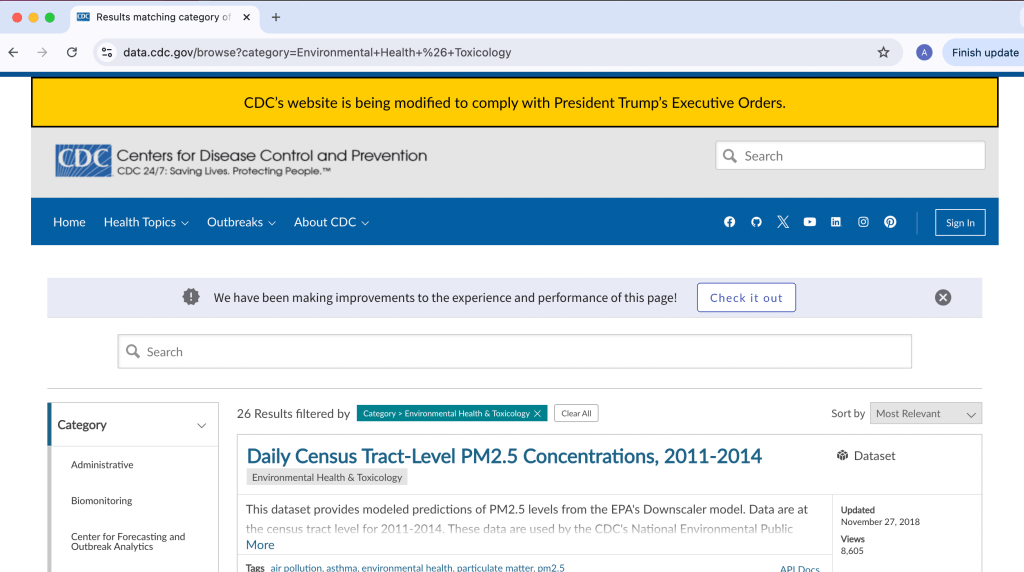
At first, the entire CDC data portal was taken down. It has since been restored, but entire datasets are still unavailable. A yellow banner across the top reads: “CDC’s website is being modified to comply with President Trump’s Executive Orders.”
Some scrubbed datasets from US Department of Health and Human Services (HHS) websites, such as the CDC and Food and Drug Administration (FDA), were ordered back online by a federal judge on Feb. 11, but questions remain about modifications and omissions.
Meanwhile, the Trump administration’s blitzkrieg approach to overhauling public data has left state and local governments and research universities hesitant to respond. “The changes are too fluid at this time for us to comment,” Georgia Department of Health spokesperson Nancy Nydam said in response to emailed questions. Fulton County’s health director referred inquiries to the state.
“As this is a fluid situation, we are reserving comment on the multitude of changes that are occurring daily and their potential impact on our institution,” said a Morehouse School of Medicine spokesperson in an emailed statement. “We are in communication with our local, state and federal officials to have a better understanding of how we may be affected.”
Emory University addressed the confusion in an email to faculty in late January, saying, “Many specifics remain unknown.”
Following orders
The disruptions began soon after President Donald Trump’s inauguration on Jan. 20, when he signed a cavalcade of executive orders, including one to enforce a definition of “biological reality” that does not recognize the existence of transgender people — or, more broadly, gender as a separate category from sex and sexual orientation.
There are only two sexes, so people are either strictly male or female, according to the new edict that the CDC and other federal agencies must follow, entitled “Defending Women from Gender Ideology Extremism and Restoring Biological Truth to the Federal Government.”
White House officials said that taking down the entire data portals for the CDC and other agencies was the only feasible way to comply with the executive order. Restoring the modified datasets, scrubbed of officially non-existent demographic categories such as transgender, could take a couple of weeks, the White House said at the time.
However, a White House spokesperson did not answer Atlanta Civic Circle’s questions about what demographic data and datasets were affected, what the modifications entail, or whether certain data collection has been halted. The CDC also did not respond to inquiries.
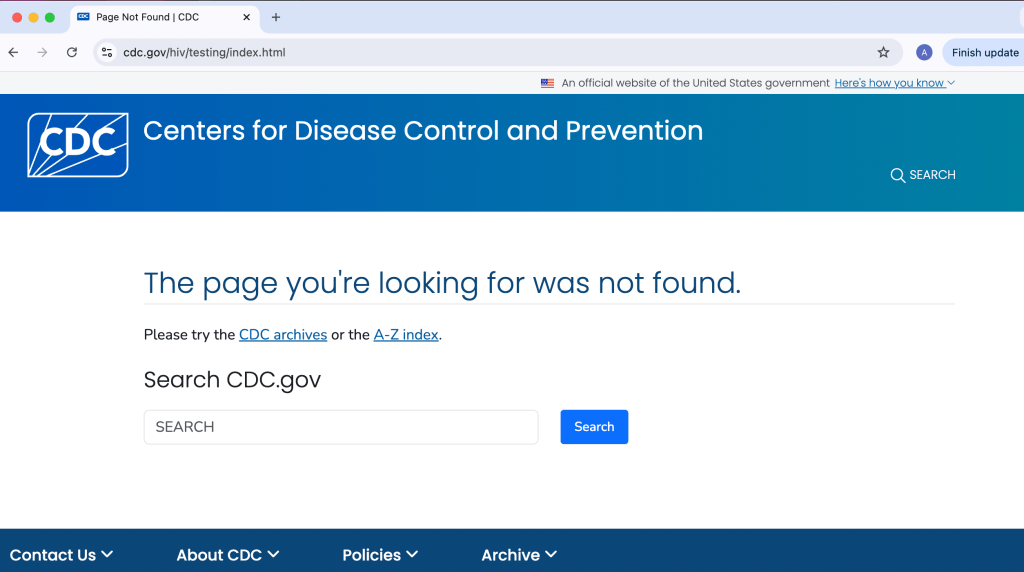
But on Tuesday, in response to a lawsuit filed by the advocacy group Doctors for America, a federal judge ordered the Trump administration to restore certain health-related CDC and Food and Drug Administration (FDA) datasets by the same day at midnight – and to show compliance to the court by 5 p.m. Friday. It remains to be seen how the court’s intervention will affect health information and datasets on HHS websites.
Why the data matters
Local public health experts emphasized that the taxpayer-funded datasets are critical for informing policy and decision-making that helps Americans stay alive and healthy.
Dabney Evans, director of the Center for Humanitarian Emergencies at Emory University, pointed to the CDC’s Behavioral Risk Factor Surveillance System. While its name may sound obscure, she said it provides key evidence to support policies that protect the public — such as data showing the dangers of texting while driving, which contributed to Georgia’s hands-free phone law in 2018.
While that CDC dataset is back online, Evans noted, it’s unclear how the specific risk-factor data pertaining to transgender people has been restored. “There have been some modifications to that data,” she said.
Why does it matter to assess behaviors for specific population demographics, such as geographic location, race, sex — or even frequency of doctor visits? “Within public health, what we’re looking at is populations, but not all people are the same,” Evans explained. “People have different risk factors for different health outcomes. So regardless of what health issue you’re looking at, we want to be able to look at differences across population groups.”
Without detailed, disaggregated data, she warned, policymakers risk implementing ineffective, one-size-fits-all solutions. “That kind of disaggregation allows us to target public health programs efficiently,” Evans said. “If we’re interested in efficiency, we need to disaggregate our data.”
Health and wealth outcomes at stake
“All of this public health information is really important to be able to make decisions,” said Jeffrey Smythe, the executive director of the Atlanta Regional Collaborative for Health Improvement (ARCHI). The nonprofit brings together local groups to address health disparities in the Atlanta area.
To improve Black maternal health or reduce heart disease, for instance, health practitioners and policymakers alike rely on these datasets, Smythe said, because they pinpoint major differences from one neighborhood to another. That helps policymakers decide where it’s most effective to deploy limited resources.
The federal datasets also matter for closing the racial wealth divide, said Alex Camardelle, who heads Atlanta-based nonprofit Kindred Futures, which promotes wealth-building for Black communities.
Carmardelle said the HHS data provides insight into “current realities that households are facing when it comes to threats to building wealth,” which helps Kindred Futures and its supporters decide how to craft solutions. “The bottom line is that taking the data out of our hands makes it very difficult to do equity-driven work and to come up with targeted solutions,” he said.
Data on transgender people was already very limited, he added, so if the existing federal data is scrubbed, “then we are at a significant loss, or, at least, forced to start at ground zero.”
Now, there’s a scramble to access and preserve the existing data, but it’s still unclear how Trump’s executive orders will affect future federal data collection.
“We hope that it doesn’t lead to a place of flying blind,” said ARCHI’s Smythe. “It’s really about how do we get better health outcomes for all, and how do we save money?”


Leave a comment