

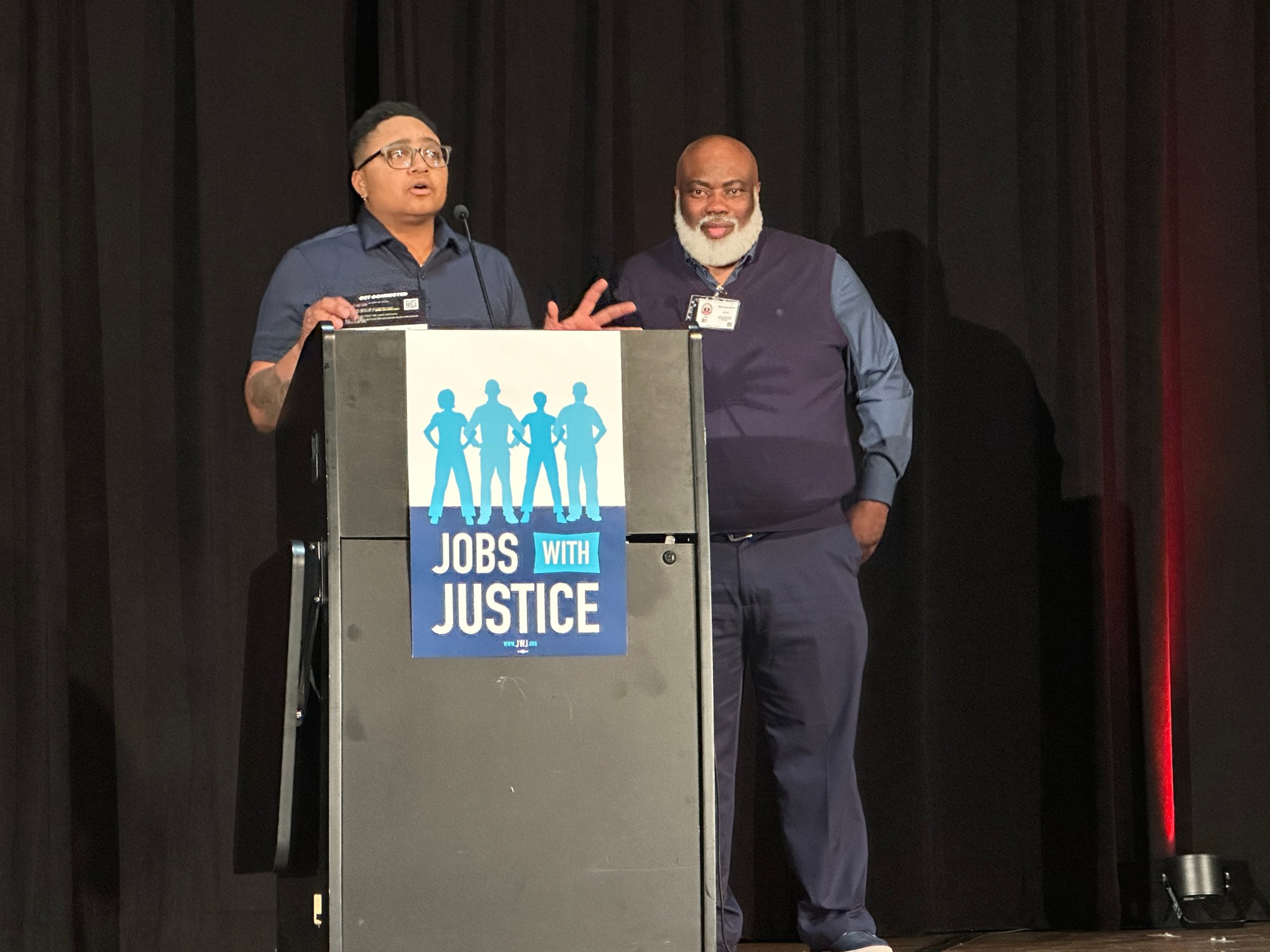
Clark Atlanta University has partnered with national labor rights group Jobs With Justice to launch a first-of-its-kind academic center for training young Black and Brown labor movement leaders, on the belief that the South is the front line for revitalizing the US labor movement as a force in political democracy.
The Labor Institute for the Advancement of Black Strategists is housed within the historically Black university’s W.E.B. Du Bois Southern Center for Studies in Public Policy.
Its mission: to develop a pipeline of trained Black strategists who can advocate for, organize, and lead workers in collective actions in the South – a region with a high concentration of Black workers, disproportionately low union membership, and longstanding hostility against unions from political and business leaders.
For Nykia Greene-Young, the Du Bois Center’s domestic policy coordinator, the new labor institute is rooted in a Southern legacy of Black working-class resistance and empowerment. “It stands on Du Bois’ legacy and his words — unapologetically helping people, especially Black people,” she said.
“We’re seeing labor under attack. We’re seeing workers under attack by the administration that is in office now,” said Greene-Young, who also teaches political science at Clark Atlanta.
The labor institute will equip students to lead worker movements through a mix of classes, fellowships, and hands-on labor organizing, Greene-Young said. Fostering a stronger labor movement in the South, she added, will “help a lot of people with quality of life, their income and their workers’ rights.” Sherman Henry, the labor institute’s director, hopes to increase union penetration in the South. Unionized workers, including government employees, make up only about 10% of the labor force nationally. Georgia is near bottom in union membership rates at just 3.8%.
Henry combines both academic and practical experience in labor relations, as a former leader for the American Federation of State, County & Municipal Employees in Florida. He previously led Jobs With Justice’s Labor Center for Advancing Black Strategists initiative, the impetus for the new Clark Atlanta labor institute.
The new labor institute aims to secure $6 million over the next three years to expand instructional capacity from four guest instructors to three full time faculty members and a network of 10 visiting lecturers, according to Jobs with Justice. It currently has 12 affiliated staff members, including administrators.
The institute is not formally affiliated with any labor union, and it is open to all students within the Atlanta University Center Consortium, which includes Spelman College, Morehouse College, and Morehouse School of Medicine.
When the labor institute officially launched in late March, Jobs With Justice executive director Erica Smiley told Atlanta Civic Circle that the vision is to reframe labor from a special interest to a cornerstone of democracy.
“We’re in this political-economic crisis of democracy,” Smiley explained. “Democratizing our workplaces through organizing and collective bargaining,” she said, is crucial to making the United States a country where it’s a majority of the people who set the standards and make decisions, whether in communities or industries.
Smiley said the vision is for the institute to become more than a training center for labor organizing and to actually shape public policy. As such, it’s a response to conservative and libertarian academic centers, which are explicitly anti-union. In particular, she said, George Mason University’s Center for the Study of Public Choice outside of Washington D.C. has served for over 50 years as a hub for effective libertarian-leaning organizing that has reshape public policy.
“There was a multi-decade plan, and they anchored it. They also had a university so that there could be academic rigor, legitimacy and [strategic] frameworks,” Smiley said. “I realized that I wanted that for democracy — and for us — and I wanted it for democracy anchored in Southern reconstruction.”


Leave a comment