

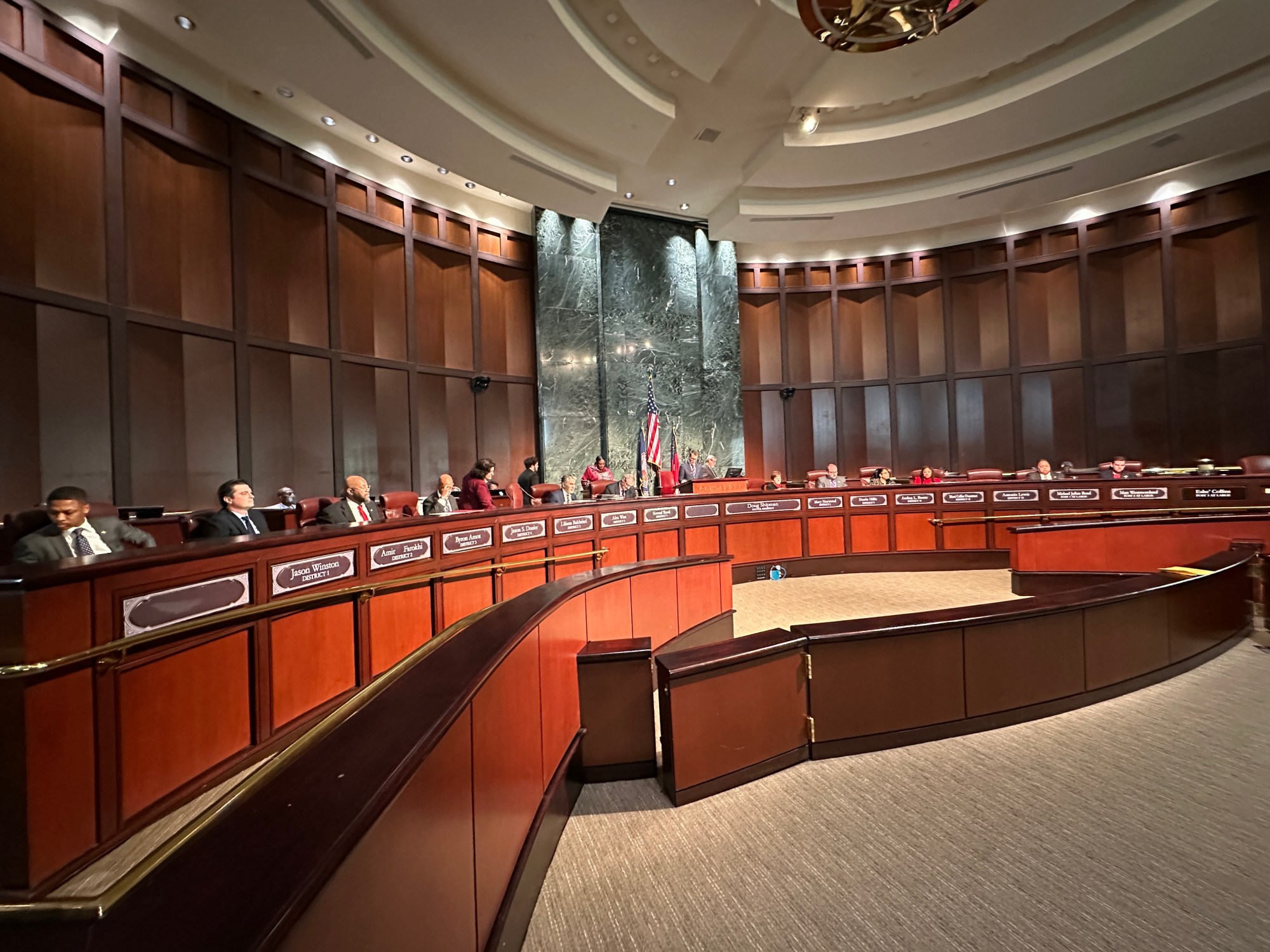
The Atlanta City Council will finalize its 2026 budget on Monday. With just a handful of hearings along the way, how accessible was the budget-planning process for everyday Atlantans?
Atlanta Civic Circle examined how Boston and Chicago engage the public in budget planning. Though these cities and their budgets are larger than Atlanta’s, they have recently increased resident involvement in their spending decisions. Here’s how Atlanta stacks up—and how the City could follow their lead.
First, how does Atlanta’s process work?
Atlantans can participate in the budget process by contacting council members or attending one of just three budget hearings, a regular council meeting, or a Finance and Executive Committee hearing, but their window is tight: Typically, just over a month passes between the release of the proposed budget and its adoption. Citizens unable to attend meetings or engage with council members in person can email budgettalk@atlantaga.gov or leave voicemails at 404-330-6043; this year, they had until May 20 to do so. The mayor released his proposed budget April 29.
According to City Council Communications Director Zena Lewis, the designated public input email and phone number received just one email and no voicemails pertaining to the budget. Council also received one in-person comment and just two comments on a social media live feed after it ended.
Another issue may be that Atlanta’s 642-page proposed budget is dense and hard to understand. Departmental budgets aren’t broken down in specific detail either. For example, the Atlanta Police Department is slated for $361 million this year, an increase of more than $54 million from last year, but the proposed budget only lists vague items like, for example, $35 million in “contracted services” or $15 million in “other financing uses.”
Natalyn Archibong, who served on the city council for 20 years, told Atlanta Civic Circle that city leaders hear from constituents and groups throughout the year, and that does influence their priorities, but that group is self-selecting and ultimately does not reflect Atlantans’ interests more broadly. “You leave a lot of folks behind,” Archibong said.
Cities like Boston and Chicago, on the other hand, proactively seek residents’ input in the budget process well before their budgets are published.
Chicago’s year-round engagement campaign
Chicago has a structured, citywide public engagement campaign focused on accessibility, equity, and transparency that runs throughout the year, not only during the month or so that a budget is before the council.
The city partnered with the University of Illinois at Chicago’s Great Cities Institute to host in-person and online events throughout 2024 for their 2025 budget. Those efforts engaged more than 500 residents from across the city’s racial, socioeconomic and geographic communities, according to Thea Crum who co-authored the institute’s engagement report.
In addition to three public roundtables and a youth-specific engagement event, the city offers Spanish translation, ASL interpretation, online surveys, and comment cards.
The process gathers ideas and recommendations on community priorities like affordable housing, public transit, and youth services, and then shares them with corresponding department leaders before the mayor’s proposed budget is released in the fall.
“By involving residents throughout the year, the City gains knowledge that shapes not only the current budget but also informs future programs and measures of progress,” according to the report.
Chicago separately has instituted participatory budgeting at the ward (council district) level since 2009 — the first city in the U.S. to do so — a process that has since expanded to include 17 wards out of 50, and since 2009 has allocated over $50 million, according to Crum.
“The culture of engagement that was created through those years led to an increased desire for participation in the city budget,” she said.
Boston’s institutionalized participatory budgeting
In Boston, the city provides extensive budget resources online, translated into several languages, with explanatory videos on how to read the budget and how to give public comment.
The City also has an Office of Participatory Budgeting. Participatory budgeting essentially lets residents decide how to spend a chunk of city money through a process of soliciting ideas, crafting proposals, and letting residents vote on them.
Last year, Boston’s OPB launched Ideas in Action, a program that asks residents how they would spend $2 million. According to the program’s report, 789 residents submitted ideas online, and the OPB held three in-person workshops in different neighborhoods, attended by 110 residents.
Bostonians were then invited to vote on 14 proposals pulled from that community engagement. As a result, more than 4,400 residents showed up at the polls earlier this year to choose which projects should be funded by the $2 million. The six projects receiving the highest number of votes were selected and included rental assistance for young Bostonians and funding to address rat infestations.
Boston has also had a youth-focused initiative since 2014 called “Youth Lead the Change,” which allocates $1 million annually for young people aged 14 to 25 to decide how to spend.

How can Atlanta increase constituent participation?
District 2 councilmember Amir Farokhi piloted a participatory budgeting initiative in his district in 2019, but it was limited to a fraction of the city’s $2.2 billion budget. Downtown Decides allowed Downtown residents to choose how to spend $1 million in leftover transportation funds. Downtown Decides funded 17 out of the 33 projects that made it to a ballot, with nearly 3,500 Downtown residents voting.
Farokhi repeated the program in Candler Park in 2021, spending $45,000 on parks and the arts. Candler Park Decides funded 14 projects with just over 1,000 voters participating. He called it “one of the easiest ways to increase civic engagement and build trust in government.” The idea hasn’t caught on in other districts, however.
Archibong, who is a proponent of participatory budgeting, said the city can reach and engage residents, pointing to past efforts to convince voters to fund penny sales taxes for water infrastructure, roads, and MARTA. “Participatory budgeting is almost like a gateway, and it shows how something could work,” Archibong said of Farokhi’s initiatives.
In the meantime, though, Atlanta’s citywide budget remains relatively inaccessible for everyday Atlantans. “It’s a process that requires the citizen to go to City Hall and engage on the City’s terms,” said Sagirah Jones, the head of the Atlanta Planning and Advisory Board.
For Jones, APAB is a structure the City could use to get more resident input. APAB is composed of leaders from each of Atlanta’s 25 Neighborhood Planning Units. The city charter says NPU recommendations should help shape the budget, but Jones noted that APAB and NPUs are all-volunteer groups with no funding or formalized mechanism for real influence.
“We don’t have a solution yet,” Jones said. “But we are setting ourselves up to be more proactive in the next budget cycle and providing recommendations on how that public engagement could look like and most effectively work in Atlanta.”
This story is part of #ATLBudget, a civic engagement project in collaboration with the Center for Civic Innovation and other organizations. Together, we’re breaking down Atlanta’s budget process to show where your tax dollars go — and how you can help shape the city’s priorities. Follow #ATLBudget on Instagram and Bluesky for updates.


Leave a comment