

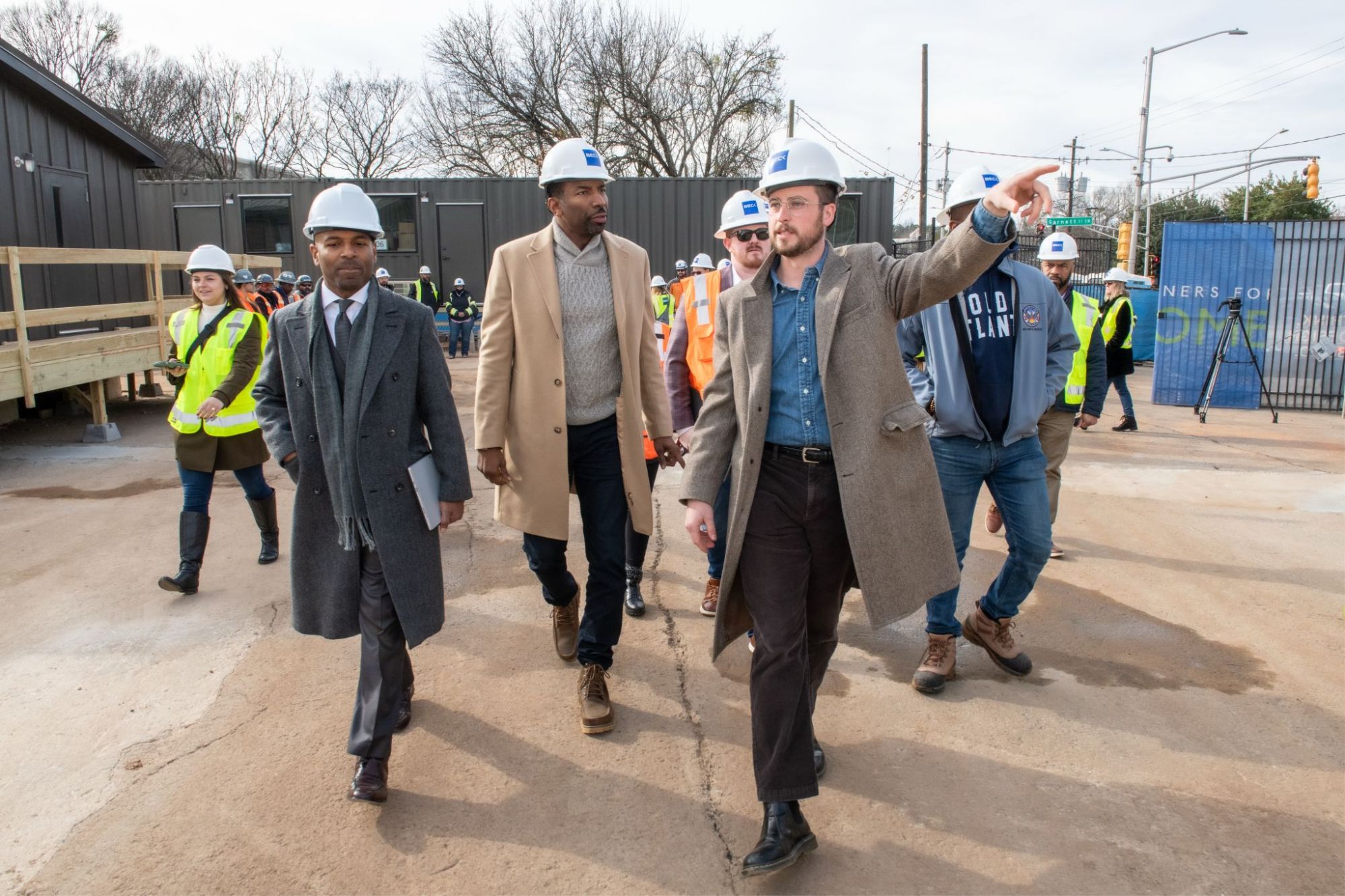
After orchestrating Mayor Andre Dickens’ goal to supercharge affordable housing development, Atlanta’s top housing official, Josh Humphries, has taken a job with the California Community Foundation to tackle Los Angeles’ own housing crisis.
He exits his post as Dickens’ chief housing advisor at a pivotal moment for the city — a time when institutional investors, negligent landlords, restrictive zoning laws, gentrification, and low wages, among other factors, have pushed affordable housing out of reach for many Atlantans.
But Humphries says that the city has assembled a “well-oiled machine” of public and private partners to build affordable housing faster than it’s disappearing, amid the rising tide of gentrification.
“Part of the reason I was even willing to consider leaving is because of what we built in the last three years,” he told Atlanta Civic Circle this week.
Humphries served as the de-facto quarterback of the mayor’s Affordable Housing Strike Force, created to centralize the efforts of all city agencies that own land suitable for housing initiatives. The city subsequently launched the Atlanta Urban Development Corporation to develop unused city-owned land in partnership with private developers. Humphries also spearheaded initiatives such as rapid rehousing for unsheltered people and the Safe and Secure Housing program, which beefed up the city’s code enforcement squad to prosecute negligent landlords.
Among the Dickens’ administration’s public and private partners, Humphries has worked closely with Atlanta Housing CEO Terri Lee, City Planning Commissioner Jahnee Prince, and in the private sector, HouseATL leader Natallie Keiser, to advance Dickens’ 2021 campaign goal to build and preserve 20,000 affordable housing units by 2030.
“Right now, we’re close to 12,000 units of housing either delivered or under construction in the last three years,” Humphries said. “And we have a system designed, and the right personnel, to continue that type of output.”
Atlanta Civic Circle caught up with Humphries to find out what’s next for the city’s ambitious goal to accelerate affordable housing development for Atlantans amid the ongoing housing crisis.
This conversation has been edited for length and clarity.
Atlanta Civic Circle: Help us understand the mayor’s aim to add 20,000 affordable housing units. That’s not the magic number that will solve the housing crisis. Where does the 20,000 figure come from, and what’s the overarching goal?
Humphries: Most cities and states across the country are asking that question: What do we do to address what has become a national crisis? Cities like Atlanta, which for a long time were affordable havens, are no longer that. If you go far enough upstream, it really comes down to chronic under-supply of housing and wage growth not keeping up with housing growth. You have people who are increasingly less economically mobile, and a housing market that’s increasingly out of reach for those folks.
When Mayor Dickens took office, we were averaging somewhere between 1,500 and 1,700 units [created] a year. We wanted to get to 2,500 units annually. That’s 20,000 divided by eight years. But it’s difficult to increase that pace, because a lot of the money that generates housing in the country comes from the federal government. We had to get creative to solve the big, hard, vexing problems comprising the American housing crisis.
You’ve said federal funding for affordable housing production is finite, so how did the city find the capital?
We’re trying to activate public land assets and use different tools, like housing bonds, including through our partnership with the Community Foundation for Greater Atlanta. [Thanks to significant philanthropic donations, the nonprofit has provided over $120 million in initial financing to developers to build or renovate almost 5,000 affordable housing units in the last two years. -Ed.]
That’s where I’m optimistic about us working our way out of the problem. This should enable us to continue 15 or 20 years from now. We’re leveraging public land and bond issuances to build as much housing, as quickly as we can — and we need to have a big portion of that be affordable every year.
To what extent does the federal government’s current chaos and anticipated funding cuts disrupt the city’s affordable housing production goals?
We’ve had a [housing production] system that’s been propped up by the federal government since the 1930s. There are a lot of nuanced ways in which the federal uncertainty makes waves in the market. It affects the cost of capital, it creates uncertainty of payment [for local governments and nonprofits] and of enforcement measures. [For instance, whether a downsized US Department of Housing and Urban Development can properly inspect the properties it subsidizes through housing vouchers. -Ed.]
The innovation we’ve done in Atlanta does not fully replace the federal resources, because they’re so substantial and because we’ve been depending on them for so long. But what it does do is give us an opportunity to look inward at the local resources we have.
Ideally, federal support doesn’t go away — and I don’t think anyone fully understands the impact at this point. But Atlanta is better positioned than pretty much any other city, because of the work we’ve been doing since the mayor took office.
Atlanta defines rental housing as affordable if units are priced for households earning 80% or less of the area median income (AMI) — roughly $86,000 for a family of four. That’s still not affordable for many Atlanta households. For its incentive deals with private developers, how does the city determine how many new units should be priced at 80% AMI, instead of at 50% AMI or below? Housing experts say we need the “deeply affordable” units most.
Just over 70% of all the units that we have brought online are priced as affordable for 60% of AMI or below. So that’s the majority of the units that are counted towards our 20,000-unit goal.
The unfortunate reality is that one in two renters in Atlanta are cost-burdened, spending at least 30% of their household income on housing. The housing market has hit such a level that people at higher and higher incomes are facing housing stress as well. The housing market is like a game of musical chairs, and people with more economic means get to sit down first.
But even as you’re seeing stress at higher income levels, you’re also seeing the most desperate levels of stress at the lowest incomes. That’s why homelessness is on the rise nationwide. It’s also why Atlanta is taking a mixed-income approach to housing creation.
Striving for housing affordability can feel sisyphean. What message do you have for your successor about the challenges they’ll face?
One of the biggest challenges that we face in trying to close the gap [of affordable units] is you really have two sides in the housing market: You’ve got the traditional multifamily guys, who are building apartments in Midtown or along the Eastside Beltline — and they’re building just to maximize returns. It’s Class A, luxury housing. And then you have your low-income housing tax-credit group — the people who are building the workforce housing.
But building the kinds of housing that we’re talking about — closing the gap from 1,700 to 2,500 units a year — won’t come from those guys. They’re both prioritizing the market-rate units. We’ve got to be creative and build a new type of capital stack and bring true mixed-income housing into the equation — projects that are 30% affordable and 70% market-rate. [Currently, a project must offer 10% to 15% affordable housing for a developer to receive government incentives, like density allowances or tax breaks. -Ed.]
We’ve been trying to pioneer that in Atlanta. It’s the [financing] system itself that poses the biggest challenge with that. It’s not just the developers. It’s not just the banks. It’s not just private equity. It’s all these different pieces that are not concerned about whether mixed-income can really work.
The whole housing ecosystem has historically been built on either 100% affordable or 100% not affordable. And I think in the future, the way to build our way out of that problem is to build true mixed-income. That’s the best way to generate economic stability and produce housing for all incomes. That’s been hard to do because these systems are so siloed — but I think we’ve started breaking that down.
If you could wave a magic wand and solve the housing crisis, how would you do it?
I don’t think there’s a single panacea. Sure, you could create the ideal zoning code optimized to build housing. You still have to have the banks finance the deals. There are a lot of areas in the city, for instance, that don’t require parking — but the banks require parking. So that’s not a zoning problem — it’s a lending ecosystem problem.
What you really need is a team of career problem solvers that are identifying and putting all the pieces together. Yeah, I think there are improvements you could make to our zoning code — which dates back to the 1980s — that would allow for more [development] versatility to provide housing that meets people’s needs. But if you don’t flank that with an increase in public-sector and philanthropic funding, you’re still going to have a hard time.
The other pieces would be really looking at a recurring revenue source that is substantial for the city — that is earmarked and guardrailed to create affordable housing. But that could take a voter referendum.
What about Atlanta’s high rents? There is already a roughly 25,000-person backlog of people seeking federal housing vouchers through Atlanta Housing – and the Trump administration wants to sharply cut the existing voucher funding.
That brings us back to the federal dependency thing. One of the biggest challenges we have right now is that we don’t have a local, annual allocation that’s substantial enough to provide the subsidy we need for low-income renters.
