
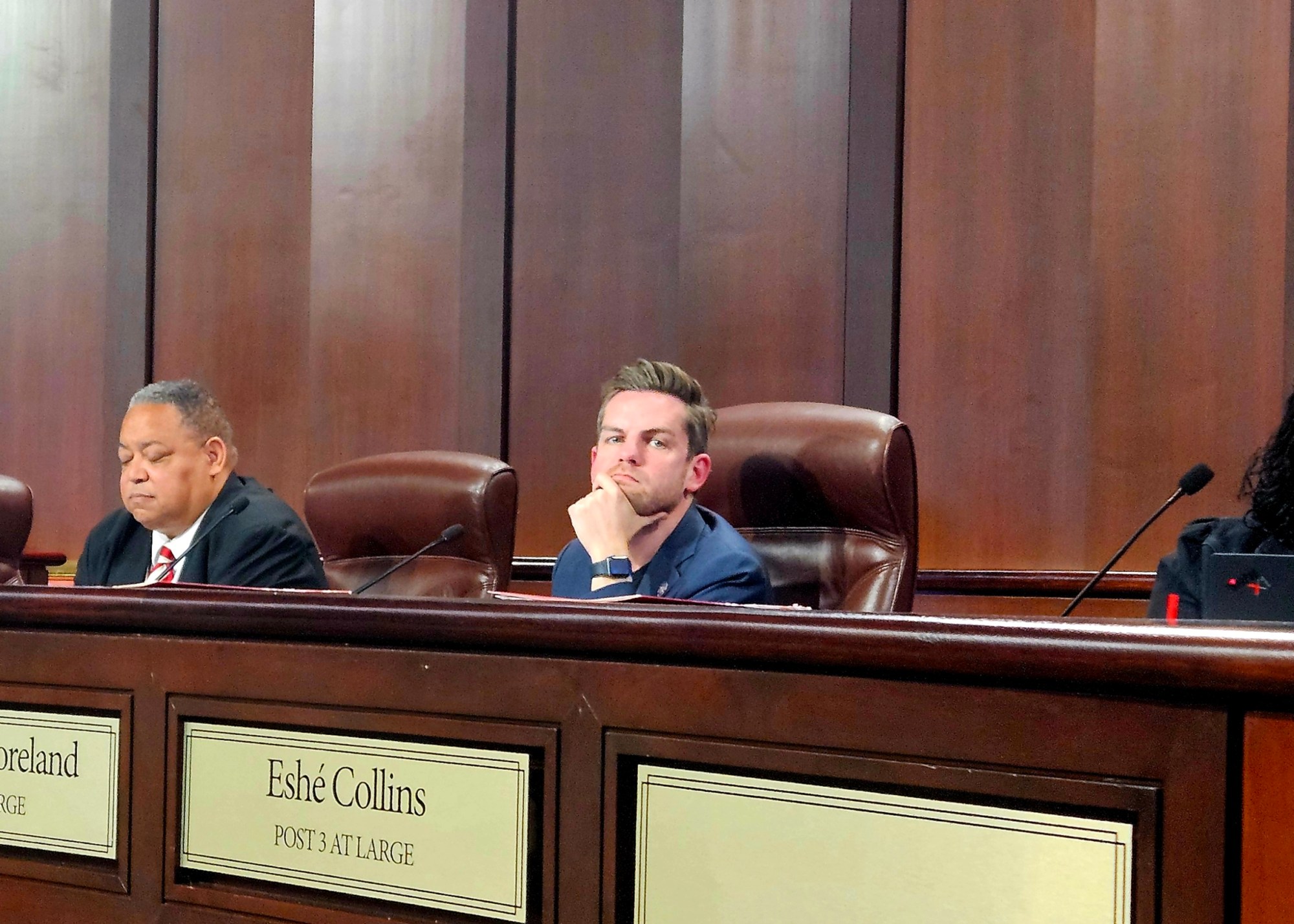

Mayor Andre Dickens’ administration successfully gutted legislation to restrict how the city can spend its Affordable Housing Trust Fund, which received $19.5 million from the city’s general fund this year. On Monday, the Atlanta City Council unanimously approved a watered-down version of the measure, reinforcing the administration’s authority to tap the trust fund as it sees fit.
After an Atlanta Civic Circle investigation in May revealed that Dickens’ office had been using over 75% of the dedicated fund for housing-related debt service and payroll, Councilmember Matt Westmoreland offered a remedy: update the 2021 legislation he sponsored to create the fund to require that it spends more on low-income housing construction than on paying bond debts and staff salaries.
Westmoreland’s Oct. 20 legislation proposed that at least half of the trust’s annual funding pay for affordable housing construction, with up to another 30% going to nonprofit housing programs. It restricted spending only 15% to service bond debt, and 5% for administrative costs and staff salaries.
Most importantly, Westmoreland’s proposed reforms dedicated most of the trust dollars to providing housing for families who earn no more than 50% of the area median income (AMI), which is about $57,000 for a family of four.
That would have marked a major departure from the way the Mayor’s Office is currently using the trust. ACC’s investigation found that of the $17 million the trust received from the general fund in FY 2025, at least $8.8 million went to housing-related bond debt and at least $4 million covered city salaries — more than 75% of the total.
The 2021 legislation that launched the trust fund made clear that it was intended to fund housing construction and rehabilitation, but it never specified how the city could do that. “Currently there is no definition whatsoever concerning quote-unquote ‘for affordable housing,’ which is how the fund has to be used,” city attorney Amber Robinson said during a council committee meeting last week.
But the Dickens administration beat back the effort to tighten controls on trust fund spending, extracting proposed regulatory language in exchange for more leeway.
Mayor’s substitute bill passes
Before the Dec. 1 council vote, the Mayor’s Office lobbied for less severe restrictions, leaving housing trust fund spending almost entirely to the executive branch’s discretion.
The substitute legislation the council approved adds a line specifying that the trust can be used to service housing bond debt — without any percentage cap — which cements the city’s ability to use the trust freely for that purpose. It also caps annual trust expenditures on staff and administration at 15%, instead of 5% — and it gives the city’s chief financial officer, Mohamed Balla, the liberty to determine those expenditures.
The new legislation also specifies that the trust must be used to fund housing that’s affordable to households making 60% or less of the area median income (AMI) — instead of the initially proposed 50% AMI. While it directs that the trust should fund housing at 50% AMI “to the greatest extent possible,” it doesn’t mandate any percentage of trust spending for that goal. It also removes the 30% cap for funding nonprofit housing programs.
In fact, the amended legislation seems to expand the city’s power to determine how to spend the trust. A new clause says that the city council can authorize expenditures for “other uses not contemplated … to address urgent and/or unanticipated needs on a case-by-case basis.”
Some city council members hoped Westmoreland’s initial Oct. 20 proposal would clarify that the fund should be used primarily to deliver additional affordable housing, although all of them voted for the substitute legislation.
“I feel like we’ve moved in the opposite direction of what this was intended to do,” Councilmember Alex Wan said at a Nov. 25 meeting of the council’s Finance and Executive Committee, which approved the substitute bill. The substitute, he said at the time, “effectively takes out all of the bumper guards, except for the 15% administrative [spending cap] piece.”
Wan and Councilmember Liliana Bakhtiari abstained from voting on the Nov. 25 substitute bill, which was approved by Finance and Executive Committee members Howard Shook, Jason Winston, Byron Amos, Dustin Hillis, and Marci Overstreet.
Atlanta’s CFO, Balla, rejected the notion that the retooled legislation was regressive. Using the trust fund to pay down housing-related bond debt allows the city to issue more bonds to fund housing development and rehabilitation, he contends.
“For every $7 million in debt we service, we can issue $100 million in Housing or Homeless Opportunity Bonds,” Balla told Atlanta Civic Circle before the Finance and Executive Committee vote in November. He argued that shifting those costs back to the general fund would force cuts in other city services.
Westmoreland conceded Balla’s point in negotiations over the substitute legislation: “The CFO told me that we would not have been able to issue the most recent housing bond or the most recent homeless opportunity bond without this trust fund being able to be used for debt service,” the council member said in an interview. “While I personally disagree with that approach, I’m not willing to be the reason that we don’t issue more housing bonds and homeless bonds in the future.”
Spending a big chunk of the Affordable Housing Trust Fund on payroll — at least 23.5% in FY 2025 — was the bigger sticking point for some council members. Balla has said the trust funds roughly 40 housing-focused positions in the Mayor’s Office, planning department, solicitor’s office, and other city agencies — but the administration has not shared a breakdown of those jobs with the council.
“Those costs should be covered by the general fund,” Wan said of the payroll expenses, adding that the “murky staffing situation” gave him pause.
“I am frustrated,” Bakhtiari said during the Dec. 1 full council meeting. “It is hard to talk about capping how much is used for employment, when we do not know what the employment numbers are.”
Consequently, the city council imposed the 15% cap on payroll and administrative spending from the trust fund. The new legislation also requires the Mayor’s Office to provide an annual accounting to the council by Oct. 1 of how it spent the fund in the prior fiscal year ending June 30.
Westmoreland said Monday’s vote established baseline guardrails for the Affordable Housing Trust Fund, and that he’d push for more restrictions once the city council reconvenes in January.
