


ACC EXPLORES
The Extended Stay Trap
Extended stays are no place for kids, but many mothers have little choice
Denise Parker, 26, worked hard to stay out of the rundown roadside hotels off highways in Clayton County where she spent most of her teen years. When she moved out at 17 into her own apartment, she made it her mission to stay in stable housing. The birth of her daughter, who’s now six, made that mission more urgent. She didn’t want to struggle like her mother and grandmother, who both spent years in the extended-stay hotel trap, bouncing from hotel to apartment and then back again when they found themselves unable to qualify for an apartment or pay the rent.


What keeps three generations of single moms stuck in the extended-stay hotel trap?
This series unpacks the overlapping challenges keeping families in Clayton County—and across Georgia—stuck in extended-stay motels when they want safe, stable homes. Through personal stories, local data, and solutions from around the country, we explore how low wages, housing shortages, and education gaps converge to trap working parents and children in cycles of instability.
Read through the series. Share your perspective. Help us spark a conversation about what it takes to ensure every family has a place to call home.
THE FACTORS
A Living Wage
Experts say higher wages, free childcare can combat the extended stay trap
Many people in Clayton County end up living in extended stay hotels when they can’t afford to keep paying an apartment lease. The struggle is acute for low income single mothers because they have to figure out how to work a job when the minimum wage in Georgia, $7.25, is a third of the living wage for a single adult in Clayton County, $23.90, in addition to paying for childcare while they work.

Adults without a high-school diploma in Clayton County earn 27% less than those with some postsecondary training.
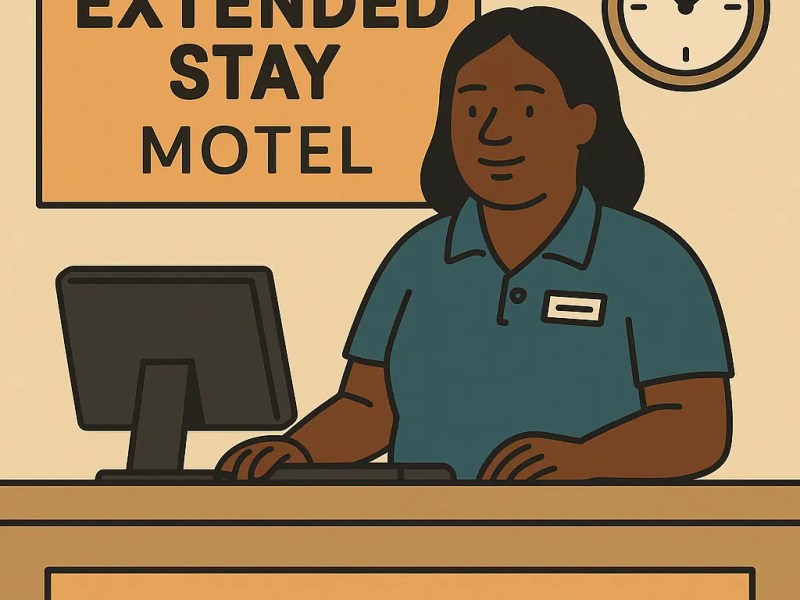
The living wage in Clayton County is $56.30 per hour for a single adult with three kids, who can expect to spend $1,840 per month on housing. Clayton County resident and single mother Tanisha Moreno has six children living with her, but earns less than a fifth of that working at the front desk of an extended stay motel for $10 an hour. Even working fulltime, she still comes up $240 short of the amount needed to house her and just three of her kids.
In-depth reporting
Education
Public schools are a lifeline
The Clayton County Public Schools Homeless Education Department (HED) identified over 2,000 students as unhoused, representing 3.69% of the student body. 745 of them were living in extended stay hotels, according to CCPS Homeless Education Coordinator Sonia Davis.
Single mother Amy Sims’s son, now 9, was one of these students not too long ago. They spent five years living in one-room extended stay hotels in Clayton County. She worked and supported her son, who has autism and ADHD, but didn’t think she’d ever find an apartment she could afford.
Sims discovered the Homeless Education Department’s resources when her son was going into first grade at Mount Zion Primary. The family received food, laundry, and Christmas gift donations and attended events such as “shoe shuffles” where kids can pick out their own shoes for free.
In metro Atlanta, more than 12,000 children are considered homeless––a number experts believe is an undercount.
“We are changing the mindset of our families. We just can’t give families funding and not help them, support them, and give them training and support about how to become and remain stable.”
CCPS Homeless Education Coordinator Sonia Davis

Evicted students miss an average of four extra school days per year than their non‑evicted peers—leading to chronic absenteeism and academic setbacks.
HOW FEDERAL ACTIONS COULD IMPACT HOMELESS STUDENTS
The Trump administration’s FY2026 budget proposal aims to eliminate the $129 million in dedicated funding for the McKinney-Vento Education for Homeless Children and Youth (EHCY) program. Instead, the money would be moved to a broader block grant that covers multiple education initiatives. Compounding this, an executive order has been signed to dismantle the U.S. Department of Education, potentially undermining federal oversight and funding infrastructure.
In Georgia, state law does not cover the core student protections under the federal McKinney-Vento Act, including access to school district homeless liaisons. According to the Brown Center on Education Policy at the Brookings Institute, Georgia also does not provide dedicated state funding for students experiencing homelessness.
The lack of protections and funding at the state and federal levels means school districts and local communities across Georgia will have to take on even more responsibility to sustain services like school liaisons, transportation, and enrollment support.

Access to Housing
“It’s a supply side issue”
It’s no secret that the cost of housing in Atlanta has skyrocketed since the pandemic. Many low income single mothers end up living in extended stay hotels long-term, cramming their families into one room spaces and paying a rate that’s the same or more than rent.
None of the four single mothers living in Clayton County who spoke to Atlanta Civic Circle preferred living in an extended stay hotel to an apartment. Yet they found themselves with little choice because of the lack of clean, safe, and affordable housing.
Housing and legal experts identified three key areas that could help abate the affordable housing crisis: limiting additional costs on top of rent, changing the power balance between landlords and tenants, and increasing the housing supply.

Clayton County has a shortage of 4,769 homes.
That means there are nearly 5,000 more families looking for housing than there are homes available. For comparison, this housing gap is higher than the average shortage in other Georgia counties—making it especially tough for Clayton families to find an affordable place to live.

Bringing compassion to the eviction courtroom
Clayton has one of the highest eviction rates of any county in Georgia, with landlords filing about 150 eviction cases every week. Legal experts say many people facing evictions may have recently lost a job or a family member, been in an accident, or just didn’t understand their rights and responsibilities as a tenant.
When Keisha Wright Hill became Clayton’s chief magistrate judge in the middle of the COVID-19 pandemic, she looked at the rapidly accumulating backlog of eviction cases and decided there had to be a better way to deal with some of the evictions that came before her.
In-depth reporting

FAST FACTS: CLAYTON COUNTY

Child Wellbeing Index
Ranked 85 out of 159 counties
Rent burden
42% of renters spend more than 30% of their income on rent


Eviction rate
6.3 evictions per 1,000 households
Unemployment rate
4.6%, June 2025

Challenges + Solutions
The challenges keeping families trapped in extended-stay motels are complex and deeply rooted. Low wages, a shortage of affordable housing, and limited support systems didn’t appear overnight—and they won’t disappear overnight either.
At Atlanta Civic Circle, we focus on solutions-oriented reporting: spotlighting what communities are trying, where policies are gaining traction, and what bold leadership might make possible. The examples you’ll see here—drawn from Georgia and across the country—are not exhaustive. They’re meant to spark conversation, inspire action, and encourage collaboration among local leaders, state policymakers, nonprofits, and residents.
Solving these problems will take bipartisan support, innovative thinking, and a long-term commitment to ensuring families have stable homes, strong schools, and pathways to economic security.
CHALLENGE: Childcare

Only 13% of full-time and 6% of part-time private-sector workers have any employer-provided childcare benefit—leaving the lowest-paid (and disproportionately non-white) workers almost entirely uncovered. (KPMG)
SOLUTION
Consider local tax credits or matching grants to help small and mid-sized employers stand up basic childcare support.
CHALLENGE: Eviction relief

In Georgia, tenants have no guaranteed right to counsel in eviction court, even though studies show legal help prevents displacement.
SOLUTION
Metro cities and counties can adopt right-to-counsel programs to ensure tenants have a fair shake in court. For example, Jackson County, Missouri––a politically diverse jurisdiction––piloted a program and achieved eviction relief for more than 80% of represented tenants. The program was framed as a way to reduce court costs and ease the strain on homeless shelters.
CHALLENGE: Housing affordability and availability

Clayton County has a shortage of 4,769 affordable and available rental homes for families earning less than 30% of Area Median Income (AMI).
For a family of four, that’s $34,260 a year in household income.
Georgia faces a broader housing deficit ––94 counties are short on single-family homes, with an average shortfall of 3,879 units. There is no dedicated state housing trust fund.
SOLUTION
Invest in deeply affordable units through tools like local housing trust funds or community land trusts. Additionally, Georgia should explore a statewide housing trust fund. Evidence shows even traditionally conservative states like Kentucky and Oklahoma successfully operate such funds to drive affordable housing investments.
Community resources
WorkSource Clayton County↗
- GED and high school diploma assistance, resume workshops, career training, and job programs
- Specific opportunities available for young adults ages 16-24
- Are you a Clayton County employer? WorkSource Clayton covers 50% or more of your training costs for new employees.
Clayton County Library System↗
- Free GED and English as a Second Language (ESL) classes
- Free passes to various attractions and museums, a savings for families
- Homework help and learning for children and teens
Clayton County Coordinated Entry↗
- Supports families experiencing homelessness, including emergency housing, healthcare services, and more
United Way’s 211↗
- Search for specific services, including transportation assistance, legal services, counseling, employment assistance, and more
About this reporting project
Since its inception, Atlanta Civic Circle has made affordable housing reporting a priority, uplifting individuals impacted by homelessness and housing insecurity while highlighting solutions and policies proven to support those in need.
This series emerged from a collaboration with Georgia Appleseed, which shared dozens of interviews conducted with their clients—most living in Clayton County. Our reporters sifted through those interviews and conducted additional conversations with residents, housing experts, and policymakers to understand the scope of the crisis and potential solutions.
In total, this project draws on more than 20 interviews and conversations, and reviewing state and national policy briefs, housing data, and solutions-oriented reporting from other cities to examine both the challenges and the ideas that could help families escape the extended-stay trap.We are grateful to Elizabeth Miller, Tanisha Moreno, Denise Parker, and Amy Sims for trusting us with their stories. Their experiences reflect broader systemic issues—and offer a starting point for imagining what change could look like in Clayton County and across Georgia.
This series was spearheaded by Katie Guenthner, with support from Brian Ikeda, Sean Keenan, Saba Long, and Meredith Hobbs.
Reporting tools included, DALL-E for illustrations, DataWrapper for graphs, and ChatGPT for research and readability. Have questions or comments about this series or have ideas for another ACC Explores? Send us an email, info@atlantaciviccircle.org.