


City Council approves oversight for Housing Trust Fund
The Atlanta City Council on Monday unanimously approved legislation to shine a spotlight on how the city spends its Affordable Housing Trust Fund, created to produce and preserve housing for lower income Atlantans. The fund receives 2% of Atlanta’s general fund each year, which will be about $20 million for FY 2027.
The resolution, if signed by Mayor Andre Dickens, would prompt an annual report from the mayor’s office, starting July 1, that accounts for trust fund dollars spent on affordable housing, compared with auxiliary housing programs, housing-bond debt service and employee salaries.
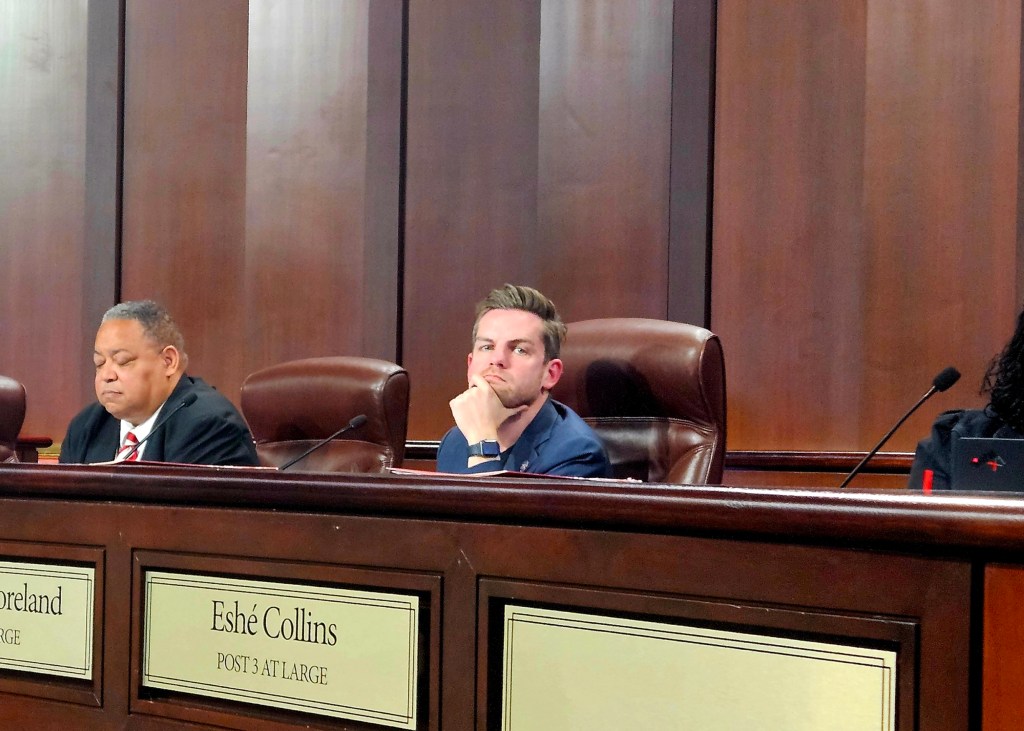
Transparency around how the city spends the trust is critical, said Councilmember Matt Westmoreland, who authored the legislation. “There’s a universal desire to have a better and more publicly digestible explanation for how these dollars are getting used every year,” he told Atlanta Civic Circle.
Read our report on how Westmoreland’s measure could add accountability to a municipal purse that’s drawn scrutiny for its past uses.
📷: Matt Westmoreland during a Dec. 1, 2025 Atlanta City Council meeting. (Credit: Sean Keenan)
How will Atlanta police homelessness during the FIFA World Cup?
Several Atlanta City Council members have raised fears that the upcoming 2026 FIFA World Cup could mean a law enforcement crackdown on homelessness akin to that of the 1996 Summer Olympics, with police displacing or even arresting unsheltered people near downtown matches.
“There’s a concern that we are at risk of criminalizing homelessness in a way that is contrary to the values that we have as a city,” said District 4 Councilmember Jason Dozier during an April 21 council work session on Atlanta’s World Cup preparations.
Advocacy group Play Fair ATL has demanded an outright ban on encampment sweeps and a moratorium on arrests or citations for quality-of-life offenses ahead of the World Cup in June.
Here’s our report on council and community’ concerns.
HEARD ON HOUSING
“I’ll take housing for $400.”
The Fulton County commission chair helps set the agenda on housing, homelessness, and the regional decisions that ripple across metro Atlanta. That makes this race one of the most consequential on your May 19 ballot.
This Wednesday, all three Democratic candidates vying for the chair’s seat will face off at Fulton County Jeopardy, a game-show-style forum co-hosted by Atlanta Civic Circle and Capital B Atlanta. Expect real answers on the issues at the center of Housing Happenings.
🗓️ Wednesday, May 6 | Doors open at 5:30; program at 6:30 pm
📍 489 Stephens St SW, Atlanta, GA 30310
HouseATL hosts housing forum for DeKalb Commissioner candidates
HouseATL on Monday grilled six DeKalb County Commission hopefuls on how they’d confront the housing affordability crisis. One key solution that arose was reducing both urban blight and homelessness by restoring dilapidated properties to provide housing for the county’s most vulnerable populations.
The May 4 discussion with current District 7 DeKalb Commissioner Ladena Bolton and challenger Oneka Willabus, plus District 3 Commissioner Nicole Massiah and challengers Keyanna Jones Moore, Tommy Travis, and Jakequeline Walls.
And stay tuned for Atlanta Civic Circle’s examination of local blight taxes that promise — and sometimes fail — to raise money for affordable housing initiatives.
May 19 primaries: How statewide officeholders influence housing policy and funding
With Georgia’s May 19 primary election fast approaching, voters focused on housing affordability may think the state legislature makes the big decisions.
Check out our two Atlanta Civic Circle explainers to find out how a wide range of statewide offices — from governor to labor commissioner — play a role in how housing gets funded, built, and regulated.
Our first explainer shows how the governor, lieutenant governor, and attorney general impact everything from state agencies’ housing budgets to which housing bills live or die at the Gold Dome.
The other shows how lesser-known posts — like the Georgia Public Service Commission and our labor, insurance, and agriculture commissioners — can quietly influence the cost of living, whether it’s utility rates, wages, or property insurance. These factors determine whether many Georgians can afford to rent or buy homes.
Atlanta is top US city for corporate homeownership
Institutional investors own more rental homes in metro Atlanta than any other major American city — roughly 72,000 — with just three companies controlling almost 20,000 homes across the region.
Consequently, “Atlanta homebuyers are paying more to purchase a home, while renters of institutionally owned homes are vulnerable to price gouging and other abuses,” according to a new study by the American Economic Liberties Project (AELP), reported by WABE.
That didn’t happen by accident. Atlanta attracted Wall Street landlords after the mortgage crisis sparked the Great Recession in 2008, when a wave of residential foreclosures opened the door for institutional investors to snap up cheaply priced homes in bulk and convert them into rentals. From there, they started building investor-owned rental homes — making Atlanta third nationally for build-to-rent homes under construction, according to AELP.
NOMINATED: THE EXTENDED-STAY TRAP
We’re nominated and we’re proud!
Our series The Extended Stay Trap is a finalist for the Atlanta Press Club’s Award of Excellence in Digital Enterprise journalism. We appreciate the families who trusted us with their stories.
Reporter Katie Guenthner spent last summer reporting on the overlapping crises keeping single mothers and their children stuck in motels across Clayton County: poverty wages, a shrinking housing supply, stretched schools, and a legal system that rarely gives tenants a fair shot.
The women at the center of the series were introduced to us by Georgia Appleseed, whose connections to Clayton County residents opened the door to this reporting. Winners will be announced tomorrow. Fingers crossed.
The result is some of the most important housing reporting we’ve ever published. If you haven’t read it yet, now’s a great time. We appreciate the families who trusted us with their stories.
→ Dive into The Extended Stay Trap
SUPPORT HOUSING HAPPENINGS
Today’s newsletter was written by Sean Keenan and edited by Meredith Hobbs. Independent housing reporting takes resources. Help us keep digging.
