

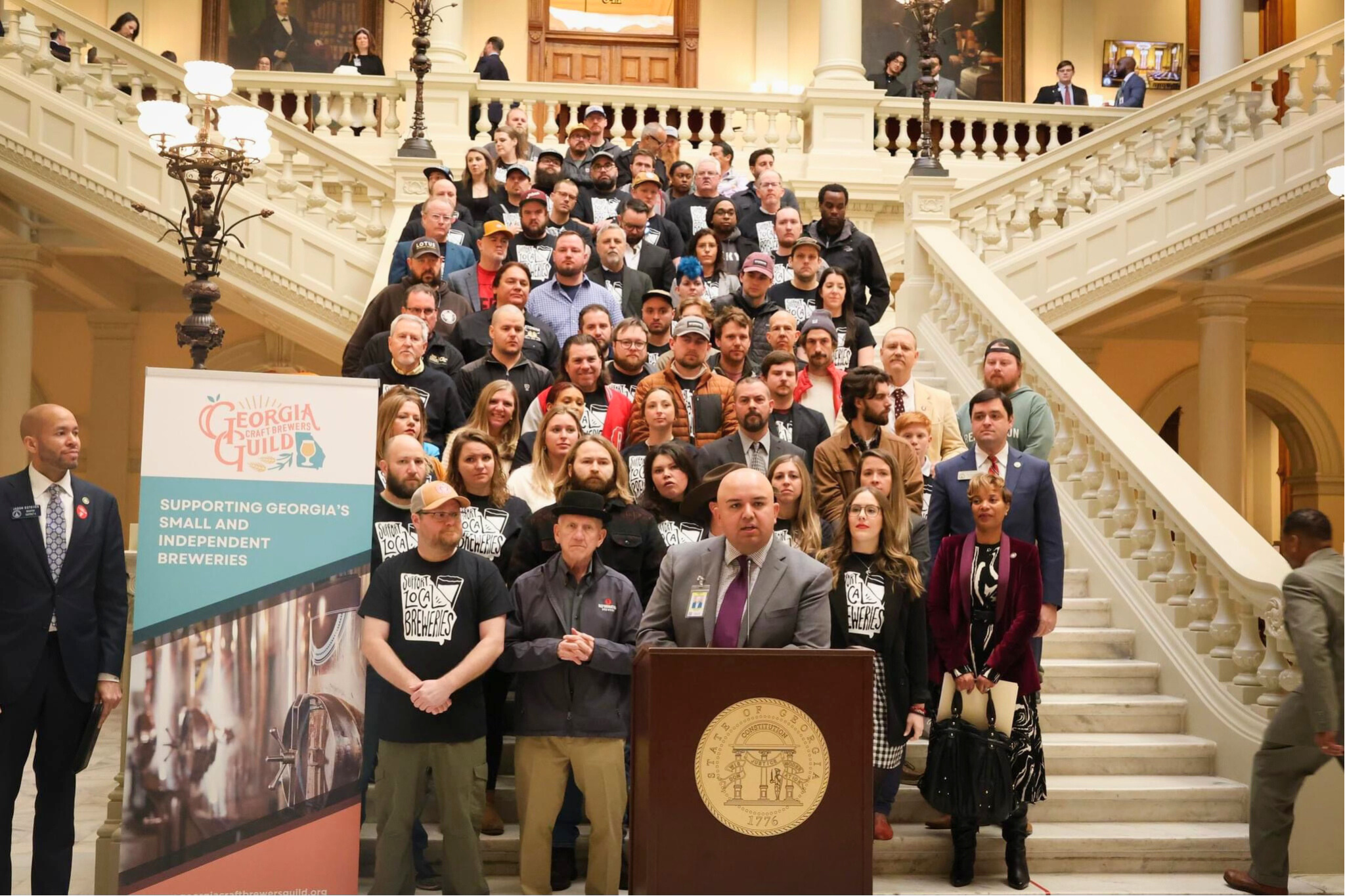
Two weeks ago, Frog Rock Brewery received what co-owner Rob Friess quipped was the “call of a lifetime.”
On the phone was Six Flags Over Georgia, who told the seven-month-old Austell brewery they wanted to distribute its beer at the popular theme park just a 10-minute drive away. There was just one problem: Georgia law prevents craft brewers from directly selling their beers offsite, so Frog Rock needed a third-party beer distributor to sell its beer to Six Flags.
And that distributor, Friess says, isn’t returning Frog Rock’s phone calls. “It’s a weird gatekeeping oligopoly mentality that these old distributors have,” he said. “We just want to be able to take a few kegs over to Six Flags.”
Ironically, that same day that Friess and about 100 brewers from around Georgia had met at the state Capitol in downtown Atlanta to advocate for a law that would have removed the requirement for a middleman between Frog Rock and Six Flags.
But despite solid bipartisan support from several established legislators, Senate Bill 163, nicknamed the F.O.A.M. Act (Fair and Open Access to Market), failed to advance out of the state Senate’s Regulated Industries and Utilities Committee before crossover day on Feb. 29. It’s likely dead for the 2024 legislative session.
“An antiquated system”
For the brewers, it’s been a hard lesson in Georgia politics: Just because a bill has momentum doesn’t mean it will see the light of day. In fact, like the FOAM Act, most bills floated in the state legislature die in committee.
“It’s frustrating,” says Joseph Cortez, executive director of the Georgia Craft Brewers Guild, a non-profit trade association representing Georgia’s 150 or so craft breweries. “We have consistently seen brewery and owner engagement at the Capitol over the past few weeks, had a good response to testimony, and got 8,000 signatures from the public, but Georgia maintains a stranglehold on this antiquated, burdensome system.”
That system has three-tiers: the brewers, the wholesalers and distributors with the warehouses and delivery trucks, and then the retailer, which is the store or restaurant that sells the beer to consumers. For beer, wine, and spirits, Georgia law requires a wholesaler to deliver products to a retailer, even if the final stop is a restaurant across the street.
According to the Georgia Beer Wholesaler Association, who are the middlemen, the legacy system works. They claim that changing the rules “undermines a system that has safeguards to protect our youth, provide more than 5,000 jobs statewide, and ensure a consistent revenue stream to state and local government.”
Many craft brewers, however, say a system designed right after the Prohibition era should adjust for the 2020s, especially since Georgia has changed other alcohol production and distribution laws in recent history.
In 2017, then-Georgia Governor Nathan Deal signed a law that allowed breweries to sell up to 3,000 barrels of beer directly to consumers onsite at a taproom. That law change helped ferment a craft brewery boom in Georgia. There were only 55 breweries in the state in 2017, but at its recent peak, that had expanded to about 170, including dozens in the Atlanta metro area.
Yet, that number has been shrinking over the past year. Several established breweries closed in 2023, including Orpheus Brewing, Second Self Beer Co., Biggerstaff Brewing, and Atlanta Brewing Co., which was the state’s oldest craft brewery. That’s due to several factors, such as the rising cost of labor, increases in ingredient prices, and supply chain issues. Brewers are also finding that people are drinking less alcohol and going out to bars less.
“It’s visceral—like, if you’re an owner of a brewery, like any hospitality business, it’s tough,” said Cortez of the Georgia Craft Brewers Guild.
The FOAM Act would have helped stop the fizzle in demand for craft beer, the brewers say, by opening up new revenue streams. Sam Kazmer co-owns Elsewhere Brewing with his wife Sara, with taprooms in Grant Park and West Midtown. He said the extra bottleneck and expense of having to use Georgia distributors to sell their suds is threatening the viability of smaller breweries like his, which opened in 2020.
“The model we have in Georgia is completely ass-backward. Nobody that works in state government understands anything about this industry, and they’re completely controlled by the distributors,” said Kazmer.

A tear in their beer?
Even though the FOAM Act is likely dead in the Senate, the small brewers aren’t planning on simply drowning in their sorrows. “I think we’ve created a huge groundswell of support that will only continue,” said Friess, who opened Frog Rock last year after a 25-year career as a business consultant.
In the unsuccessful push to pass the FOAM Act, Friess dusted off his political know-how, which included sitting on a small business commission during Gov. Brian Kemp’s first term. He’s asked customers to sign a pro-FOAM Act petition, lobbied legislators, and testified in front of the Senate Regulated Industries and Utilities Committee. “I spent a lot of time down [at the Capitol] and in politics, and I helped [other brewers] understand how this lawmaking process works, know who your representatives are and how to influence them—It’s been fun for me,” said Friess.
Cortez believes craft brewers can exert even more political pressure in the future, saying the Georgia Craft Brewers’ Guild has been working with a couple of contract lobbyists and developed some great advocates in the effort to sell SB 163 to the legislature. “So certainly, we’ll be pressing the case, and we’re not going to scurry away with our tails between our legs.”

Although Atlanta Brewing Company thanks you for mentioning our beer company in your article, I do have a couple points of clarification. First of all, ABC did not shut down our manufacturing facility because of “rising cost of labor, increases in ingredient prices, and supply chain issues”. We had to shutter our operation because after being in the same location for 15 years our lease was expiring, and our landlord was doubling our rent if we decided to stay. Second, other factors outside of our control led to us suspending our production and distribution activities temporarily. Third, despite rumors to the contrary, ABC has not ceased to exist and still intends to resume production and distribution in the near future. We certainly intend to continue to make a big splash in this industry for years to come. Lastly, ABC is among the small minority of craft beverage companies that has always been opposed to F.O.AM. until a more organized and disciplined approach to self-distribution is unveiled.