

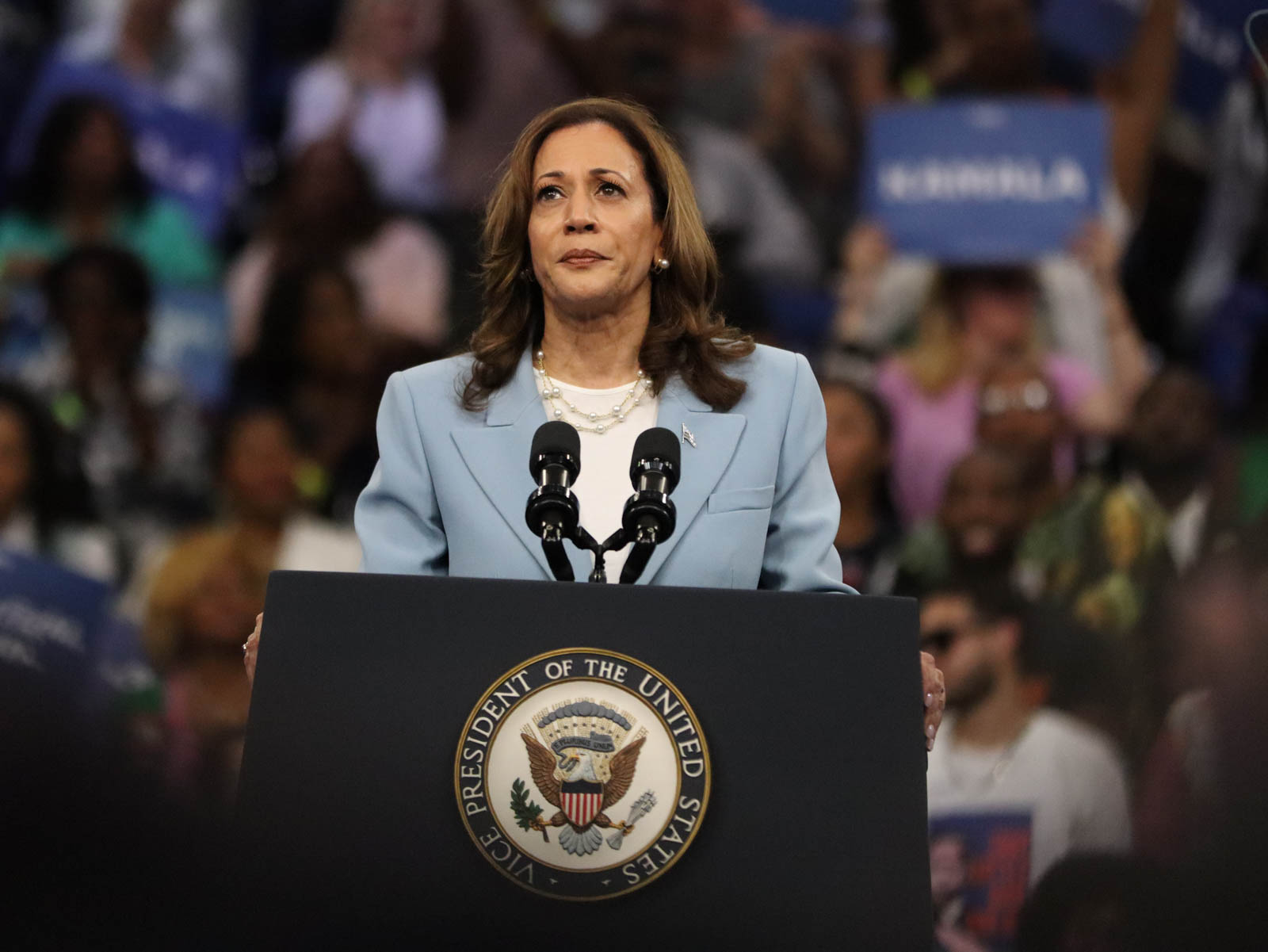


Vice President Kamala Harris has made abortion rights a key focus of her campaign for president — describing the U.S. Supreme Court’s 2022 overturning of Roe v. Wade as a “healthcare crisis.”
But many voters view reinstating abortion rights nationally as an empty promise, pointing out that Congress has not passed legislation to legalize abortion in the over 50 years since the 1973 Roe v. Wade decision. “If [President Joe Biden] actually wanted to make abortion legal again, it would have already happened,” said Khushi Patel, a student at Kennesaw State University, echoing a common perception among her peers.
So, why hasn’t he? To find out, Atlanta Civic Circle spoke with two political science professors, Robert Howard, an expert on federal courts and public policy at Georgia State University and Elizabeth Gordon, an expert on judicial politics, law, and gender issues at Kennesaw State University.
Codifying abortion rights
The most direct way to reinstate abortion rights nationally would be for Congress to pass legislation to legalize abortion. But congressional gridlock makes that unlikely, Gordon and Howard said.
“The president can certainly advocate for a piece of legislation and negotiate with members of Congress,” Gordon said. However, she pointed out that such advocacy would not translate into law without sufficient support in Congress. “The partisan divide is so close that there’s really not enough support to pass any legislation like that.”
It is challenging for Congress to pass new laws, particularly a politically charged one like abortion rights, due to the Republican majority in the U.S. House of Representatives combined with the filibuster in the U.S. Senate, which requires 60 votes, if invoked, to pass legislation. For example, the Women’s Health Protection Act was introduced by House Democrats to codify abortion rights and protect abortion services. It passed the House in 2021, but stalled out in the Senate in 2022.
“Without a filibuster-proof majority, that bill is unlikely to pass,” Howard said.
What’s more, any congressional legislation aiming to codify abortion rights nationally would face significant legal challenges from abortion opponents and would need to withstand scrutiny under the current Supreme Court’s narrow interpretation of constitutional rights for bodily privacy.
Supreme Court regulation
In the absence of a law from Congress, the federal courts have regulated abortion rights nationally.
The foundation of U.S. abortion rights can be traced back to the Supreme Court’s Griswold v. Connecticut decision in 1965, which established the right to privacy in matters of birth control.
This right to privacy was extended to include abortion with the Supreme Court’s 1973 Roe v. Wade decision, which was based on a trimester approach. In the first trimester, it was solely the pregnant person’s decision to terminate a pregnancy. By the third trimester, if the fetus were viable the states could restrict abortion rights but had to allow an exception to protect the health of the mother.
The Supreme Court modified this approach with its 1992 Planned Parenthood v. Casey decision, which introduced an “undue burden” standard. This allowed states to impose certain restrictions on abortion, such as wait periods and parental or spousal consent requirements, as long as they didn’t place an undue burden on the woman’s right to an abortion.
The Supreme Court’s 2021 Dobbs v. Jackson Women’s Health Organization decision was the precursor to overturning Roe v. Wade the following year. The High Court ruled that a person’s right to privacy did not extend to abortion, and returned abortion regulation to state lawmakers.
This decision was driven by a conservative majority on the court, appointed largely by Republican presidents, including former President Donald Trump, who appointed three justices during his term. The Supreme Court’s decisions are independent of the current presidential administration, given the justices’ lifetime appointments.
With Roe v. Wade’s overturn, women seeking an abortion are faced with a patchwork of abortion laws, with some states enacting strict bans and others more broadly protecting access.
What can the president do?
The president can make it easier for people in all states to have access to abortion care, as opposed to fully restoring the abortion rights that Roe v. Wade granted. So far, the Biden administration has taken steps to protect access to medication abortions, where a healthcare provider prescribes mifepristone or misoprostol to end an early-stage pregnancy. Medication abortion was used for 54% of all U.S. abortions in 2020, according to the Guttmacher Institute.
“They’ve done things to make it permissible to use telemedicine to prescribe it, so it’s easier to access for people who cannot travel to a clinic,” Gordon said.
While the president can issue executive orders, such as protecting access to abortion medication through interstate commerce regulations, these orders face legal vulnerabilities and can be challenged in court. “A law passed by Congress has an automatic force of law, whereas the president’s executive order doesn’t carry that assumption,” Howard said.
“There’s no executive order that Biden could issue that would say states have to mandate an abortion which wouldn’t immediately be challenged in every court,” Howard added. “You would immediately get a restraining order from just about every [federal] district court judge stopping that from being enacted.”
Given these challenges, the Biden/Harris administration’s promise to restore abortion access nationally is also about signaling Democratic support for abortion rights and mobilizing voters. Democrats are using this issue to galvanize support in the upcoming elections, emphasizing the need for a Democratic majority in both chambers of Congress to pass such legislation.
The most effective strategy right now for protecting abortion rights is through action at the state level. States like Ohio have initiated ballot initiatives to amend their constitutions to protect abortion rights – and last year Ohio voters approved an amendment ensuring access to abortions.
While Georgia is a purple state as far as its voters, our legislature is dominated by Republicans. In 2019, the legislature enacted one of the most strict six-week abortion bans in the country, which the Georgia Supreme Court upheld in 2023 after Roe v. Wade was overturned.
“If you oppose that, get out and vote — not just in this election in 2024, but in the 2026 elections too, when you’ll have the chance to vote for a new governor,” Howard said.
It’s pregnant WOMAN. We fought for equal rights and made many inroads only to have “political correctness” eliminate us.
you are a loser and I sincerely hope you take your own life
you are a loser and I sincerely hope you take your own life!