
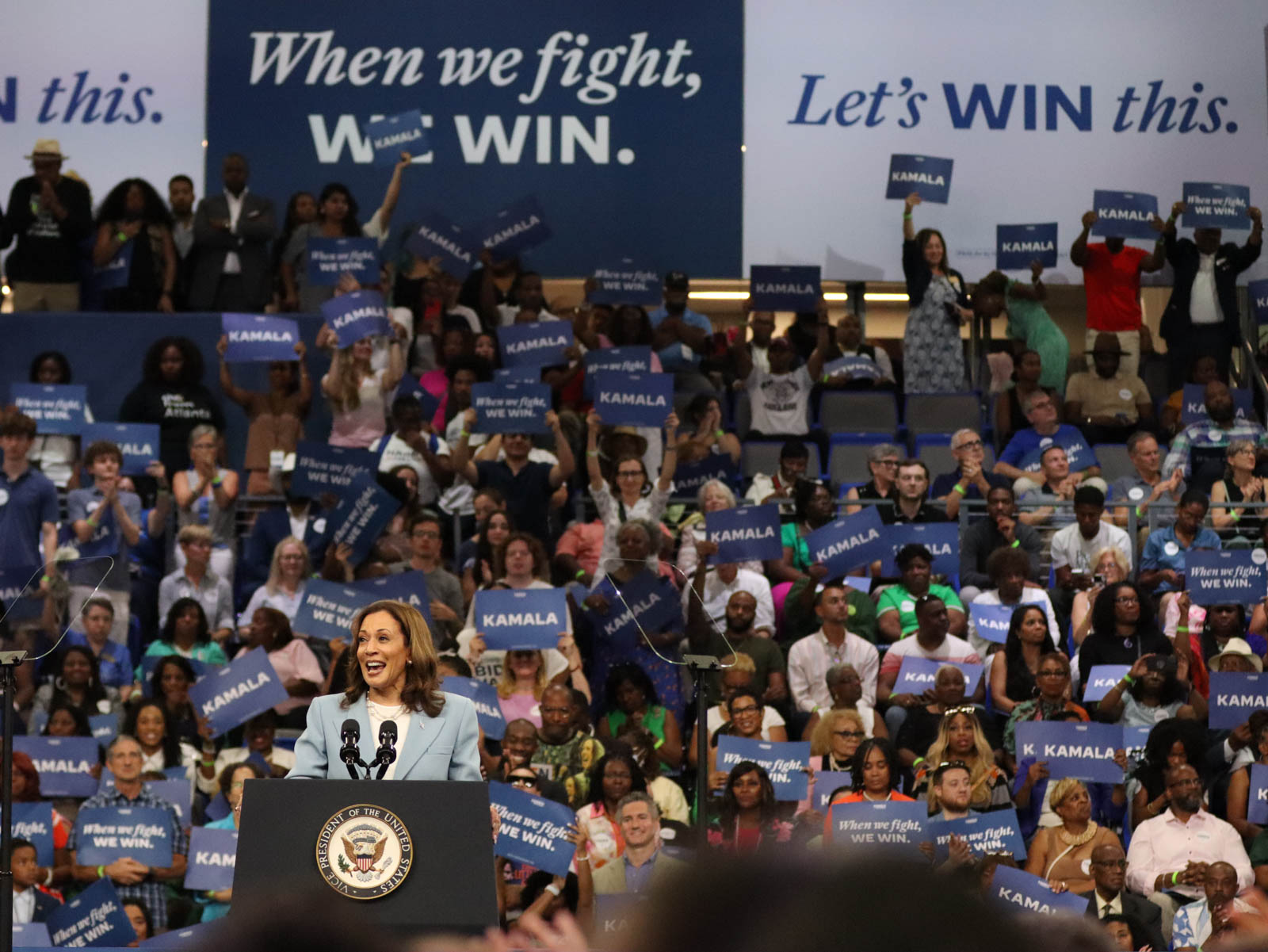

Vice President Kamala Harris’ campaign for president is surging forward as her favorability ratings climb among both Democrats and independents. In the past week, she has received endorsements from many of the largest labor unions in the country, including the AFL-CIO, United Auto Workers, United Steelworkers, and Communication Workers of America.
However, things may not be so clear-cut for Harris for building a strong labor coalition of voters. Traditionally, unions have overwhelmingly backed the Democratic nominee for president, and Harris is widely expected to receive the Democratic Party’s nomination at its convention next month in Chicago.
But some large unions are being judicious about affiliating themselves with either the Democrats or the Republicans this year. For example, International Brotherhood of Teamsters president Sean O’Brien became the first Teamsters’ chief ever to address the Republican National Convention earlier this month.
“Today, the Teamsters are here to say we are not beholden to anyone or any party. We will create an agenda and work with a bipartisan coalition, ready to accomplish something real for the American worker,” said O’Brien in his July 15 speech to kick off the convention. “The American people aren’t stupid. They know the system is broken. … That’s why I’m here today, because I refuse to keep doing the same thing my predecessors did.”
And some union leaders say that they don’t know Harris very well. “I don’t have a relationship with her,” Transport Workers Union president John Samuelsen told ABC News. “I got to know Biden pretty well, and I have faith in Biden that he wouldn’t screw transport sector workers.”
That said, the United Auto Workers (UAW) just endorsed Harris on Wednesday. Revitalized under new leadership from president Sean Fain, the UAW has made headlines over the past year for winning historic contracts from the Big Three automotive manufacturers and pushing non-unionized auto workers in the South to begin organizing.
With things moving so quickly, here’s a quick snapshot of Harris’s record on labor rights as both a senator and vice president for some insight into how she might navigate the issue if elected president.
learn more
What power does the president really have over labor rights?
Here’s a breakdown of how the U.S. president impacts your work life.
White House worker taskforce
One of the clearest examples of Harris’s work on the labor rights front is her stint heading President Joe Biden’s Taskforce on Worker Organizing and Empowerment, which the president created to push his pro-worker agenda.
The task force convened Harris, the Secretary of Labor, other cabinet members, and high-ranking executive branch members with a mandate to work with the U.S. Department of Labor to strengthen worker protections and opportunities.
This work has included reviewing ways to strenghten executive policies on behalf of workers, producing fact sheets to inform workers of their rights, bolstering data and reporting on unions and union activity, and consulting with the National Labor Relations Board and other agencies on implementing laws regarding worker organizing and collective bargaining.
2020 presidential campaign and Senate record
While Harris wasn’t the strongest Democratic candidate on labor rights in the 2020 presidential campaign, where both Bernie Sanders and Biden campaigned harder on worker empowerment, she did have a significant policy agenda on labor.
Harris has not yet released a policy platform on her current campaign website, but she laid out key points of her labor rights agenda on her now-shuttered 2020 campaign site. These include:
- Making sure that everyone can join a union. That included banning “right to work” laws and strengthening union protections for private-sector employees.
- Establishing baseline labor protection requirements for all employers, including overtime protections and raising the federal minimum wage to $15 per hour.
- Creating new worker protections and holding corporations accountable.
- Ensure worker support as the economy changes.
One prominent labor policy proposal from Harris’s 2020 presidential campaign was banning states from implementing “right-to-work” laws. These laws, widespread in Southern state including Georgia, discourage union membership by allowing workers in a unionized shop to avoid joining the union and paying dues, while still benefitting from the union contract that their co-workers have won.
As a senator, Harris co-sponsored the Protecting the Right to Organize (PRO) Act in 2019. The legislation, which has not yet passed, would ban right-to-work laws and penalize corporations for trying to suppress workers’ right to organize. This law would also expand and protect union organizing rights for gig workers.
It must be noted that many Democrats in the House and Senate are co-sponsors of the PRO Act, which by 2021 had gained 213 sponsors.
While in the Senate, Harris also co-sponsored the Public Service Freedom to Negotiate Act, which would mandate that all public-sector employees can join a union and collectively bargain. Those rights are left to the states at the moment. In Georgia, for instance, state employees can unioize, but they do not have collective bargaining rights. So far, that law hasn’t passed either.
In a July 25 speech at the American Federation of Teachers Convention, Harris reiterated her support for labor reforms, specifically the PRO Act. “President Joe Biden and I promised to sign the PRO Act into law, and I promise you I will keep that promise,” she said.
