


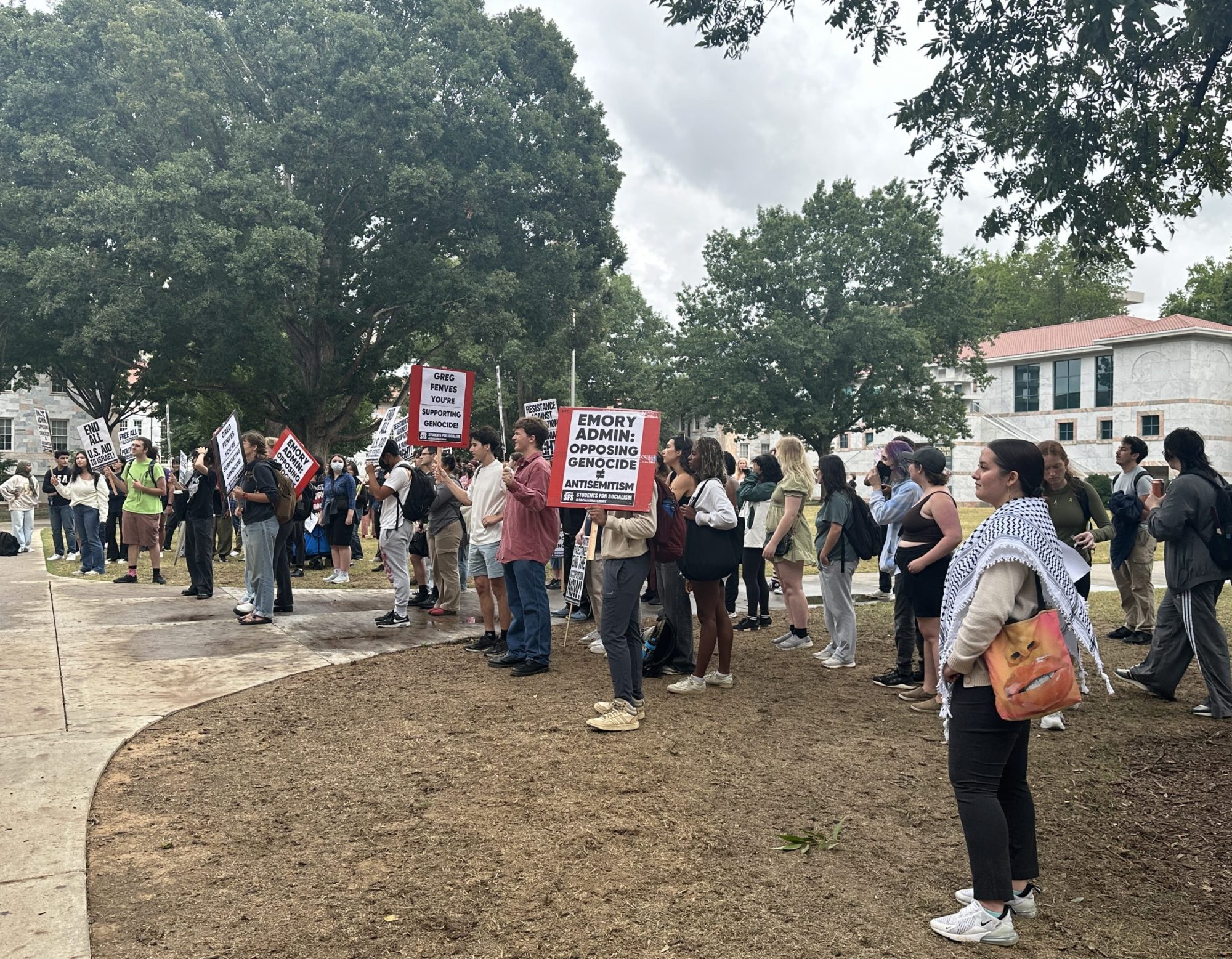

About 150 Emory University students held a pro-Palestine protest Thursday afternoon, the first of the academic year. It was also the first since Emory President Gregory Fenves unilaterally re-wrote the campus’s freedom of expression policy in August to restrict protest activities, with a new ban on encampments.
Fenves attracted harsh criticism last April – including ‘no confidence’ votes by both students and faculty in Emory’s College of Arts and Sciences – after he called in police to dismantle a newly erected tent encampment on the main quad, resulting in 28 arrests. The ‘no confidence’ votes were a damning rebuke of the university president’s leadership but ultimately have no binding consequences, since it’s up to Emory’s board of trustees whether to fire Fenves.
Thursday’s two-hour demonstration, which was attended by some faculty and also drew a couple dozen pro-Israel student counter-protestors, played out peacefully on the same quad — but students and faculty were unsubdued about their disdain for Fenves’ rule-changes.

“The only real rule is that those with real power do whatever they want, whenever they want it!” Zach Hammond, president of the Emory Students for Socialism chapter, shouted through a megaphone to a crowd that chanted back “Shame!”
Addressing fellow protestors in front of the president’s office, Hammond called the university administration “repressive” and decried the implementation of the new rules without faculty consultation or consent.
“They’ve [already] been enforcing these policies before they’re announced,” Hammond told a reporter. He said that when Emory called Georgia State Patrol and the Atlanta Police Department to violently crack down on the student encampment on April 25, there was no ban on encampments in university policy.
One professor on the quad, Pamela Scully, said the rules “are fundamentally undemocratic, and hostile to the very nature of education.” She expects faculty to hold their own demonstration against them in the coming week.
Fenves announced the changes to the open expression policy in late August. In addition to the ban on setting up encampments or other structures and overnight camping, the changes include a ban on demonstrations from midnight to 7 a.m. and a ban on occupying campus buildings.
“I’m upset [the rules] got forced down our throats. It could have been discussed this summer,” said another faculty member at the Sept. 12 protest, who declined to be named for fear of doxxing.
“Emory could have led — and done as the president of Wesleyan University has done, seeing the conflict of ideas as the very stuff of education,” added Scully, a Women’s, Gender and Sexuality Studies professor.
Wesleyan President Michael Roth penned a Sept. 2 New York Times op-ed encouraging more political expression from students, despite the disruptions. “I disagreed with the protesters’ tactics and some of their aims — and I was often the target of their anger — but I respected their strong desire to bear witness to the tragedy unfolding in Gaza,” Roth wrote.
Wesleyan allowed a roughly 100-tent encampment to remain on campus last spring, because the protests were peaceful and did not disrupt university operations. “Their right to nonviolent protest was more important than their modest violations of the rules,” Roth wrote.
Emory, meanwhile, “followed the authoritarian playbook and many faculty are upset,” Scully said.

Protest policy changes
Fenves billed the changes as “recommendations to improve how we keep our community safe,” in an Aug. 27 university statement.
In response to questions about the changes, an Emory spokesperson referred Atlanta Civic Circle to a statement: “The addendum to the Respect for Open Expression policy codifies what has been a longstanding practice at Emory, across multiple administrations, to place reasonable restrictions on time, place, and manner. Such rules enable us to keep our community safe while improving the ability of every member of our community to focus on our academic mission.”
Emory’s move to tighten its protest rules is part of a national trend of colleges restricting how students can protest and express dissent on campus in reaction to a tumultuous spring term when students launched a wave of protests over U.S. support for Israel’s war in Gaza and demanded that universities divest their endowments from investments in Israel.
In the Atlanta area, Kennesaw State University has also banned encampments, according to its freedom of expression policy, last revised in August. Spokespersons for KSU did not respond to questions from Atlanta Civic Circle about what specific changes occurred in that revision.
Police arrested at least 3,200 people at anti-war protests nationwide last spring, which included students erecting encampments and occupying university buildings. The 28 people arrested at the Emory encampment in April were mostly students and several faculty trying to protect them from police.
Those students and faculty are still awaiting trial dates. During a faculty webinar in May, Fenves said that Emory would not drop any of the misdemeanor charges. The students were mostly charged with trespassing, along with disorderly conduct or simple battery charges for some faculty members.
Earlier this week, over 130 Emory faculty and staff signed an open letter to Fenves in the Emory Wheel student newspaper, asking him to drop the charges. So far, that plea has been met with silence.