

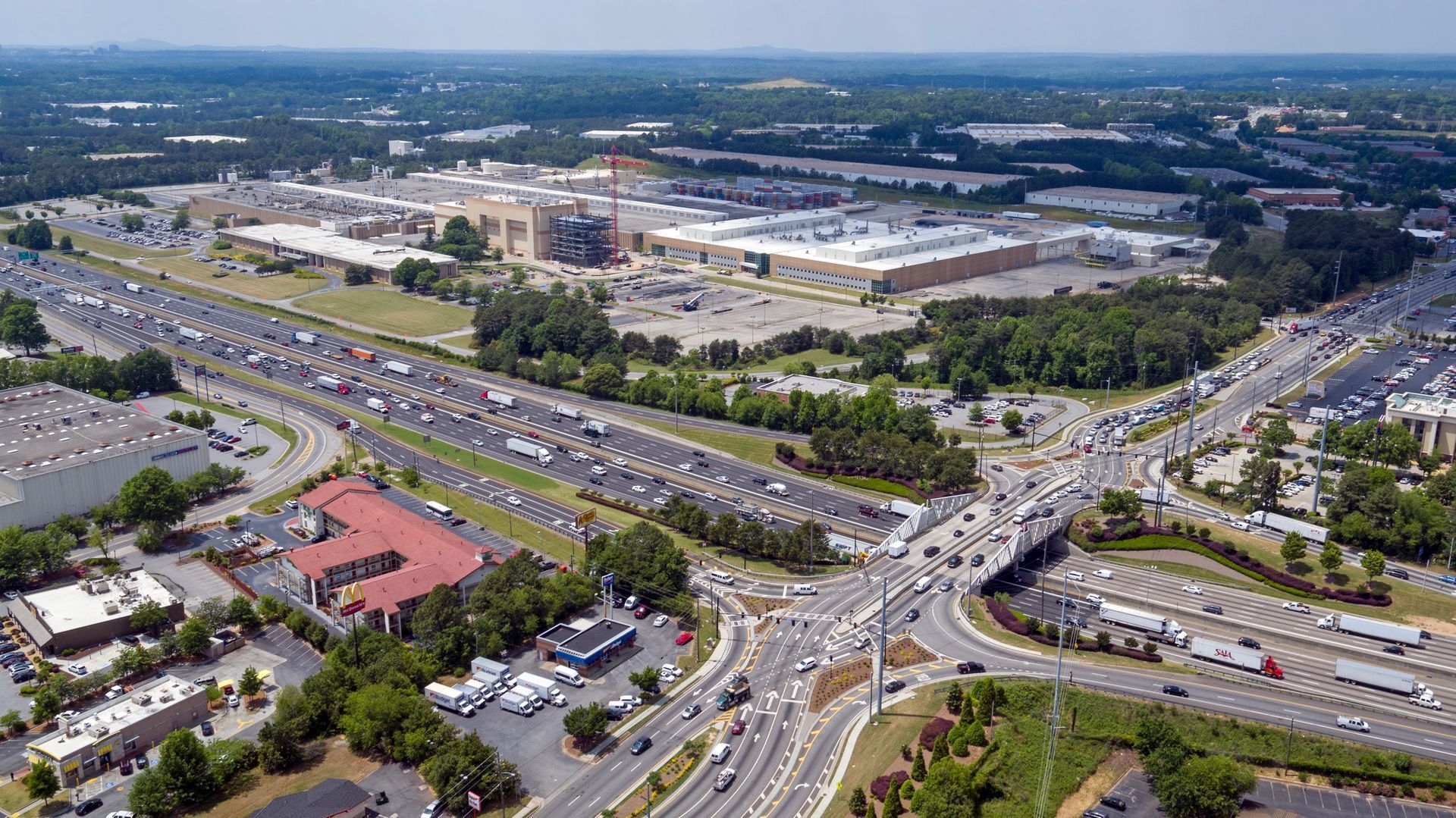


In the years before the Atlanta Braves packed up and moved to Cobb County, a mammoth mixed-use development like The Battery would have struck many Cobb residents as distastefully out of scale for their historically suburban and rural community.
Mid-rise apartment blocks stacked atop restaurants and shops, some affordable housing units scattered here and there, and an audacious skyscraper jutting up from the wooded Cumberland area — in other words, real development density? Forget it.
But times are changing. The dazzling, quasi-urban complex surrounding the Braves’ relocated ballpark is a harbinger of the growing pains that have forced Atlanta’s booming northern suburbs to take a hard look at how they envision their built environments — and how to accommodate a burgeoning new population without leaving longtime residents feeling (too) disaffected.

“In Cobb County, there’s a desire to maintain that suburban atmosphere, which for many is made possible due to lower density,” said Lisa Cupid, the chair of the county’s board of commissioners.
Sure, the new construction spawned by the Truist Park development — and the presence of the ball club itself — has attracted newcomers to Cobb, but people were coming already. And local officials have long agonized over how to get a handle on the influx, Cupid said.
As in Atlanta, it’s almost impossible for a government to keep everyone happy while it plans for future growth. In Cobb, many residents, especially longtime homeowners, resist what they consider drastic changes.
“Cobb is a diverse county with some areas that are suburban and some that lean more towards the urban field, if you go into the Cumberland area and the Six Flags area of South Cobb,” Cupid said. “And then we also have West Cobb and areas that look more rural in character. Some of the density that would be considered acceptable in northern Cobb may not be in those areas.”
Along with development comes higher rents and home prices. In her 12 years on Cobb’s board of commissioners, Cupid said, “I can’t say there’s been an evolution or warming up to density, as much as I think there’s a warming up to the understanding of the need for affordable housing.”
It’s a start, she added. But efforts to create housing for low- and moderate-income households are often stifled by NIMBYism (a “not in my backyard” mindset).
That’s a familiar problem in Gwinnett County, said Nicole Hendrickson, who chairs the county’s board of commissioners. Now a northeastern Atlanta suburb, Gwinnett’s exponential growth over the last decades has been driven in part by people seeking cheaper housing away from the big city.
“It’s still not becoming growth-friendly, because we are still very much a suburb, and a lot of people move to the counties in the suburbs to get away from the density and what they came from in that urban life,” Hendrickson said. “But the growth is already here, and we are not creating the challenges. We’re responding to it.”
High housing costs
In Lawrenceville, Gwinnett’s largest city, the average rent price for a one-bedroom apartment is $1,427 per month, according to Apartments.com. In Cobb’s largest city, Marietta, it’s $1,312. Price points in both suburban counties are edging toward Atlanta rent prices, which average just under $1,600 monthly.

Hendrickson blames high rent prices on a housing shortage, which she said stems from generations of restrictive zoning regulations that allowed only “three types of housing: single-family, multi-family, and townhomes.”
“We never had the ability to permit ‘missing middle’ housing,” she added, referring to accessory dwelling units (ADUs), duplexes, triplexes, and small- and mid-sized apartment complexes.
Gwinnett’s board of commissioners recently approved zoning code amendments to permit more diverse housing types in some areas. That drew such ire from so many residents that they tried to form their own city — with their own zoning code — and succeeded.
Enough northern Gwinnett residents voted in May to create the city of Mulberry, which will be the county’s second-largest city with about 41,000 residents. The aim, Hendrickson said ruefully, was “so that these residents can insulate themselves from the county with ‘out-of-control zoning.’”
Single-family detached houses make up almost 95% of Mulberry’s housing, The Atlanta Journal-Constitution reported — and the county will have little say in the city’s future development.
In Cobb, Cupid said, residents are also conflicted about housing density and affordability. There’s “so much dissension about housing and affordable housing and more dense housing,” she said, that it’s challenging to confront the mounting housing crisis.
Cupid intends to propose changes to the county’s zoning code to allow more density. The zoning regulations only cover unincorporated parcels not overseen by city governments — but even that will be an uphill battle, she said.
Zoning tensions
The tensions over growth and higher housing prices in the northern suburbs mirror what’s happening in Atlanta, which is currently updating its 40-year-old zoning code to mitigate the strains posed by rapid population growth. Currently, most of Atlanta’s residential land is zoned exclusively for single-family development.
Atlanta City Planning Commissioner Jahnee Prince has told Atlanta Civic Circle the city will likely take a piecemeal approach — neighborhood by neighborhood — to the zoning overhaul, because different communities want such different things when it comes to development.
That might be how things pan out northwest of Atlanta as well, as Cobb’s county commissioners try to gain buy-in for big land-use changes that promote greater density: “I think there’s a realization that Cobb is not homogenous, and some things might be more conducive in one part of the county than others,” Cupid said.
But NIMBYism will still create roadblocks — as will politics.
“There is an inherent fear for any elected official to push beyond the will of the active, vocal minority of the population,” Cupid said. “But at the end of the day, we all have to do what is right.”
Matt Elder, the director of Gwinnett’s newly created Housing and Community Development Division, told Atlanta Civic Circle that sometimes you just have to make unpopular decisions and show people the results.
“The best tool we have in terms of trying to combat NIMBYism or public support against [density] is just to put the proof in the pudding and show that it can happen,” he said.
“We have a great example right here in Gwinnett County, out in the city of Duluth,” he added. “There’s a transitional housing shelter right next to a multi-hundred-million-dollar redevelopment called ‘The District,’ which is luxury apartments.”
The stark class disparity there hasn’t presented any problems for residents, Elder emphasized, adding, “Affordable housing and housing solutions for the most vulnerable populations can exist and flourish next to luxury style apartments.”
It would be great to have leaders that actually are responsive to what the people want. It obvious by these comments that Cobb and Gwinnett do not have such leaders. Gwinnett grew from 595,000 people in 2000 to 975,000 today, but somehow it has not growth friendly? Actually the reverse is true, too growth friendly to high density housing and that is not what the people want. The new city of Mulberry is the perfect example and reaction to this. We left Gwinnett County in 2022 for exactly people like Matt Elder who is not even an elected official but feels it is his responsibility to go against the will of the people. The best days of Cobb and Gwinnett have passed. As new people come in, established residents are leaving.
I did not move to Gwinnett for quiet country living. I relocated for affordable living and warmer weather. Everything grows. For those who want rural, Georgia has something for everyone. What I would love to see is better public transportation and more services for our growing senior population.
Cobb county has too many apartments going up! Which is bringing too much traffic to north Cobb parkway! It used to be a very quiet area with some small farms. I don’t mind single family homes, but all these apartments are excessive!
The growth is happening regardless. People can either give more freedoms to the market to meet the demands of the growth (ie les restrictions on property type) and the market will respond where demand is highest, or these areas can continue to be more restrictive, and then we’ll continue to see higher costs and all of the problems that go with that.
As a new resident to Atlanta (South Fulton), I appreciate the info in this article and learning more about the region’s geographical and socio-political history. Well written and very informative!
As for my opinion, these cities need to take a look at other booming metro areas and take note on what’s been successful and what has not. The data is already out there; no need grasping at straws and hoping the outcome is successful or well-received, and only then using the outcome as “proof” of one thing or the other. This has also given me pause about whether I want to move further north to these areas in the future, depending on how they respond to the housing needs.