


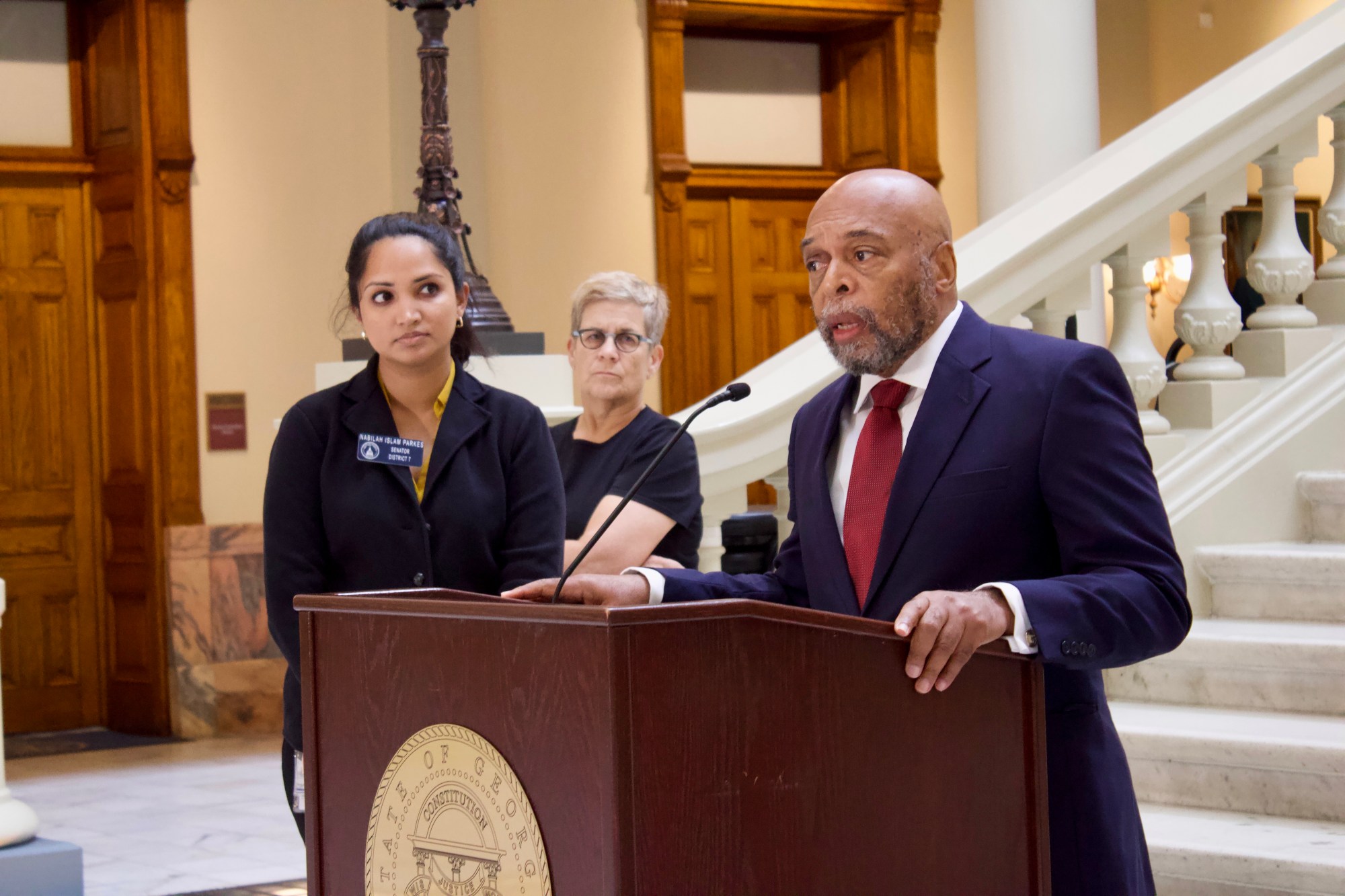
Georgia State Sen. Nabilah Islam Parkes (D-Lawrenceville) on Wednesday announced she was taking legal action against Gov. Brian Kemp aimed at forcing him to investigate three Republican members of the State Election Board —- Janice Johnston, Janelle King, and Rick Jeffares —- for alleged violations of state law and the state ethics code.
Parkes warned that the three were “playing their loyal part in a larger national scheme to allow Trump-aligned officials to obstruct elections and sow chaos,” at a press conference at the Georgia State Capitol.
“The extremist MAGA majority on the board has held illegal private meetings and enacted new rules requested by the Georgia Republican Party, which give the green light to GOP election interference,” Parkes said.
Two other Democrats joined the petition for mandamus: former Fulton County Elections Board chair Cathy Woolard and Randal Mangham, a Stone Mountain lawyer who is running for state senate.
But the State Election Board’s controversial rule-making isn’t what their legal action is about. All three petitioners individually filed ethics complaints with Kemp last month against Johnston, King, and Jeffares, arguing that state law demanded his intervention. But Kemp has taken no action, Parkes, Woolard, and Mangham say in the mandamus petition, which they filed Sept. 24 in Fulton County Superior Court.
The ethics complaints filed in August allege that the three MAGA-aligned State Elections Board members held rule-making meetings that violated Georgia open meetings laws. The complaints also call into question Jeffares’ impartiality as an election rule-maker, alleging that he’d angled for an Environmental Protection Agency job in a second Trump administration that could benefit his business interests
“Jeffares is using a government position for personal gain,” Mangham said at the Capitol, calling it a “flagrant ethical issue that warrants investigation.”
At the press conference, Parkes accused Kemp of neglecting his duty to investigate the three State Elections Board members’ actions and remove them if warranted.
That prompted the new legal action. It does not prevent the State Election Board’s last-minute new rules from going into effect, the petitioners’ lawyer, Wayne Kendall, emphasized.
Rather, the mandamus petition “is strictly and solely about removing the individuals … from continuing in their roles as members of the State Election Board,” Kendall said. He added that the case likely won’t be decided before the Nov. 5 election.
Ethics complaints ignored
Kemp declined to act on the ethics complaints after asking Georgia’s attorney general, Chris Carr, whether he was compelled to do so. Carr said in a Sept. 6 legal opinion that state law did not require the governor to act.
But Kendall argues that Carr’s interpretation of the law is incorrect. “We think that the law is absolutely clear, crystal clear, that he [Kemp] has a mandatory legal duty,” the petitioners’ lawyer said.
The petition filed Tuesday asks a judge to compel Kemp to investigate the three State Elections Board members through a writ of mandamus — a legal order that can be issued to enforce a law when there is no other recourse.

“We can disagree on policy issues among Democrats and Republicans, but where we do agree is that we have to … follow the rule of law as we conduct our elections and as we conduct legislation,” Woolard said at the press conference.
State Election Board under fire
The State Election Board has drawn criticism from Secretary of State Brad Raffensperger, Carr, local election officials and a number of Georgia Democrats and Republicans alike, due to the actions of its MAGA majority.
The trio, whom former President Donald Trump praised as “pitbulls” fighting for “victory” at an August rally in Atlanta, constitute a voting majority on the five-member board. They have passed a number of controversial last-minute rule changes for how county elections offices must conduct the Nov. 5 General Election, which critics say will cause chaos – compromising both election security and public confidence.
Most recently, the State Election Board passed a rule at its Sept. 20 meeting that requires poll workers to hand-count ballots at each precinct after the polls close on Nov. 5. The trio voting in favor said that will ensure the number of ballots cast matches the digital machine count — but county election officials testified against the hand counts, saying human error could easily result in discrepancies, according to NPR.
The trio also passed a rule that requires Georgia’s 159 county elections offices to publicly release ballot scans within 72 hours of Election Day.
Carr, the state’s attorney general, warned in a memo released before the Sept. 20 meeting that these rules exceed the board’s authority, run afoul of Georgia law, and would likely draw successful legal challenges.
Two rules that the State Election Board passed in August that expand county election boards’ powers to investigate vote tallies before certifying results have already been challenged in two separate lawsuits – one filed by the Democratic National Committee, the Georgia Democratic Party and local election officials and another by a conservative group. A judge has set an Oct. 1 hearing for the Democrats’ lawsuit.
These eleventh-hour rule changes aren’t just happening in Georgia: They’re a trend across several other battleground states that critics warn are meant to cause chaos and lay the groundwork for spurious challenges to election results.


As a professional lawyer interested in the content of this article, it is concerning to see allegations of unethical behavior and potential violations of state law by members of the State Election Board. The accusations of holding illegal private meetings and favoring a particular political agenda raise serious questions about the integrity of the electoral process in Georgia.
Given the seriousness of these allegations, it is crucial to ensure a thorough investigation is conducted. My question is, how can we guarantee that the investigation into the actions of Janice Johnston, Janelle King, and Rick Jeffares is fair, impartial, and conducted within the legal framework of the state of Georgia? It is essential that any legal action taken in this case upholds the rule of law and preserves the public’s trust in the electoral process.