

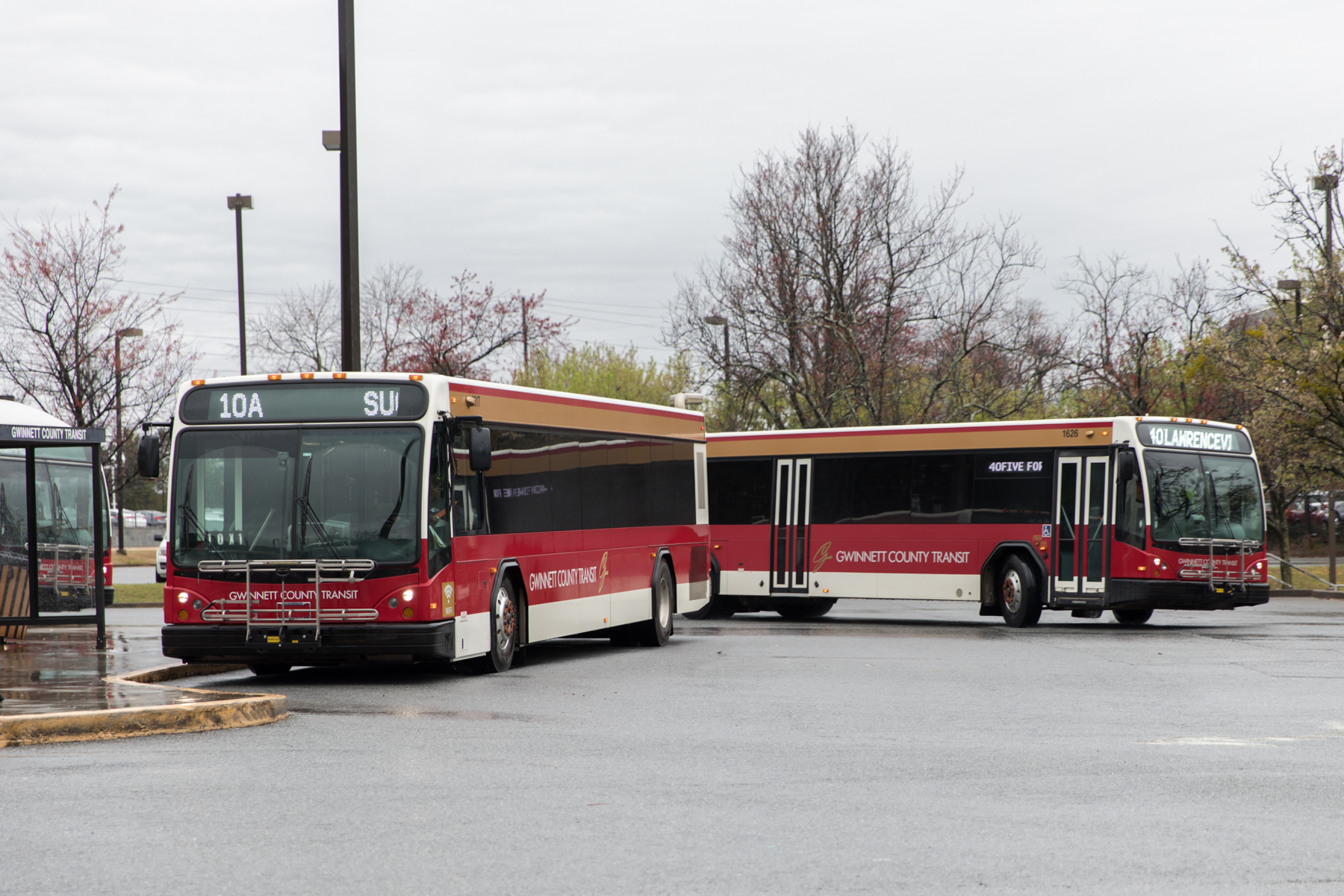


When they go to vote, Gwinnett County residents will once again face a familiar question: Should they tax themselves to expand public transit?
It’s the fifth time since the early 1970s that they’ve been asked to weigh in on a 1% sales tax to expand the suburban county’s mass transit system, but this time as the county’s population tops one million.
The Transit Special Purpose Local Option Sales Tax (TSPLOST) would generate $12.4 billion over the 30 years of the penny sales tax, with an additional $4.6 billion coming from federal grants and fare revenue. The funds would pay for 75 transit projects, like an additional 115 miles of quick-ride BUS service, 26 miles of bus-rapid transit (BRT), and countywide shuttle services (called microtransit).
A similar transit proposal failed in 2020 by a razor-thin vote margin of just 0.28%. But the new proposal leaves out any mention of heavy rail or connections to Fulton and DeKalb County’s MARTA rail system — something that had stirred controversy in previous proposals — and instead places more focus on BRT and local on-demand shuttle services.
If approved, the TSPLOST would increase Gwinnett’s sales tax from 6% to 7%. The current sales tax includes a 4% Georgia tax and another 2% from existing Gwinnett SPLOSTs — an E-SPLOST to fund public school projects and a SPLOST for county and city facilities, parks, road improvements, and libraries.

Cameron Ilich, a six-year Gwinnett resident, said he voted in favor of the 2020 TSPLOST referendum because it included a heavy rail spur that would connect to MARTA, but he opposes the current proposal due to its expected cost.
“I’m generally in favor of expanding public transit, but I think $12 billion is a little bit excessive in terms of the budget necessary for a few more buses and a few more routes,” he said, adding that expanding MARTA services would benefit the county more. (The current TSPLOST proposal does connect Ride Gwinnett bus routes to the Doraville and Indian Creek MARTA stations in DeKalb.)
But, the county has rejected a MARTA expansion four times since the 1970s. Even in 2019 and 2020, when traffic congestion was mounting in the sprawling suburban county, voters turned down similar TSPLOSTs.
Opponents often point to concerns about unnecessary government spending, fear of increased crime, and a preference for car travel in suburban areas. Their critics counter that these objections arise from the greater Atlanta area’s long history of racial bias, with concerns among some white populations that date back over 50 years about MARTA bringing more people of color into predominantly white neighborhoods.
These days, however, only 35% of Gwinnett’s population is white, while the bulk of the fast-growing county’s population is made up of Black, Latino, and Asian-American residents, according to US Census data.
SEE WHAT ELSE IS ON THE GWINNETT BALLOT

Another concern for some Gwinnett TSPLOST opponents is the 30-year funding commitment. That is a big departure from the more familiar four-to-six-year SPLOST cycles that have consistently raised sales tax money and received more voter approval than for any other part of Georgia, according to Nick Masino, the president and CEO of the Gwinnett Chamber of Commerce, which backs the current TSPLOST.
Masino explained that these shorter tax cycles give residents a sense of control, allowing for quicker changes if they perceive a SPLOST isn’t delivering on expectations. He emphasized that Gwinnett’s proven success in managing SPLOST funds should build trust in the TSPLOST’s lengthy duration.
“We have the best history in the state of Georgia, bar none, in how we’ve executed our infrastructure projects. This is different, but I hope the trust we’ve built over years of successfully managing four-to-six-year SPLOST cycles will help us get over the hurdle and secure this crucial 30-year investment,” the Gwinnett Chamber president said.
Gwinnett needs a 30-year transit plan to fund sufficient bus and shuttle infrastructure to keep pace with the population, Masino added. It would be a game-changer for the county’s public transit system, he said, and the largest public transit investment in the nation this year.
“In general, human beings don’t like change. That’s a concern some people have shared — it’s different, and it’s long,” he said.
But the long-term penny sales tax increase is necessary to unlock federal funding for large-scale transit projects, Masino explained. “When you get federal transit funding, you have to have a commitment for funds. By approving the 30-year plan, we’re in line to receive a windfall of federal dollars, something you just can’t do in chunks like traditional [SPLOST] transportation funding.”
Masino also addressed attempts to politicize the TSPLOST, particularly given the shift from a Republican to a Democratic majority on the county commission board, which approved the transit referendum by a 4 to 1 vote in June. “Some people try to spin this as a political thing… But this same funding strategy — almost exactly the same — was proposed by a majority Republican commission in 2019 and 2020. The real issue here is that people don’t like change, but this [duration] is necessary to secure federal support.”
The Atlanta Regional Commission estimates that Gwinnett’s population grew by 14,900 people in the last year alone, the second-highest increase in the metro area. The hope among TSPLOST proponents is that with more residents relying on public transportation and a new plan that doesn’t include MARTA expansion, Gwinnett voters may finally be ready to embrace change.
HOW THE TSPLOST WILL APPEAR ON YOUR GWINNETT BALLOT:
“Shall a special one percent (1%) sales and use tax be imposed in the special district consisting of Gwinnett County for a period of time not to exceed thirty (30) years and for the raising of funds for transit projects?”
So what’s in the Gwinnett TSPLOST?
Within the first 10 years of the TSPLOST, Gwinnett could have countywide microtransit (shared shuttle) coverage, 346 miles of expanded “county ride” bus service, 115 miles of “quick-ride” (faster, higher frequency) bus service, 26 miles of bus rapid transit, and 20 transfer centers. Speedy buses could take passengers from Lawrenceville all the way to Doraville’s MARTA station in DeKalb, or from the Mall of Georgia to Hartsfield-Jackson Atlanta International Airport south of Atlanta. Airport shuttles are also part of the plan.
Rideshare
Rideshare, or microtransit, is an on-demand shared shuttle service that allows riders to request and pay for their ride using a mobile app, similar to Uber or Lyft. Residents can call for a ride to go anywhere within their designated zone via mini-buses or vans that provide fixed-cost, door-to-door service.
Gwinnett’s current limited microtransit service, which Ride Gwinnett debuted for Lawrenceville and Snellville last year, costs $3 per ride. Our Atlanta Civic Circle reporter found it to be a smooth ride, but with a wait time more than the advertised 20 minutes.
Rideshare would serve over half of Gwinnett by 2027 and 100% of the county by 2033, according to the Gwinnett TSPLOST prospectus.
- Operates 18 hours a day, seven days a week
- Average wait time of 20 minutes
- 27 rideshare zones operating in the next 10 years
County ride
This would expand the county’s fixed-route bus service with consistently spaced bus stops and predictable schedules. A total of 18 county ride routes would be fully implemented by 2043, connecting Stone Mountain and Loganville, then Suwanee and Gwinnett Transit Center, along with Lawrenceville and the Mall of Georgia. The final county ride routes would extend to Dacula and add service on Peachtree Industrial Boulevard.
- Operates 12 to 18 hours a day, seven days a week
- Buses every 15 to 30 minutes
- Riders could transfer between County Ride routes or connect to other transit like Quick Ride, Rapid Ride, Airport Ride, and Shared Ride
Quick Ride (BRT lite)
Quick Ride or “bus rapid transit lite” is a high-frequency bus service with speedier service than regular bus routes due to transit improvements like signal priority and queue jumps. Eight routes covering 115 miles would gradually roll out between 2027 and 2036, for more frequent connections between places like Peachtree Corners, Gwinnett Place Mall, Snellville, Sugar Hill, Lawrenceville, and the Indian Creek and Doraville MARTA stations in DeKalb.
- Operates 12 to 18 hours a day, seven days a week
- Buses every 15 to 20 minutes
Rapid Ride (BRT)
Rapid Ride would be the fastest bus service, thanks to dedicated bus-only lanes, limited stops, and advance fare payment.
- Operates 18 hours a day, seven days a week
- Buses every 10 to 15 minutes