


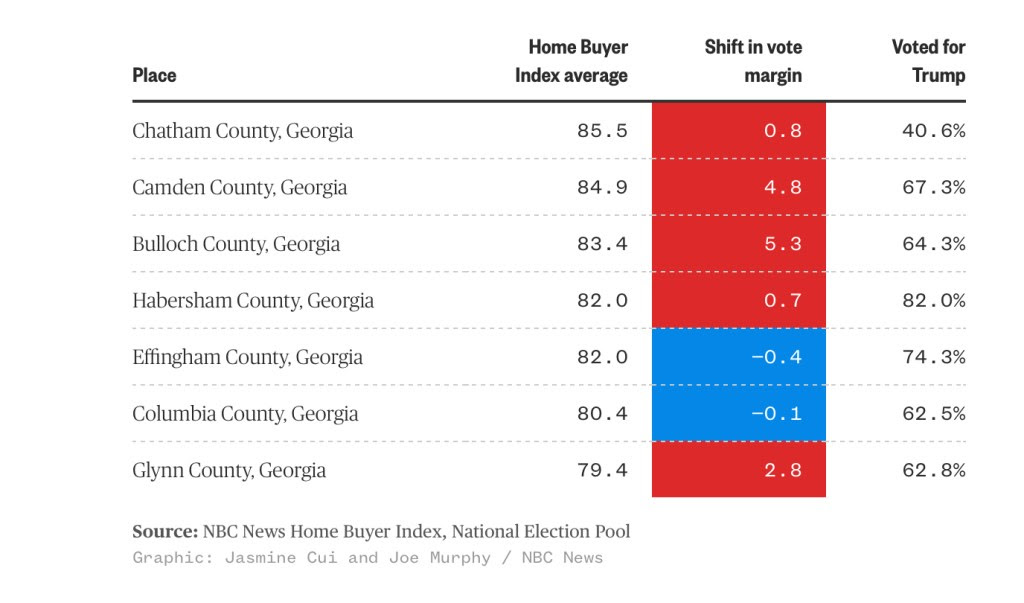
Nationwide, the counties where it’s most difficult to buy a home saw the biggest voter shifts toward President-elect Donald Trump in the election, according to an NBC News analysis of housing and voting data. That widespread rightward shift underscored the severity of America’s affordable housing shortage — and helped Trump reclaim the presidency.
But Trump’s imminent return to the White House poses “serious challenges” for people seeking affordable housing, warned the National Low Income Housing Coalition (NLIHC) in a Nov. 6 statement.
NLIHC head Diane Yentel vowed to “mobilize our members and partners across the nation and work closely with our congressional champions to oppose any cruel or harmful measure offered by President-elect Trump and his administration that would undermine housing justice, exacerbate racial and social inequities, and worsen America’s housing and homelessness crisis.”
During Trump’s previous term, his administration tried to slash federal investments in affordable housing, sought to raise rents for Section 8 tenants, and attempted to impose more stringent work requirements for renters who rely on government subsidies.
Most of those efforts failed, thanks in part to NLIHC lobbying. The organization acknowledged that the Trump administration approved billions in housing funding during the COVID-19 pandemic, including $25 billion for emergency rental assistance, and a temporary nationwide eviction moratorium.
While not all U.S. House races have been tallied, it appears that Republicans will likely control all three branches of the federal government after Trump’s inauguration. Housing advocates worry his administration could dismantle or weaken many of the public housing programs that so many lower-income Americans rely on.
“The high cost of housing was a top election issue for voters in 2024, and voters have made clear that they want policymakers at all levels of government to advance solutions,” Yentel said. “NLIHC urges President-elect Trump to work with policymakers on both sides of the aisle to enact meaningful affordable housing solutions and to leave behind the divisive, hateful, and harmful rhetoric too often used during his campaign.”
Trump’s housing policies, at a glance
New home construction: Trump has pledged to lower housing costs by relaxing environmental restrictions and homebuilding permit rules to increase supply. He’s also committed to restricting low-income housing development in suburban communities, Fortune reported.
Trump has also claimed that illegal immigration is largely to blame for high housing costs. He’s promised to deport undocumented people en masse, alleging that this would free up supply. Doing so, however, could hurt homebuilders’ ability to find construction workers, effectively driving up construction labor costs, experts have cautioned.
Homelessness: Trump established himself on the campaign trail as the “treatment-first” candidate for providing federal services to unhoused people. This is the belief that unhoused people should only have access to government services and financial assistance if they can prove their sobriety and show that they’re working, or at least trying to find gainful employment.
This ideology is antithetical to the more widely embraced “housing-first” philosophy, which maintains that people with substance-use and mental-health issues are better positioned to get treatment once they’re stably housed.
Trump has attempted to distance himself from the right-wing Heritage Foundation’s controversial Project 2025 manifesto, which advocates a “treatment-first” approach to homelessness — but his own stance mirrors it.
HUD funding: Retired neurosurgeon Ben Carson, who led the U.S. Department of Housing and Urban Development (HUD) under the first Trump administration, wrote Project 2025’s housing section, which calls for a complete “reset” of the agency. The manifesto asserts that HUD’s funding of housing for low-income people has created “intergenerational poverty traps” and an overreliance on government services.
Agency appointments: Trump will soon have the authority to appoint a brand-new roster of federal agency heads, including new leaders for HUD, the Federal Housing Finance Agency, and the U.S. Treasury and Justice Departments — all of which oversee housing programs and funding.
Local referendums spark big housing policy shifts in Georgia, other states
Almost two-thirds of 4.8 million Georgia voters approved a constitutional amendment that will cap any increases in the assessed value of someone’s primary residence at the annual inflation rate statewide.
When the Local Option Homestead Property Tax Exemption takes effect on Jan. 1, it will limit property-tax hikes for homeowners when their residences’ fair-market value increases at a higher rate than inflation — but more so for the rich.
Critics have cautioned that the amendment would sharply reduce revenue for local school districts, which rely heavily on property taxes for funding. What’s more, the assessment cap extends indefinitely, since it’s a constitutional amendment. That means the effects would magnify over time, so as long as home values increase at a faster rate than inflation.
Some other states, however, approved progressive housing measures at the ballot box last week: Rhode Island voters, for instance, adopted a statewide bond measure to fund $120 million in housing production and community revitalization — including $80 million for affordable housing projects, according to the NLIHC’s Courtney Cooperman, who led its Our Homes, Our Votes campaign.
Likewise, Los Angeles voters approved a half-cent sales tax to fund $1 billion in homelessness prevention and housing services, while New Orleans voters approved a new affordable housing trust fund of about $15 million annually, Cooperman posted on X.
In North Carolina, a trio of local bond measures — in Asheville, Charlotte, and Chapel Hill — will together direct $135 million toward affordable housing.
Other cities and states approved new tenant-protection measures (like Berkely, California, seems poised to do), rent stabilization statutes (Santa Ana, California, and Old Orchard Beach, Maine), increased public rent subsidies, and strengthened affordable housing trust funds.
But other local governments proved more resistant to progressive housing changes. Sedona, Arizona, for example, shot down a proposal to allow people to sleep in their cars at public parks — after the city council there approved a temporary program that allowed workers to do just that, due to the housing shortage.
Thanks for this coverage. Really scary future