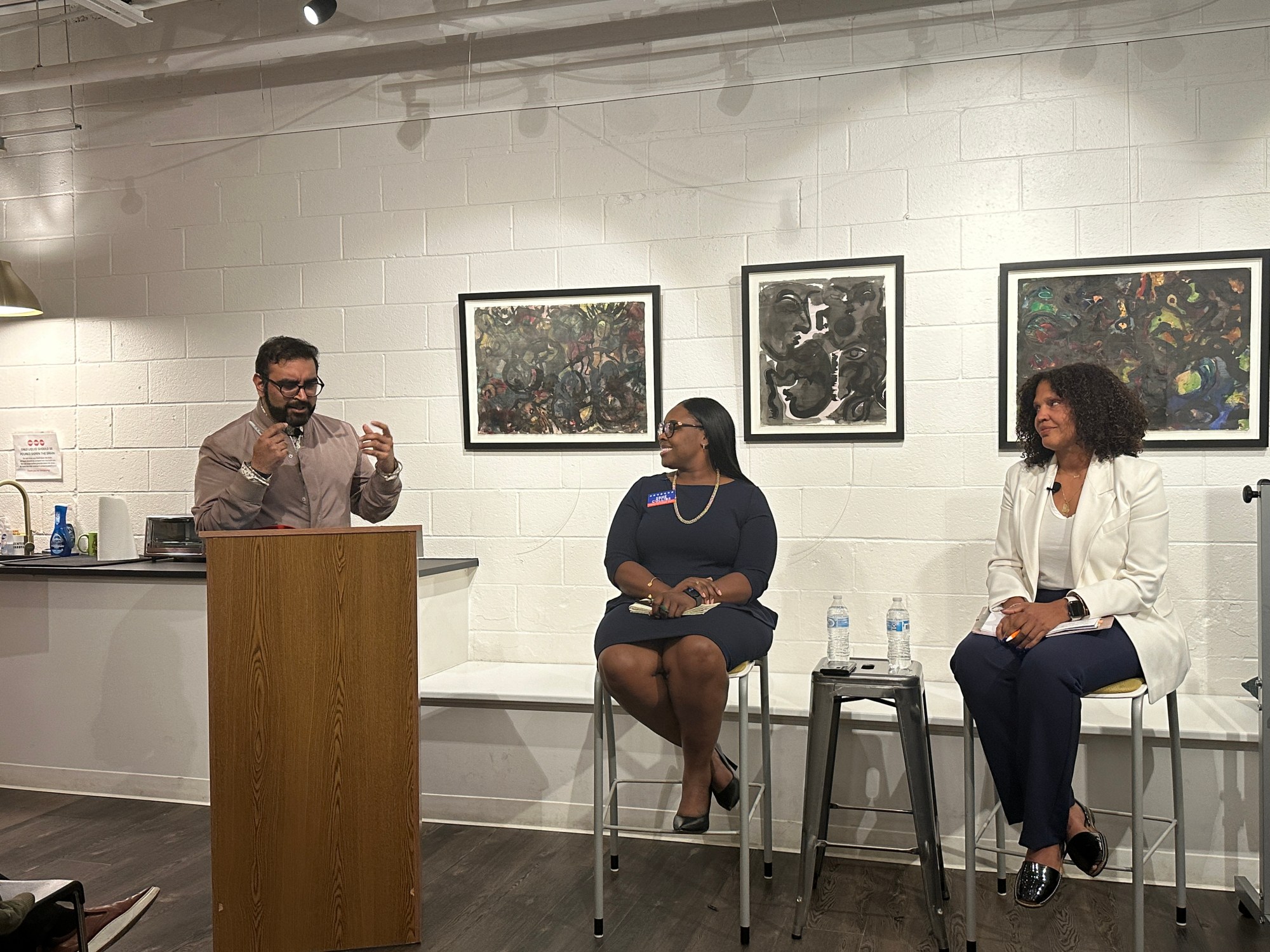

At the close of an almost three-hour candidate forum between Post 3 At-Large city council runoff candidates Eshé Collins and Nicole “Nikki” Evans Jones, the moderator, Center for Civic Innovation’s executive director Rohit Malhotra, polled the audience.
“How many people in this room [had] already decided who they were going to vote for?” Malhotra asked. Hardly anyone in the audience raised their hand.
Then he asked, “How many of you feel clearer on who you are going to vote for now?” Just a few more raised their hands. The vast majority remained undecided.
Malhotra turned back to Collins and Jones and asked, “Help us differentiate between the two of you.”
But neither ultimately did — at least, not as far as what specific policies they would champion or oppose on the Atlanta City Council. Jones drew on her experience as an educator and former school principal, while Collins touted her experience as a civil rights attorney and former chair of the Atlanta Board of Education.
Local civic organizations have deemed both candidates well qualified to hold the office. The Committee for a Better Atlanta (CBA), a nonpartisan coalition of Atlanta’s business and civic organizations, last month gave both Jones and Collins high marks in a candidate scorecard for the citywide Atlanta City Council seat.
Malhotra pushed Jones and Collins on how to address housing affordability, the high cost of living and income inequality, government transparency and accountability, as well as corporate influence in government. But their lack of specificity on solutions to Atlanta’s most pressing challenges sometimes left the moderator visibly frustrated.
“I genuinely just need some help here,” Malhotra said, after asking how they would check corporate power in the city. “I need to know how you are going to check unchecked corporate power inside of this city that has done irreparable damage to Black communities in Atlanta. How will you do that? Tell me. Give me a mechanism. Because I hope this is all you think about.”
Both promised they would hold corporate power accountable, but without saying how. “I’m not feeling the answer,” Malhotra said before moving on. “Because I think that I’m still unclear how we actually hold corporate power accountable.”
When Malhotra asked how the city council can regain the people’s trust, after shutting down a voter referendum over building the Atlanta Public Safety Training Center (“Cop City”) — which is still tied up in federal court — the two candidates offered little more than an assurance to make sure it doesn’t happen again.
Jones and Collins were also unaware of the specific recommendations released Nov. 6 by an Atlanta City Council task force to limit the Office of the Inspector General (OIG)’s powers in probing wrongdoing within the city of Atlanta. The inspector general position was created in 2020 after a federal probe into corruption at Atlanta City Hall, but some city employees have alleged that Inspector General Shannon Manigault has taken her investigations too far. Manigault has denied the allegations.
The two city council candidates did agree — when pressed — that OIG reports should be released to the public at the same time they are released to officials, which was contrary to the task force recommendation.
During the forum, Malhotra complimented both candidates on not attacking one another. Indeed, civility and respect were the highlight of the night.
Housing proposals
That said, Jones and Collins did address pressing Atlanta issues in their responses to candidate questionnaires for an Atlanta Civic Circle–Atlanta Journal-Constitution ballot guide,
Jones said her top three issues were housing, public safety and transportation, while Collins cited housing and equitable economic development.
On affordable housing, Jones said in the questionnaire, “Let’s keep growing the [Housing] Trust Fund, while ensuring that we get the 2025 zoning re-write done correctly, so that the city can become more densely populated in areas where it makes sense, so that we can create more housing units/inventory and drive down prices in the process.”
“We need access to every option from what I call the “Affordable Housing Toolbox” at our disposal,” Jones added in her response. “This includes dynamic solutions around zoning regulations, transit orientation, square footage requirements, grants, tax incentives, homelessness, and more.”
Collins also addressed affordable housing and economic development in the questionnaire: “The rising cost of housing in Atlanta has displaced many residents, threatening the fabric of our communities. By focusing on policies that increase affordable housing options and preserve existing neighborhoods, we can ensure that long-time residents are not pushed out by development pressures. At the same time, I will advocate for smart economic development that creates jobs, supports local businesses and attracts new investment to underserved areas.”
In the General Election on Nov. 5, the Post 3 At-Large city council race was overshadowed by the presidential election at the top of the ticket, drawing 20% fewer voters, according to the Center for Civic Innovation.
Jones and Collins emerged as the top two vote-getters, with about 39% of the vote for Jones and 25% for Collins, out of a field of five. The other candidates were: Amber Higgins Connor (15.2%), Devin Barrington Ward (13.7%) and Duvwon Robinson (6.5%).
Early voting begins Nov. 23 for the runoff election on Dec. 3.
You can watch the full candidate forum for Jones and Collins here.