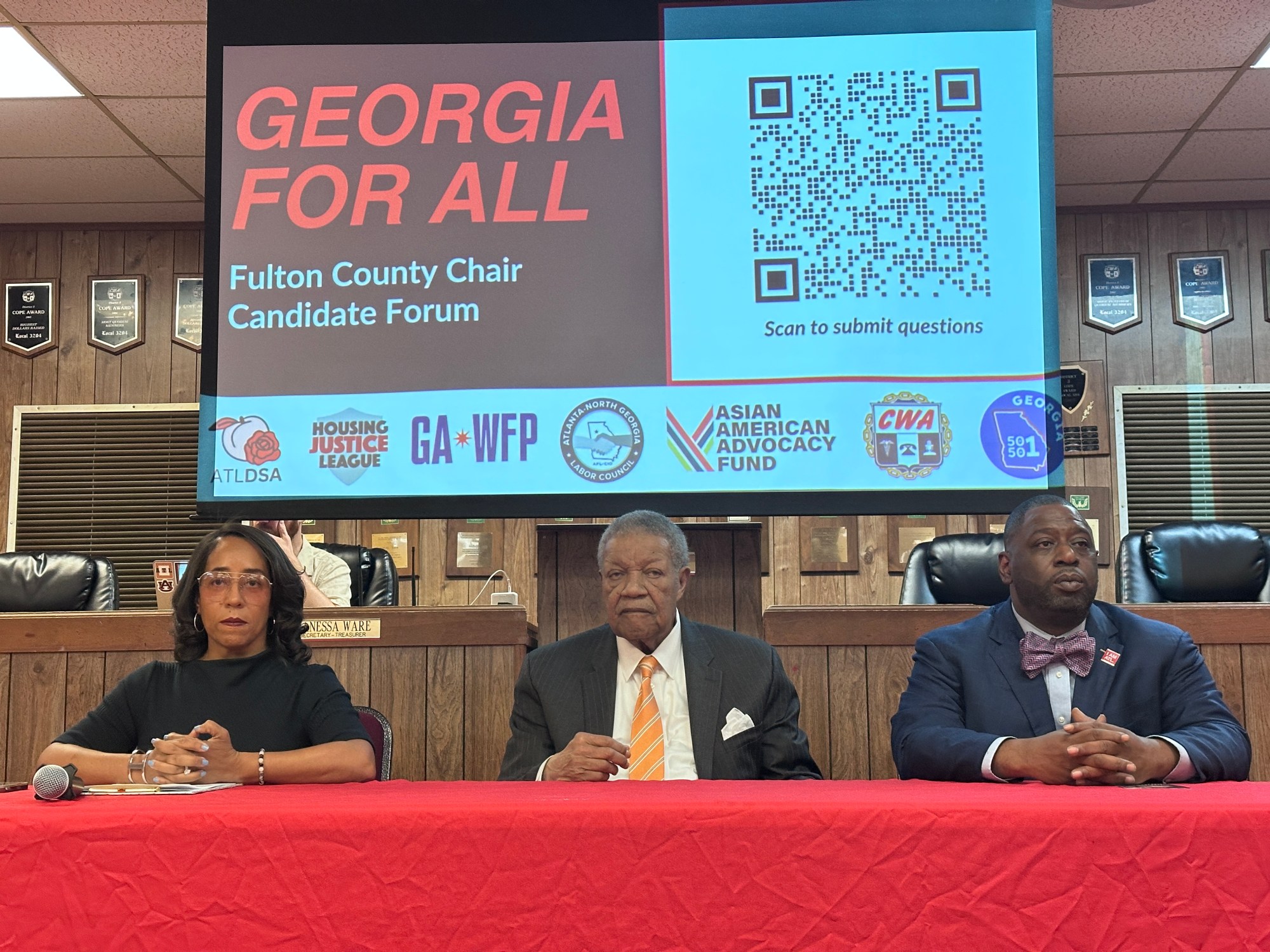
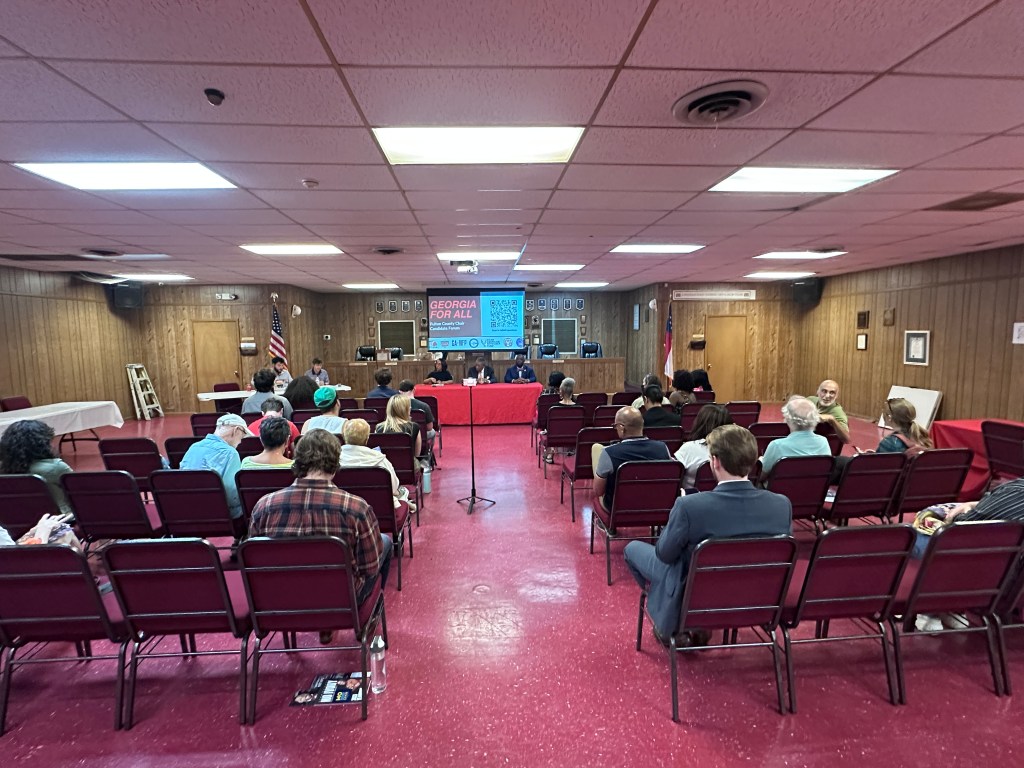
Democratic candidates for Fulton County Commission Chair pitched themselves to voters Thursday evening at a sometimes heated forum hosted by labor and progressive groups ahead of the May 19 primary election.
Incumbent Fulton Chair Robb Pitts debated District 5 Commissioner Marvin Arrington Jr. and former District 4 Commissioner Mo Ivory over solutions to the troubled Fulton County Jail, the housing crisis, election security, and public transit expansion.
The candidates also differed over whether to extend the timelines for the city’s eight tax allocation districts (TADs) to fund the mayor’s $5.5 billion Neighborhood Reinvestment Initiative, which requires county approval.
Pitts, who’s served on the Fulton Commission since 2003 and as chair since 2017, highlighted his record on lowering the county property tax millage rate and suing the federal government after the FBI raided the Fulton County elections office.
“I believe that we’re at war with Washington,” Pitts said, urging voters to trust his decades of experience in Fulton leadership. “This is not the time for on-the-job training.”
But Ivory, who resigned her District 4 seat to run for chair, said the county needs new leadership. “This race is not about political comfort. It is about whether Fulton County will keep protecting the status quo, or finally, start protecting the people,” she said.
Arrington, a Fulton Commission member for 12 years, highlighted his work on veterans’ services and pre-arrest jail diversion programs. He said greater investments in youth and the arts can reduce criminal justice system costs. “If we spent more money on our youth and on our arts on the front end, we would not have to spend that much money on the courts and the criminal justice system on the back end,” he said.
Here are the candidates’ responses on hot topics like the Fulton County Jail and housing. The event was hosted by the Democratic Socialists of America, the AFL-CIO, Housing Justice League, Working Families Party, and Asian Americans Advancing Justice at the Communications Workers of America Local 3204 Union Hall in Capitol View.
Questions and answers have been edited for length and clarity. For a refresher on what the Fulton County Commission does, read our Q&A with former Fulton County Attorney Patrise-Perkins Hooker.
Fulton County Jail
Audience question: Given the severe overcrowding at the Fulton jail, what is the solution? Do you support using tax dollars to build a new jail, or do you support the “Path to 1,000” framework developed by Communities Over Cages Coalition, which seeks to safely reduce the jail population through diversion and pretrial reform?
Arrington: I believe that we do need a new jail. That jail is in horrific shape. It is not clean, it is not sanitary, and it needs to be replaced. We have inmates crawling through brick walls to assault other inmates. The jail is disintegrated. It is 20 years behind its useful life. I did support, the other day, building the new 1,800 person medical facility for the [jail] mental health patients, but I made it very clear on the record that I do not support renovating the Rice Street jail.
Ivory: I think all of those options are things that need to be discussed. There are ways to reduce the population – take [people convicted of] misdemeanors out of the Fulton County Jail and put them on ankle bracelets. It does not have to be overcrowded.
But just this past Wednesday, the Fulton board unanimously approved a $1.3 billion jail plan. When that plan first came up in 2025, when I was on the board, I voted no. That jail will not be ready until the year 2031 or 2032, so no, I do not believe in the plan that was currently adopted. When I become the chair, I plan to make adjustments.
Pitts: The key is reducing the jail population, versus building a brand new – what I call country club style – jail that will house 4,500 to 5,000 people who are primarily Black and Brown. Which is why I’ve supported from day one the renovation of the Rice Street facility and the construction of a separate medical facility on the same footprint to treat the 70% of our detainees who have either a mental issue or a substance abuse issue.
Housing affordability
Rita Scott, CWA Local 3204: Would you support capping property taxes for those who have been in their homes 30 years and above?
Arrington: I support making sure seniors and legacy residents are protected from tax increases. I don’t necessarily know that a cap is required to do that.
Ivory: I want to make sure seniors are receiving every exemption available to them. If they are not, we should identify that and help them access those exemptions. That does not mean capping taxes across the board.
Pitts: Yes.
Eviction prevention
Matthew Nursey, Housing Justice League: Atlanta has the highest eviction rate in the country, according to the Eviction Lab at Princeton University. What would you do as commission chair to address that crisis in Fulton County?
Arrington: It’s an affordability problem. The county is a safety net – especially with what we’re seeing from Washington – and it has to step in to fill those gaps and help people stay in their homes.
Ivory: Georgia has some of the most landlord-friendly eviction laws in the country, and that comes from the legislature. It’s important for us to work with our representatives to create more balance. Fulton County also operates the REACH Clinic, which helps people facing eviction, and I would work to expand it.
Pitts: The solution begins with the state legislature.
Homeless services
Allen Hall, Justice for Cornelius Taylor Coalition:If elected, will you commit to increasing county funding for wraparound services for unhoused people – and can you name what new investments you would prioritize in your budget?
Arrington: I’ve already worked to commit over $7.5 million towards wraparound services for the homeless. Working with our nonprofits that already serve the homeless is the best thing that we can do. At Fulton County, we currently give $5 million towards that.
Ivory: It took pressure from the community to get [$4.8 million for wraparound services to the city of Atlanta] restored to the budget, even though we promised in an agreement to give it. I then proposed to have that money put in the budget for 2027, but the ‘Gang of Four’ voted no. [A reference to Pitts and Fulton Commissioners Bob Ellis, Dana Barrett, and Khadijah Abdur-Rahman – Ed.]
Pitts: The vast majority [of unhoused people] are residents of the city of Atlanta. For the county, that is not one of our primary responsibilities. We provide those services through nonprofits that we fund on an annual basis. We also provide job training.
Election security
David Nielsen, 50501 Georgia: President Donald Trump has indicated intent to interfere with elections by sending federal officers to polling places and seizing voting machines. What steps would you take to keep county elections free and fair?
Arrington: I’ve been meeting with our veterans empowerment commission, and we have a group of veterans that are willing to stand guard at our election polling centers.
Ivory: I plan to be proactive about protecting our elections from Trump’s administration. We knew Trump was coming. We had all the indications that Trump was coming, and we were not prepared.
Pitts: The FBI raid that occurred on the night of January 28 was not known about in advance. We reacted as quickly as we could. We went to court to get the warrant unsealed. We’re still fighting to get the ballots and personal information back. I think we’ll succeed with that. But the real advantage that we have now is your vote. We can call President Trump every name under the sun. But if you do not vote, it doesn’t mean a hill of beans.
Transit expansion
Rita Scott, CWA Local 3204: How would you support expanding public transit on the south side equal to other areas of Fulton County?
Arrington: We’ve talked about expanding BRT [bus rapid transit] along Campbellton Road, aka State Route 166. We have to do whatever we can to help expand transportation and mobility needs.
Ivory: I have hoped in the last 35 years that I have lived as an adult in Atlanta that public transportation would expand, but it looks much the same as when I first got here when I was 18 years old. So before we talk about flying cars and autonomous vehicles at the airport … I’d like to just see more bus routes in South Fulton. I’d like to see more things that people who go to work every day really need. That requires collaboration between the county and the city.
Pitts: We don’t have what I consider to be adequate [county] representation on the MARTA board. We’re going to have to work with our legislature to get more representation.
[MARTA’s 13-member board is appointed by Fulton, DeKalb and Clayton Counties, the city of Atlanta, and the governor. The state legislature has the power to change MARTA’s governance structure. – Ed.]
Extending TAD timelines
Audience question: The mayor of Atlanta is trying to extend all eight tax allocation districts (TADs) for another 30 years. Do you support this?
[Mayor Andre Dickens wants to extend the TADs’ current expiration dates to fund his proposed $5.5 billion Neighborhood Reinvestment Initiative. A TAD diverts property tax revenue above a baseline set at its creation from Atlanta Public Schools (APS), the city of Atlanta, and Fulton to fund development within the TAD. -Ed.]
Arrington: I am supportive of extending TADs. These TADs are in neighborhoods that are mostly underdeveloped. However, I do believe that there needs to be a review. There have been some abuses and other things going on, but I am supportive of supporting the city of Atlanta and extending the TADs.
Ivory: I support an analysis of the tax allocation districts before any discussion about extending them happens. I thought it was extremely premature to announce there would be a neighborhood revitalization plan based on the financing of our portion — which is 25% — and that that funding would be a part of it, before the conversation about the performance of these TADS was taking place.
Pitts: I’m open to discussing all of the TADs with the mayor and the city. We’ve had preliminary discussions with him. But also the big player in this is APS [which contributes half the tax increment revenue to each TAD]. So the three of us will be getting together to look at the revenue implications for each of the three jurisdictions. I’m not opposed to it, but a blanket extension? No, it’s not going to happen.
The deadline to register to vote in the May 19 primary is April 20. To check your voter registration status, polling place, and what races you are eligible to vote for, visit the Georgia Secretary of State’s My Voter Page.