

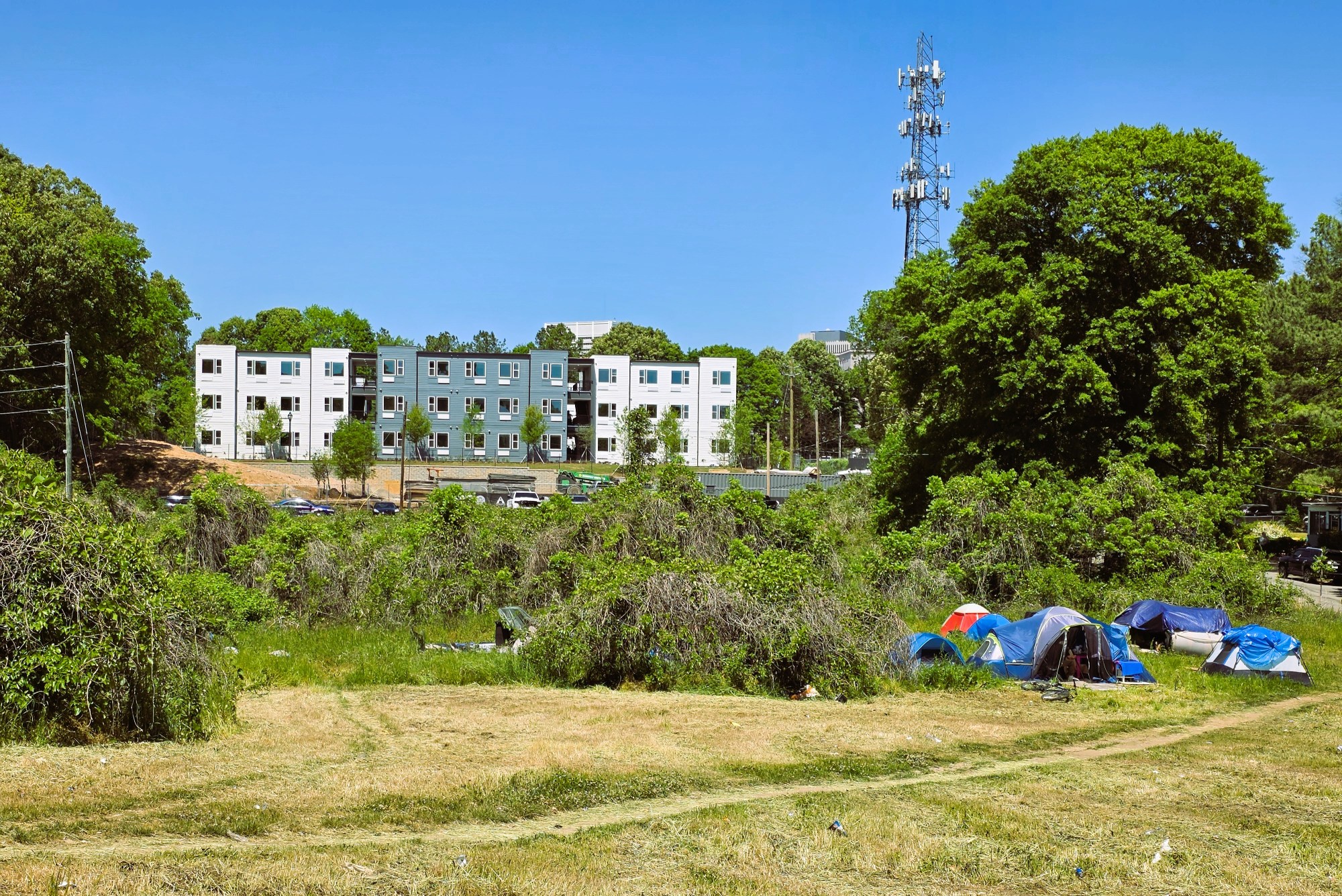
The city of Atlanta reached a slightly overdue milestone Thursday with the debut of The Beacon rapid housing complex in Mechanicsville. The 112-unit apartment project’s ribbon-cutting marked 500 city-funded permanent supportive housing units for homeless people — a target the city had aimed to hit by the end of 2025.
Mayor Andre Dickens’ administration pitched the initiative, launched in early 2024 with the opening of downtown’s shipping container village The Melody, as a faster way to move people out of encampments and shelters into permanent supportive housing with government-subsidized rents.
To do that, the city used modular construction on underused, city-owned land or renovated existing apartment buildings. The rapid housing projects are a mix of refurbished apartments and newly constructed complexes in Midtown, Old Fourth Ward, and the Westside.
The Beacon replaced a homeless encampment on an overgrown lot at 405 Cooper Street SW — and a smaller tent community still exists nearby. Some of the unhoused residents who’ll move in next month are returning to their former address, but this time with a roof over their heads.
“This is really not just about a number,” Dickens said at the April 16 ribbon-cutting. “This work is all about people. It represents 500 opportunities, 500 lives, 500 chances at stability, at dignity, and 500 Atlantans — whether they are Atlantans today, or whether they were Atlantans five years ago, or whether they just showed up recently and became Atlantans. This is now about how we provide a foundation to rebuild their lives.”
Late last year, the city was still 246 units short of its goal to rehouse 500 Atlantans in permanent supportive housing, underscoring the challenge of piecing together land, funding, and service providers amid federal government turbulence.
The city’s 500-unit rapid housing push was backed by an over $60 million funding package that included $50 million in city-issued Homeless Opportunity Bonds and $10 million from its Affordable Housing Trust Fund. It also used tax allocation district (TAD) dollars: The $17 million Beacon development, for instance, received $3 million from the Stadium TAD.
A fast-paced experiment
The city’s rapid housing initiative is a departure from traditional affordable housing development, which can take years to build. It emphasizes speed, with small units, quicker construction timelines, and wraparound services aimed at stabilizing residents once they move in.
The Beacon, which features 200-square-foot studios and 500-square-foot one-bedroom apartments, took just nine months to materialize. Thirty of the 112 apartments are earmarked for unhoused people with chronic mental health and medical conditions, with services provided by Project HEAL.
“These are places of safety, dignity, healing, and new beginnings — new lives,” said Cathryn Vassell, who heads Partners for Home, the city’s homeless services partner. “In many cases, they represent stability for our neighbors who have experienced the real trauma of homelessness, and they represent what is possible when a community acts with urgency.”
Case managers staff each site to connect residents to supportive services like mental health care and job assistance, often coordinated through Partners for Home.
Vassell said The Beacon and the city’s broader rapid housing initiative reflect Atlanta’s embrace of the evidence-based Housing First approach to housing chronically homeless people, by getting them stably housed, then offering services. Funding for this established approach has been threatened by the Trump administration’s efforts to force unhoused people with substance use or mental health conditions into treatment facilities before they can receive subsidized housing, Atlanta Civic Circle has previously reported.
What’s next?
With the initial 500-unit goal reached, the city aims to expand its rapid housing footprint. But first, it will need to find the funding. The city-issued Homeless Opportunity Bonds were a one-time source, Vassell said.
“What’s next is identifying a way to secure a sustainable, dedicated revenue stream to continue to do more housing,” she said. “We created a proof-of-concept with rapid housing. We aligned the necessary public and private resources, but we need a sustainable resource to be able to continue making these investments.”

I would really like to get into one of these units I am living on social security and totally unable to work steady because my legs are bad I’m on a cane please leave me in the right direction to get one of the units
Thinking the same, how can I get into one of those one bedroom or studio
I need a apartment like asap
This is such good news. How great that so many people organized around this vision to make it a reality. I would love to learn more so we can achieve such a dream here in the NW corner of Connecticut.