


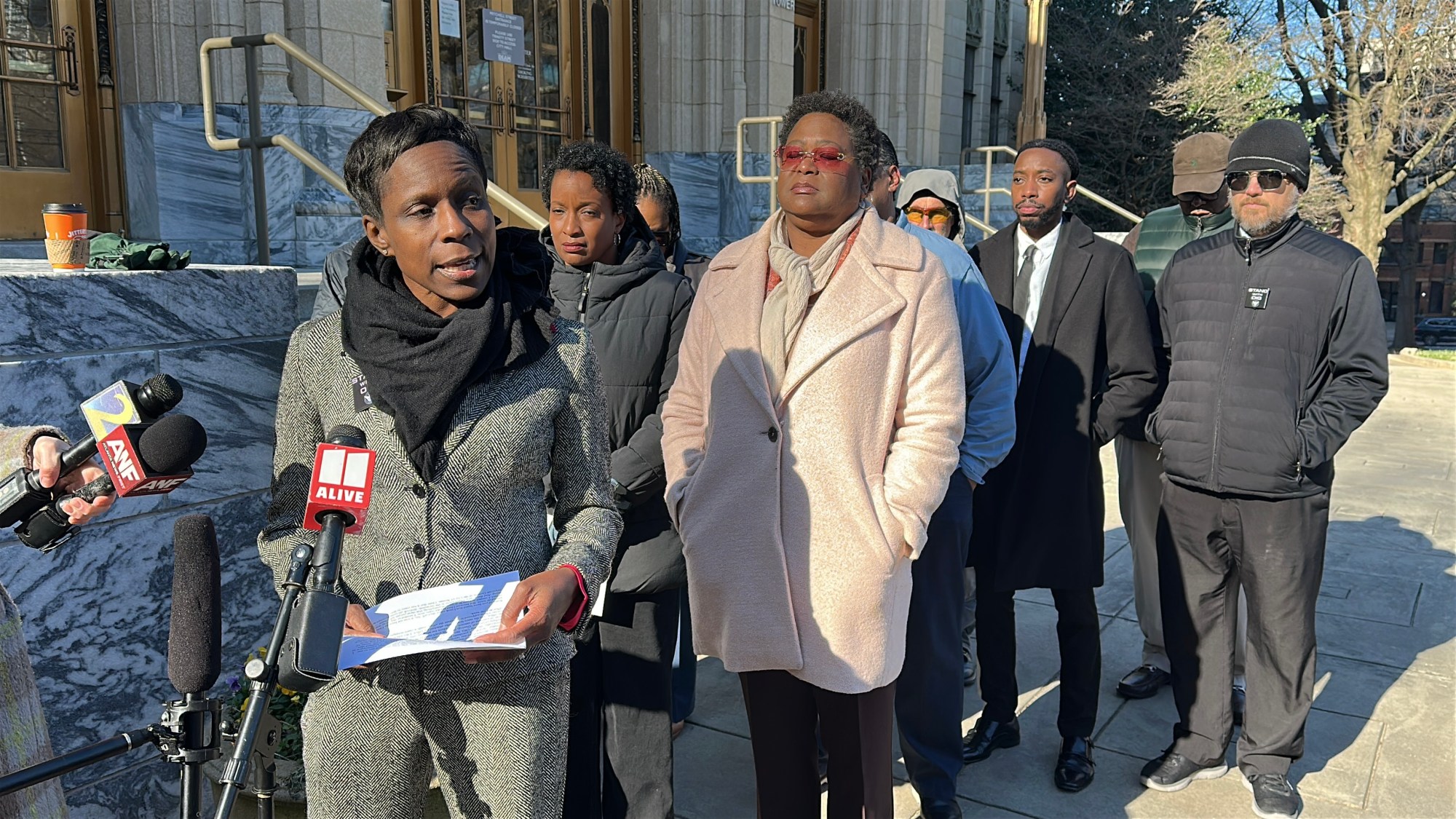

Atlanta Inspector General Shannon Manigault announced her resignation Monday morning on the steps of City Hall, citing city leadership’s attacks on her office, herself personally, and her family.
“I’ve come to the incredibly difficult decision to resign as Inspector General of the city of Atlanta. I hate that it’s come to this for the members of the public,” Manigault said, flanked by members of her staff, former Atlanta City Council president Felicia Moore, former Office of the Inspector General (OIG) board chair Nichola Hines, and her office’s outside counsel, James Radford of Radford Scott.
Courtney English, Mayor Andre Dickens’ chief policy advisor, said the city had no immediate comment on Manigault’s resignation, or those of three board members over the weekend — former OIG board chair Hines, Terri Simmons and Cecily Welch. That followed the resignations of two of the board’s other nine members, Lisa Liang and Natalie Lewis, in December and January.
“I have been subjected to threats, bullying, intimidation, and harassment at the hands of people who have been the subjects of our investigations. Pure and simple, it’s retaliation. The attacks have been systematic, sustained, and savage as we have uncovered more corruption, once again, at the highest rungs of City Hall,” Manigault told reporters Monday morning.
Manigault’s resignation comes after a year of rising tension between her office and the Dickens administration. Manigault first caused a stir when she appeared before the city council last May to allege systematic obstruction of the OIG’s work rooting out waste, fraud and abuse in city government. The city council subsequently assembled a task force to review the OIG, which in November published recommendations to sharply curtail the office’s independence.
In January, Councilmember Howard Shook introduced a bill to curb the OIG’s investigative purview that incorporated the task force’s recommendations. While the bill has been amended to dial back some of its harshest limitations on the OIG’s investigative independence, its critics contend it will still gut the office’s powers. The city council is expected to pass the bill later today, after further review from the Committee on Council.
“All I can do is try to make sure that the serious allegations that you all have entrusted to the OIG do not die with me [resigning] or with the imminent death by legislation of our office,” Manigault said to city employees and the public on Monday.
Subpoena powers
Manigault has come under fire over the past few weeks for how her five-year old office has issued third-party subpoenas to banks for financial records pertaining to investigations. The Atlanta City Attorney issued a cease and desist order that accused the OIG of violating state law by not notifying account-holders in advance of the subpoenas.
But Radford – whom the OIG board hired as the OIG’s attorney last week – struck back at the Feb. 17 press conference, saying the city charter allows the OIG to issue third-party subpoenas without prior notification for criminal investigations. Of 61 third-party subpoenas issued by the OIG, 51 were for potentially criminal matters, according to an open records request.
“We did careful legal research on that question, and determined that, in fact, the Office of the Inspector General in the city charter has the power to conduct criminal investigations. It is a criminal law enforcement agency, as that term is defined legally — and therefore, under Georgia’s banking laws, the Office of the Inspector General absolutely had the authority to issue these financial subpoenas without tipping off the people who were being investigated,” Radford said.
Manigault’s office has published multiple investigative reports that the city administration has taken action on: uncovering nepotism in the city’s human resources department, which prompted the council to fire the human resources commissioner and bribery in the city’s commercial building permit office, which also led to terminations.
“OIG has open, active investigations — serious investigations — that after today, because of the proposed legislation, we may not be able to pursue — which means that ultimately, the fate of the office now rests in your hands, the hands of the public,” Manigault said.
UPDATE: The Atlanta Mayor’s Office released the following statement after Manigault’s resignation this morning:
“We thank the Inspector General for her service to the City of Atlanta. We look forward to working with a new Inspector General and independent Board in the near future. Ethical government has been one of the Mayor’s four pillars since day one. The City will continue advancing policies and practices that reinforce public trust and protect taxpayer resources, while also ensuring all oversight efforts respect the rights of our employees and are conducted with fairness, transparency and accordance to the law.”