The Atlanta City Council is one full council vote away from passing a bill that would overhaul two independent city watchdogs: the Office of Inspector General (OIG) and the Ethics Office.
Introduced on Jan. 6 by Councilmember Howard Shook, the original bill drew sharp rebukes from Atlanta Inspector General Shannon Manigault and civic organizations, such as the NAACP and the national Association of Inspectors General, for sharply curtailing the independent investigative powers of the city’s top corruption watchdog, the OIG.
The revised version of the bill that emerged from a Feb. 3 full council meeting dials back some of the original legislation’s most contentious provisions. That followed reviews by the Committee on Council, the Finance and Executive Committee, and a public work session.
Here’s a recap of the latest key changes:
- The bill sets a new process for the OIG and the Ethics Office to obtain city records and city-issued phones, laptops and other devices. Now, the offices must ask the records-keeper or individual device-holder to voluntarily submit them. If the city employee refuses, the OIG or Ethics Office can issue an administrative subpoena, which can be quashed or approved by a municipal judge.
- To access personal devices or records, such as bank and phone records, from city employees or other individuals, the OIG also must seek an administrative subpoena, subject to a municipal judge’s approval. This provision appears aimed at resolving privacy concerns that the city has raised around the OIG’s ability to access personal records from city employees or others — for example, bank records if they’re suspected of having paid or accepted a bribe.
- The bill restores the OIG’s ability to make criminal referrals to local, state, and federal law enforcement agencies. It also confers that ability to the OIG governing board.
- It forbids the OIG from using “covert surveillance technology” for investigations. That said, it does not define covert surveillance technology.
- The Ethics Office and Inspector General will each have their own, independent governing boards, made up of five members for the Ethics Office and seven for the OIG, with the appointments made by citizen groups. A proposal to give the mayor and the city council each an appointment was dropped. Currently, the offices are governed by a joint nine-member board appointed by citizen groups.
Our previous story about the Feb. 3 city council meeting has additional details.
What’s next?
Councilmember Eshé Collins, who chairs the Committee on Council, is hopeful the legislation is close to its final form.
“I feel that we’re at a great sweet spot,” Collins said, pointing to a provision that restored the independence of both office’s governing boards. “I do feel that a lot of the sausage-making has happened to get this at a really good spot,” she added.
Collins anticipates some further discussion around the OIG’s subpoena powers and whether the office can solicit voluntary interviews from city employees, which could be used in a later criminal prosecution. Otherwise, all OIG interviews would be understood as compulsory.
Concerns that the new guidelines for obtaining city records could delay investigations also are still being hashed out. “There is still dialogue that needs to take place around the timeliness of access to city records, and this concept of voluntary versus compulsory testimony” said Councilmember Matt Westmoreland.
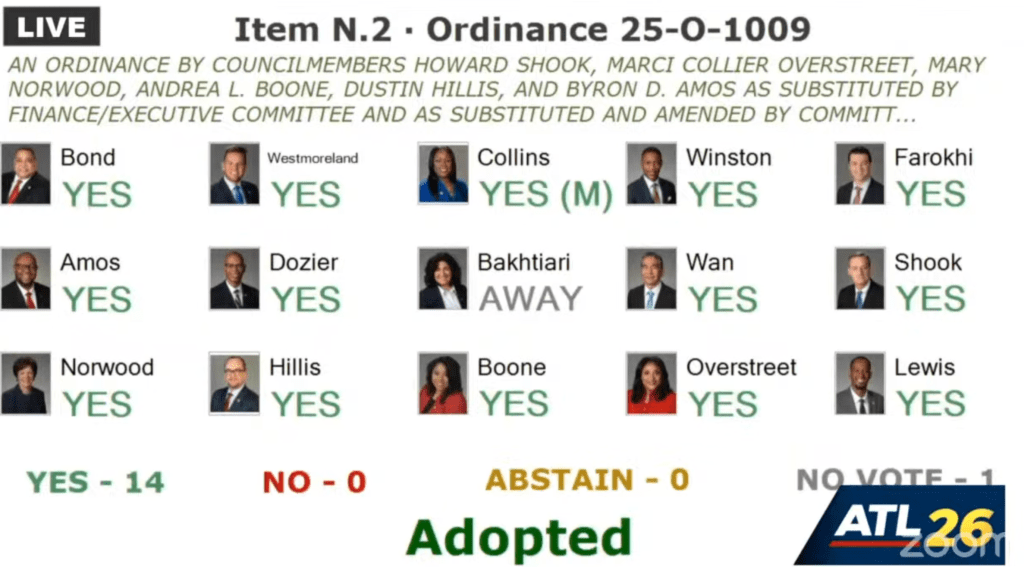
He introduced a successful amendment at the full city council meeting Monday that restores the OIG’s discretion to refer investigative findings for criminal prosecution. It also strikes language that expressly forbade the OIG from investigating potentially criminal matters.
Since Shook introduced the bill a month ago, it has undergone revisions by the Finance and Executive Committee and the Committee on Council, followed by the full city council’s review on Feb. 3.
In response to public outcry over a lack of public participation and a rushed process, the two committees held a joint work session on Jan. 30, where the full council heard from the public, the OIG and Ethics Office, and Mayor Andre Dickens’ administration — which has pushed strongly for the OIG’s powers to be reigned in.
“Some of the changes introduced on Monday [Feb. 3] improve the proposed legislation, others negatively impact the effectiveness of the office. Overall, the legislation continues to weaken rather than strengthen OIG’s ability to serve the taxpayers,” Inspector General Manigault said of the latest iteration of the bill.
The bill can still be modified further as it returns to the Finance and Executive Committee on Feb. 12, then the Committee on Council on Feb. 17, before heading to a final vote by the full council, currently set for the afternoon Feb. 17.