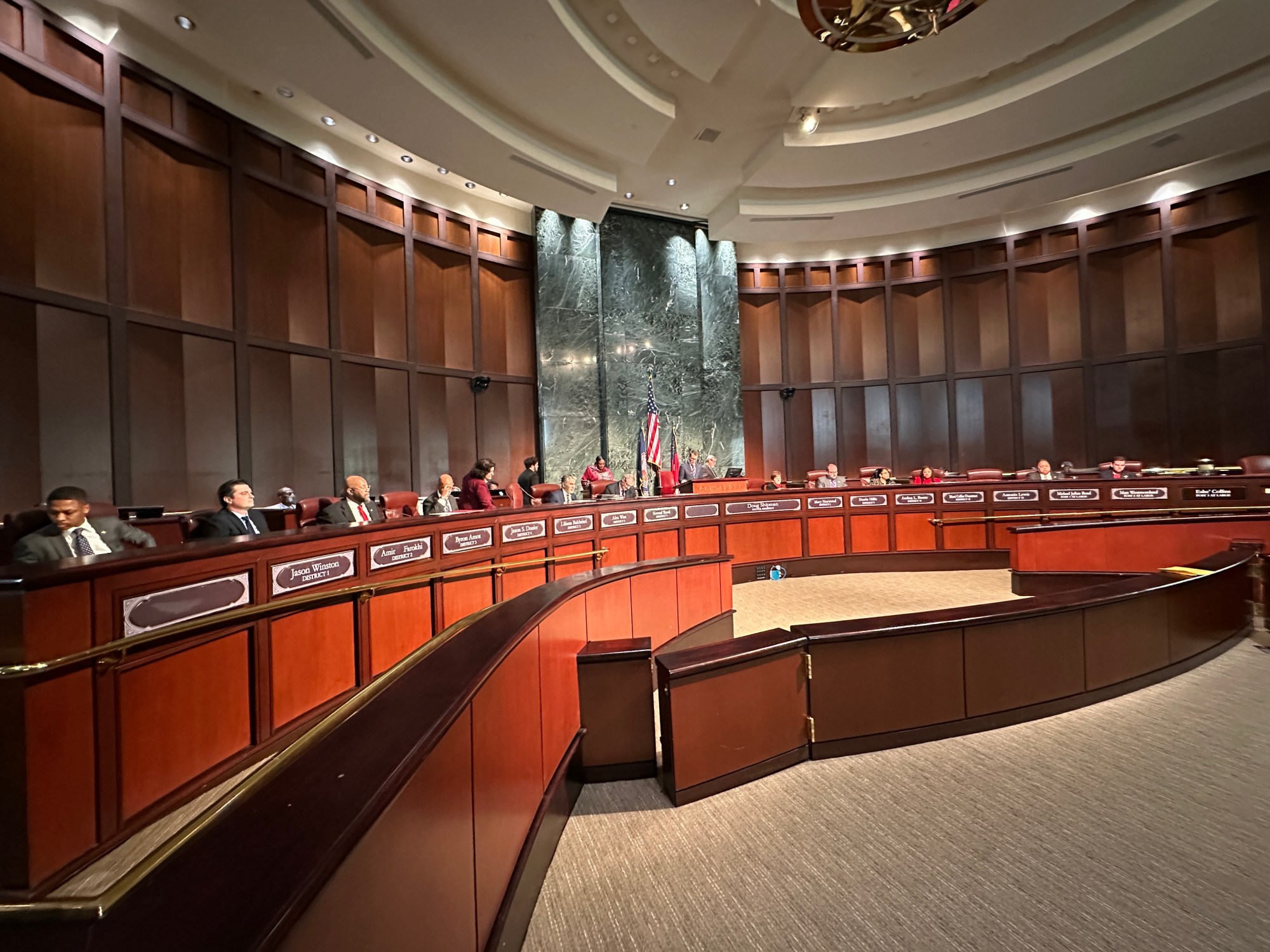

By the time it was Matthew Cullen McClellan’s turn to comment at an Atlanta City Council meeting last week, he’d spent nearly five hours at City Hall.
That’s because he donated his two minutes of speaking time to Housing Justice League organizing director Matthew Nursey, forcing him to stay until it was Nursey’s turn to speak.
It used to be that public comment went in the sign-up order, but now speakers with donated time must go last, and those who donate time must stay until their time is used — due to changes made by City Council President Marci Collier Overstreet.
“I’m fortunate that I can bring a laptop with me, and I can get work done, you know, which I did. But not everybody can do that,” McClellan, a Reynoldstown resident, told Atlanta Civic Circle. “It seems like the voices of the people that want to give their voice to someone else are kind of suppressed by them going last.”
McClellan also said he had to pay nearly $30 for a full day’s parking because the two-hour pass he’d bought was far from sufficient.
Councilmember Byron Amos and the Southern Center for Human Rights (SCHR) proposed several fixes at the May 18 city council meeting to make the comment period more accessible to working Atlantans: scheduling public comment right after the biweekly meeting’s 1 p.m. start time and restoring the old first-come, first-serve rule for longer comments.
Public comment before proclamations
Currently, Atlantans must sign up to comment before full city council meetings, which take place at 1 pm every other Monday, then wait until their name is called, which can be hours after the meeting is called to order.
One of Amos’ resolutions would move public comment to before proclamations, which often take an hour or more. The other would require the council to display a timer for proclamations, which are limited to 15 minutes but often go over, and limit proclamations to four per council meeting, instead of the current five. If there is more than an hour of public comment, the rest would come after the proclamations.
“It will give people some type of time frame of when they will be able to speak,” Amos said. “We have heard [that when] we do it after proclamations, they don’t know when they’re going to speak, and they take time off for work.”
Amos added that using a 15-minute timer for council members to make proclamations would hold them to the same standard as the public, where a two-minute timer is displayed for each comment.
Debate over donated time
Kendell Long of the Southern Center for Human Rights distributed a draft ordinance called “The People’s Voice Act” to council members that takes aim at Overstreet’s new policy of bumping a speaker using donated time to the end of the line.
People can yield their two minutes of time to another person up to 10 minutes — meaning up to five people can band together to deliver one longer remark.
The legislation would prevent speakers who receive yielded time from having to go to the back of the line. It would also strike the requirement that people who donate time remain in the council chamber until their designated speaker can comment.
“The council should be invested in encouraging people to participate in public comment, rather than curating rules that deter thoughtful public engagement with elected officials,” said Long, the Southern Center’s First Amendment policy lawyer.

In response, Overstreet said that people who sign up with donated time can still speak individually for two minutes at their spot in the sign-up order. But her assertion drew murmurs of confusion from the public who — like reporters in the chamber — were unaware of that rule.
People who’ve donated time can opt to speak themselves if they’re pressed for time, Overstreet added. “Everyone can have their two minutes, even if they have to leave. They can say, ‘I no longer want to cede my time.’”
For Long, the issue is that people donating time should not be penalized by having to wait hours. Not having “to speed through very complicated issues that affect large swathes of the community — that’s the benefit of having ceded time,” he said.
Overstreet did not return Atlanta Civic Circle’s request for comment.
A starting point
McClellan, who spent five hours at City Hall for two minutes of speaking time, said he hopes the council embraces the proposed changes, but he’s not holding his breath. “I’m absolutely in support of it, and I would like to think that my city council would be in support of it too,” he said.
Amos said he’s open to talking to the Southern Center about their proposal and views his own as a good starting point for making public comment more accessible. “I hope my colleagues see this as well – as a good start to begin to show some accountability and some efforts that we’re actually listening to the public,” he said.
The council referred Amos’s resolutions to the Committee on Council, which he chairs. It is scheduled to meet at 11:30 am on June 1, right before the 1 pm full council meeting.
Do you have thoughts on Atlanta City Council’s public comment procedures? We want to hear from you. Email ACC summer intern Hailey Weiner at hailey@atlantaciviccircle.org.