

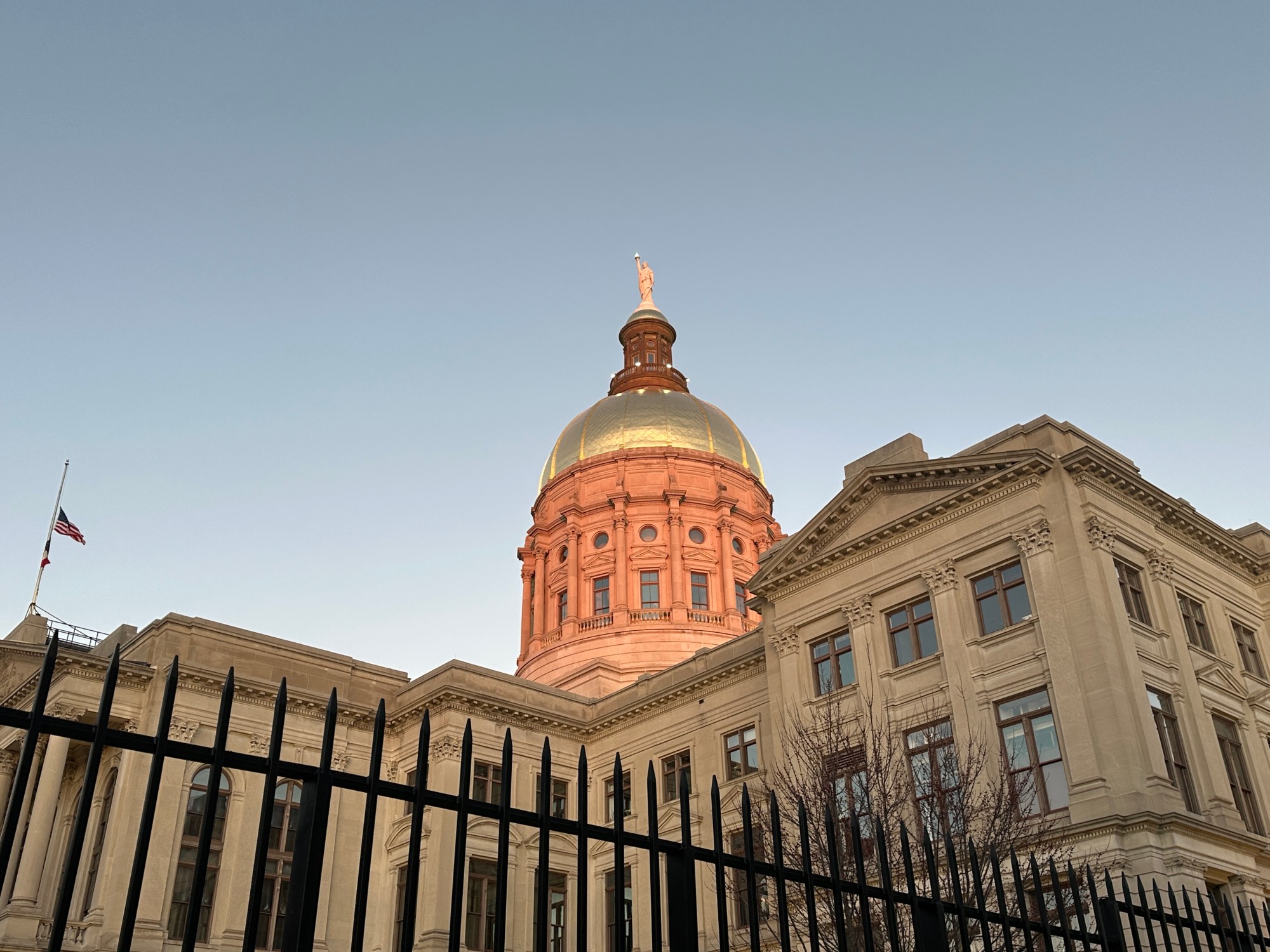


Georgia lawmakers spent about 12 hours on Crossover Day last week angling to push legislation over a crucial hurdle for a chance at becoming law. Atlanta Civic Circle tracked a slate of proposals regarding democracy, labor, and housing that passed — or failed — just before legislators clocked out around 11 p.m on March 6.
That was the final opportunity to move bills to the other legislative chamber for a chance at adoption this year. Proposals that made it over the Crossover Day hump now have until April 4, the last day of the legislative session, to clear a final vote. But legislation that fails to pass in the House and Senate by then could still be up for consideration next year — the second of the two-year legislative session.
Here’s a breakdown of bills that are still in play and those that failed.
Speech & civil liberties
Senate Bill 57: Freedom of Speech and Belief Act
STATUS: SENATE REJECTED (43-13)
This Republican-backed bill sought to prohibit financial service providers and utility companies from denying service to business customers based on certain activities, such as choosing not to help employees access abortions or gender reassignment services, or engaging in business related to firearms, ammunition, oil, and gas.
Senate Bill 74: Criminalizes librarians for distributing “harmful materials” to minors
STATUS: SENATE PASSED MARCH 3 (32-23)
This bill would remove the current exemption that protects libraries and librarians from criminal penalties, under a 2024 state law against distributing harmful materials to minors. It would make any knowing violation a “high and aggravated misdemeanor,” which carries a $5,000 fine and jail time of up to one year. It also provides a legal defense for librarians who make good-faith efforts to remove such materials.
Senate Bill 1: Bans transgender women from female sports teams, restricts bathroom access
STATUS: SENATE PASSED FEB. 6 (35-17)
The “Fair and Safe Athletic Opportunities Act” went through multiple amendments before ultimately passing the Senate.
It would ban transgender students (middle school through college) from playing on sports teams that align with their gender orientation. For instance, transgender female students would not be allowed to play on female sports teams. It also would require schools to designate teams and athletic facility restrooms based on gender. Democratic legislators questioned the need for the law, pointing out that there is no recorded instance of any transgender girls and women participating in female sports teams in Georgia.
The bill also defines female gender statewide as “an individual who has, had, will have, or, but for a developmental or genetic anomaly or historical accident, would have the reproductive system capable of producing human ovum.” It does the same for male gender, replacing “ovum” with “sperm.”
Elections and governance
House Bill 397: Allows Saturday advance voting for municipal elections
STATUS: HOUSE PASSED MARCH 6 (159-13)
This bill would allow municipalities in Georgia to opt into providing advance voting on Saturdays for municipal elections. The goal is to enhance voter access, which could increase voter turnout.
House Bill 215: Voter List Integrity Act
STATUS: Passed in committee – NO FLOOR VOTE
This bill would have banned the Georgia Secretary of State and local elections offices from participating in multistate voter-list maintenance organizations, which cross-check voter lists across states to ensure that participating states have up-to-date, accurate voter rolls. For instance, a registered Georgia voter who’s relocated to Maine and registered to vote there would be deleted from the Georgia roll. President Donald Trump called on Georgia to pull out of the Electronic Registration Information Center (ERIC) in March 2023, which is the largest such group.
House Bill 502: No waiting in line for older voters or those with toddlers
STATUS: Passed in committee – NO FLOOR VOTE
Voters who are over age 75, or have a disability and require assistance to vote, may vote immediately without waiting in line under the current statute. This bill proposed expanding that accommodation to voters accompanied by a child under the age of two. It aims to increase access to the polls for parents with young children.
Senate Bill 175: Ban on ranked-choice voting
STATUS: SENATE PASSED MARCH 3 (36-19)
The bill would prohibit any local, state or federal election in Georgia from using a ranked-choice voting system. The bill defines ranked-choice voting as “a voting method that allows electors to rank candidates for an office in order of preference and has ballots cast be tabulated in multiple rounds following the elimination of a candidate until a single candidate attains a majority.”
The measure has been pushed by Lt. Gov. Burt Jones and State Sen. Randy Robertson (R-Cataula). “Ranked-choice voting is designed to cause confusion and fatigue among voters,” Jones said. Proponents of ranked-choice voting say it allows voters to express preferences for non-frontrunner candidates without fearing that they’re “wasting their vote” — and increases voter participation by eliminating the need for runoff elections, plus the extra expense for taxpayers.
Senate Bill 37: Artificial Intelligence Accountability act
STATUS: Stalled in committee
This bipartisan bill seeks to create the “Georgia Board for Artificial Intelligence,” a state body that would set best practices for local and state governments’ use of artificial intelligence. The bill also would require local and state government agencies to create and disclose AI “usage plans,” so the public understands when and how they’re using AI.
Labor rights
House Bill 16: Warehouse Workplace Protection Act
STATUS: Stalled in committee
This Democrat-backed bill would establish more comprehensive labor protections for employees working in warehouse distribution centers, like Amazon. Key provisions include: limiting work-speed quotas, mandating paid rest breaks, and ensuring adequate health and safety protections such as water stations and proper air conditioning.
Housing
House Bill 92: Requires local governments to opt out annually from homestead exemption tax cap
Status: HOUSE PASSED FEB. 18 (173-1)
This bill would require local governments that opted out by the March 1, 2025 deadline from the state’s new homestead property-tax exemption to continue opting out annually. Georgia’s new constitutional amendment caps any increases in the assessed value of someone’s primary residence at the annual inflation rate statewide for property-tax purposes.
House Bill 305: Protect the Dream Act
Status: Stalled in committee
This bipartisan bill would prohibit investment funds with $6.25 million or more in assets, or who own at least 25 single-family homes in any single county, from buying more houses anywhere in the state. Homebuilders and nonprofits would be exempt. The bill aims to reduce the outsize pricing influence that institutional investors have over Georgia’s housing markets.
House Bill 399: Big landlords must have in-state staff
Status: HOUSE PASSED MARCH 3 (163-4)
This companion legislation to HB 305 would require big, out-of-state landlords to employ in-state staff to respond to tenant communications about maintenance issues. It would apply to any out-of-state landlord that owns or operates 25 or more single-family or duplex rental houses in Georgia.
House Bill 374: Allows local landlord registries
Status: Stalled in committee
This bill would permit local governments to establish residential rental registries – databases tracking landlord, property owner, and/or property manager information – to improve transparency and accountability within rental housing markets. It would also impose fines for entities that fail to provide that information. The aim is to enable local governments to more closely monitor institutional investors, such as hedge funds, in Georgia’s residential rental markets, so that they can better enforce housing codes and landlord-tenant laws.
House Bill 170: Statewide Interagency Council for the Homeless
Status: SENATE PASSED MARCH 6 (50-2)
This bill would create a Georgia Interagency Council for the Homeless to coordinate a statewide approach to addressing homelessness. The 21-member group, all appointed by the governor, would conduct a statewide survey of current resources for unhoused people, identify gaps in services, and coordinate services statewide. It would also coordinate statewide efforts to combat the criminalization of homelessness.
The council would be led by the Department of Community Affairs commissioner, with 13 officials from the Department of Public Health and other state agencies, as well as one member of the Continuum of Care network, three members who have personally experienced homelessness, and three service-provider members.
House Bill 725: Creates standards of habitability for rental housing
Status: Introduced, no committee referral
State Rep. Terry Cummings (D-Mableton) filed legislation on March 4 to supplement last year’s House Bill 404, the “Safe at Home Act,” which requires landlords to provide rental dwellings that are “fit for human habitation.” HB 404 didn’t define “habitability,” so Cummings aims to establish livable standards under state law for rental housing conditions.
House Bill 689: Stable Family and Homelessness Prevention Act
Status: Stalled in committee
This bipartisan legislation would create a flexible local-grant program that draws on the Georgia Department of Community Affairs’ statewide Housing Trust Fund for the Homeless to provide short-term rental and utility assistance, legal representation for tenants in landlord-tenant cases (such as evictions), and other homelessness-prevention services.
House Bill 295: Pressures local governments to enforce urban camping laws
Status: Stalled in committee
This Republican-backed bill would allow property owners to claim a tax refund if they can prove their property depreciated in value or that they incurred expenses due to a local government’s failure to remediate blight or to enforce any relevant urban camping or panhandling laws. Crafted by the Cicero Institute, a conservative think tank, the aim of the legislation is to pressure local governments to clear homeless encampments and enforce any applicable laws for people experiencing homelessness.