
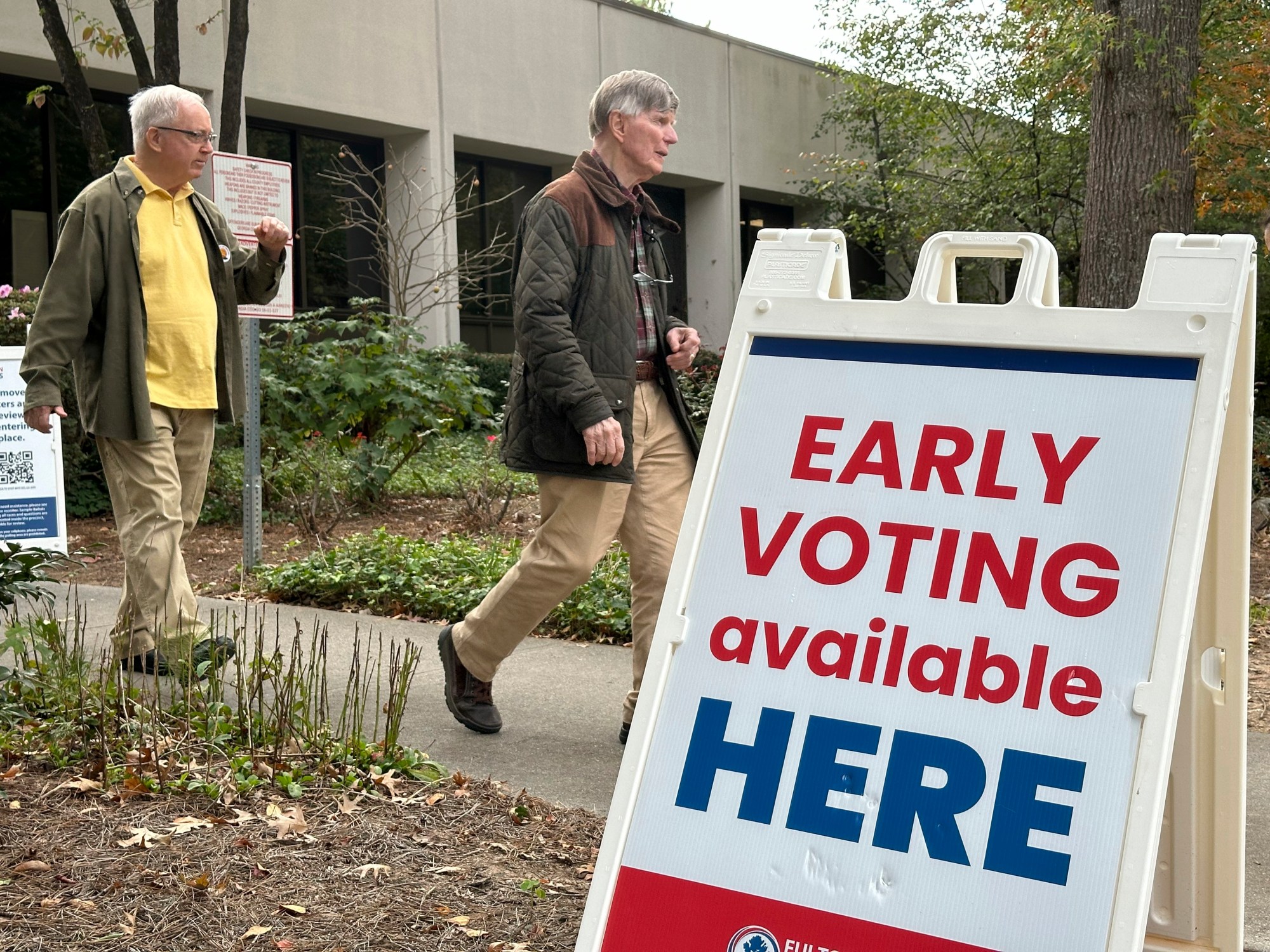


Two Republican-backed election-overhaul bills that are rapidly heading to floor votes — one in the Senate and the other in the House — would cause a raft of changes to Georgia’s elections, alarming both state elections officials and voting rights advocates.
Their top concern is that both House Bill 397 and Senate Bill 175 would withdraw Georgia from the national Electronic Registration Information Center (ERIC), which helps the Georgia Secretary of State’s Office keep voter rolls accurate and up to date.
Among other changes to state elections law are proposals to reduce early voting access, require 24-hour video surveillance of ballot drop boxes, and expand poll watchers’ access to ballot print-outs, which could compromise voter privacy.
That said, both bills underwent massive surgery before passing out of House and Senate committees over the past week, cutting some of the most concerning provisions. SB 175, now under consideration in the House, was originally a ban on ranked-choice voting. The House governmental affairs committee stripped that language from the bill entirely on Thursday and substituted in parts of HB 397, which is now before the Senate.
As the legislative session fast approaches its final day next Friday, the bills must be approved by each chamber’s Rules Committee to head to full floor votes. At this point, both bills have undergone such extensive changes that if either succeeds in a floor vote, it must return to its home chamber for what’s called an agree-disagree vote, before landing on Gov. Brian Kemp’s desk.
“I don’t think we’ll know what bill we’re getting until midnight on Friday,” said Marisa Pyle, a lobbyist for the voter advocacy group All Voting Is Local.
ERIC exit
The major concern for state elections officials is that both bills would withdraw Georgia from ERIC in 2027, which they say would be costly and reduce voter-roll integrity. ERIC members, made up of 24 states and the District of Columbia, share voter registration information, so they can catch duplicate registrations across state lines.
ERIC’s board is composed of top elections officials from Republican and Democratic states alike — such as Georgia and Vermont. Even so, a number of Republican states, such as Louisiana and Texas, have exited, due to political pressure from right-wing election integrity groups that claim ERIC is a partisan conspiracy
Georgia Secretary of State Brad Raffensperger, a Republican, has hailed the bipartisan ERIC initiative as one of the state’s most effective tools for preventing vote fraud and keeping Georgia’s voter rolls clean. People often forget to cancel or update their voter registration when they change states, so information-sharing through the ERIC compact facilitates real-time, voter-roll updates.

Raffensperger’s office this month announced a planned purge of 455,000 inactive or otherwise invalid Georgia voter registrations — and nearly half were identified through ERIC.
“The benefit of a multi-state organization, such as ERIC, is that we can share that type of data very securely. ERIC does the voter-matching for us in a secure and efficient and cost effective way,” Raffensperger’s general counsel, Charlene McGowan, told senators at a Mar. 26 Ethics Committee hearing on HB 397.
McGowan warned that leaving ERIC would be very costly, since Georgia would have to independently enter bilateral arrangements with all 49 other states. What’s more, states that have left ERIC are struggling to find replacements.
“It would require more staff [and] technology,” McGowan said, pointing to Texas as an example. “The staff that they used to perform voter-list maintenance had to be enlarged from five full-time staff to 28.”
Democrats are also concerned. “To force the secretary of state to leave the ERIC compact when no viable alternative exists will result in voter roll inaccuracies,” Rep. Saira Draper (D-Atlanta) told Atlanta Civic Circle. She added that both bills’ mandate for Georgia to exit ERIC “is contrary to the Republicans’ stated goals of voter accuracy and election integrity.”

What else is in both bills?
- In a change welcomed by both Georgia elections officials and voting advocates, both bills ban the State Election Board from enacting new rules within 60 days of an election. The aim is to avoid the chaotic and unprecedented flurry of last-minute rule-making from the board right before the 2024 election, which drew several lawsuits.
- Both bills allow municipal elections officials to opt out of offering early voting on Saturdays. However, after committee pushback in both the Senate and the House, the opt-out requires cities to first hold a public hearing and a city-council vote.
- In a move that provoked widespread opposition, both bills prohibit county elections offices from accepting any absentee ballots on the weekend before Election Day. Currently, local elections officials can decide to open their offices to accept drop-offs the weekend before Election Day. The bills also require county elections offices to provide advance notice if they decide to accept absentee ballots on the Monday before Election Day. “This is a reduction of voter access,” warned Draper.
A House add to SB 175
- In the House Ethics Committee this week, Draper added a provision to the otherwise Republican-driven SB 175 as a check on the State Elections Board. The new measure would empower the speaker of the House and the lieutenant governor, who leads the Senate, to remove their respective chamber’s appointees to the State Election Board when the legislature is not in session.
Currently, the House and Senate can only remove their appointees to the five-member board during the session. (The State Election Board’s other three appointees come from the governor and the Georgia Republican and Democratic Parties.)

Two Senate adds to HB 397
- The Senate has added a mandate to HB 397 for 24-hour video surveillance of ballot drop boxes, seemingly driven by fears that someone could tamper with the drop boxes outside of voting hours. At the Senate Ethics Committee hearing on Wednesday, voting advocates, plus some senators, raised concerns that the videos could be used to doxx election workers.
- The Senate also added a provision to HB 397 that expands poll watchers’ access to observing the vote count at each precinct on Election Day. Speaking to Atlanta Civic Circle, Pyle, the All Voting Is Local lobbyist, raised concerns over poll watchers seeing voters’ personal identifying information on individual ballot print-outs. She and other voting rights advocates question what safeguards will be put in place to protect ballot confidentiality.
What did the Senate cut from HB 397?
- HB 397 initially had a measure to require every precinct’s poll workers to hand-count ballots after polls close on Election Night. The Senate Ethics Committee cut that, after county elections officials across Georgia opposed it, warning it would introduce human errors and increase costs. The State Election Board already tried to impose this rule in a flurry of rule-making last summer before the presidential election, but it was struck down in court.
- The Senate also struck unclear language in HB 397 that appeared to reduce the number of early voting locations to just one per county.
- Also cut was a proposed change to how voters appeal any challenges to their registrations. The rejected change would have required Georgians to make their appeal to the State Election Board in Atlanta, rather than their local courthouse. That’s a long trip for many Georgians, and it would have meant pleading their case before a board of political appointees, rather than a nonpartisan judge.

Says:” Changes will alarm people” = Don’t care, People need to be Alarmed.
Says:” They might get your data” = All my data has been stolen 10 times over, don’t care.
We Really need, ONE DAY VOTING ON PAPER BALLOTS, AND RESULTS BY 10PM.
For the people who can not get there, tough. Grow a Spine people, ALL the Elections have been Rigged for Decades, Especially GEORGIA.