


Mario Guevara, a prominent Spanish-language journalist, was arrested while covering a protest against US Immigration and Customs Enforcement (ICE) on Saturday. He should have been released on Monday on a signature bond. Instead, ICE placed a detainer on him, his attorney told Atlanta Civic Circle.
“We were able to secure a signature bond for him this morning,” said Guevara’s attorney, Giovanni Díaz. But around 3 p.m. Díaz learned that ICE had placed the hold on Guevara, putting his immediate fate in the hands of federal immigration authorities.
Guevara, an independent journalist, is an El Salvadorian citizen authorized to work in the US. He was working to secure permanent residency — a green card — when DeKalb County police arrested him on Saturday on charges of “pedestrian improperly entering a roadway,” “obstruction of law enforcement officers,” and “unlawful assembly,” according to booking records.
Such charges may be leveled against protestors who don’t get out of the way fast enough, only to be later tossed by a judge or dropped by prosecutors. But for Guevara, they pose a legal quandary that highlights the precarious position that non-US citizens, especially those working in journalism, face under the Trump administration’s aggressive immigration policy.
“He was doing what he’s been doing for 20-plus years, which is documenting things that are important to the community, and he identified himself as press and just videotaping, and officers walked up to him and detained him,” Díaz said.
Guevara, has lived in the US for over 25 years and has a 21-year-old son. He has amassed a following of over 800,000 on his Facebook page where he livestreamed the June 14 protest and his arrest.
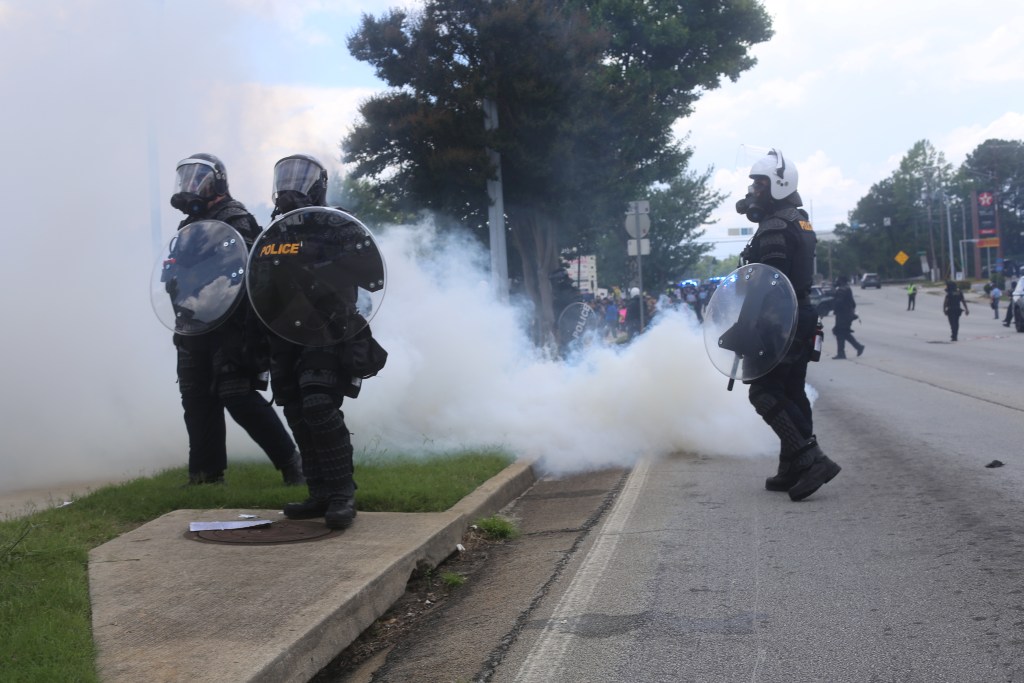
In the moments leading up to his arrest, the livestream shows him standing on the sidewalk filming a line of police officers in riot gear as they slowly advanced on the retreating, thinning crowd. Without any apparent warning, an officer grabs him, prompting Guevara to say: “Officer, officer, — I’m a member of the media, officer.”
“It’s a pretty straightforward case, but obviously if this ultimately does end up with ICE [detention], it will complicate that process, but the process will continue,” Díaz said, noting that there’s a possibility Guevara may be released after 48 hours if ICE does not take him into custody. “In this posture, we just have to wait.”
Guevara’s risk of deportation is low, given he has no apparent criminal history, according to local immigration attorney Charles Kuck — but his legal conundrum just got a lot more complicated.
“He has a way forward to remain in the country and ultimately get a green card, but that path — to use the legal term — sucks,” he said. “There’s no evidence to charge him with that crime. So even if you were convicted of that crime, that is not a deportable offense, nor a basis to deny a green card.”
Kuck said the charges Guevara faces would normally just get a signature bond, “but it’s also normal for ICE to put a detainer and detain anybody who’s released on those kinds of bonds. That’s ICE’s new policy.”
“It’s everybody, and they’re going to force him to go to immigration court and get a bond from an immigration judge,” Kuck explained. The process may take weeks.
For Kuck, who reviewed footage of Guevara’s arrest, the fact Guevara was arrested and charged in the first place is concerning.
“It’s outrageous that the police arrested him, but what ICE has done here, they have done to thousands of others, and it’s no surprise whatsoever,” he said.
Guevara’s case, he said, “represents complete disregard for the First Amendment, clearly. But second, and most importantly, it represents the fact that our Congress refuses to fix the situation.”
Atlanta Civic Circle reporters were just a few steps from Guevara when police in riot gear detained him while he was livestreaming the tail end of a protest where DeKalb County and Doraville police officers liberally deployed tear gas on the crowd of peaceful demonstrators on at least three separate occasions — first to chase them off the roadway, then to disperse them off the sidewalk.
At the anti-ICE protest, organized by the Party for Socialism and Liberation and Immigrant Rights Alliance, DeKalb police said they arrested “at least” eight people.
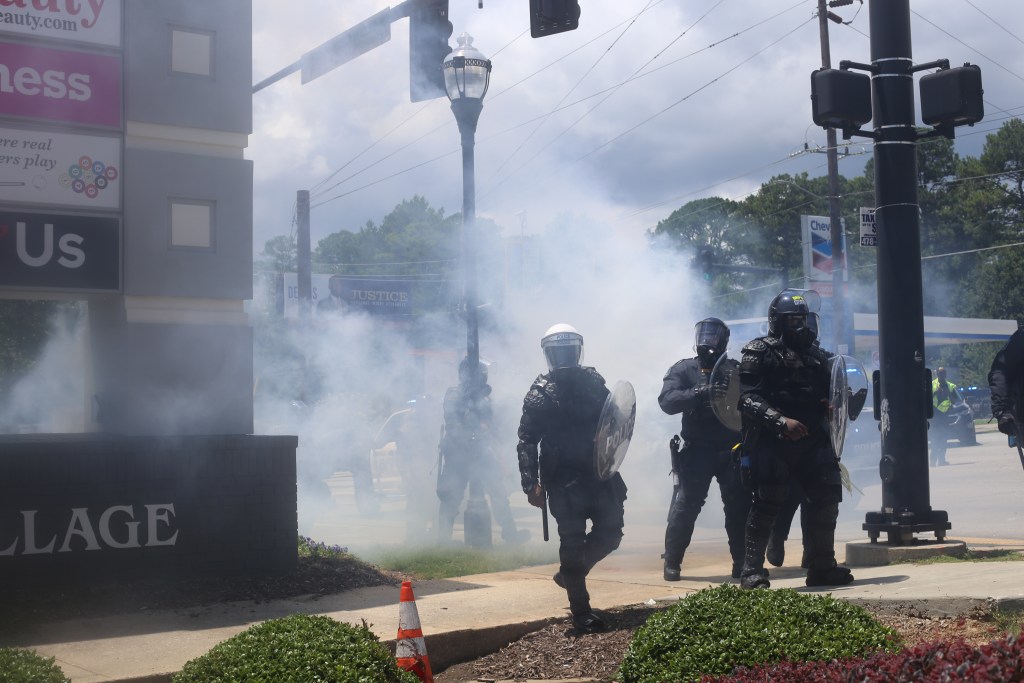
Officers clad in riot gear corralled members of the press away from the original protest site on Chamblee Tucker Road shortly after deploying tear gas for a third time. Officers clearly stated that they would arrest journalists as well as protestors if they did not leave. Guevara was complying with officers orders to move back, but was closer to police than other members of the press — including Atlanta Civic Circle reporters who saw him apprehended when he briefly stepped off the sidewalk.
Society of Professional Journalists (SPJ) national president Emily Bloch, in a statement to Atlanta Civic Circle, said the organization is concerned any time law enforcement “interferes with reporters covering the news.”
“Mr. Guevara seems to have been clearly identified as press, and while we are still looking into the details, based on what we know, he should not have been prevented from doing his job, much less taken into custody,” she said.

DeKalb County did not respond to a request for comment about Guevara’s arrest, but in a statement on Monday afternoon said that the police response was justified because protestors were moving towards an interstate ramp, “contributing to the need for crowd control and intervention.”
The statement also said the county is reviewing the police response at the request of concerned citizens. “We are conducting a full and transparent review of all law enforcement actions taken,” DeKalb CEO Lorraine Cochran-Johnson said.


He FAFO
He is legally allowed and authorized to work in the US. He is a legitimate journalist who was working at the time, not protesting. The press are not supposed to be targets or silenced. This is a dangerous and slippery slope of censorship when journalists are arrested while doing their job. He absolutely did not FAFO. He did his job and was unfairly, and unconstitutionally targeted (1st amendment freedom of press clause protects the press from government interference, prosecution, and constraint)