

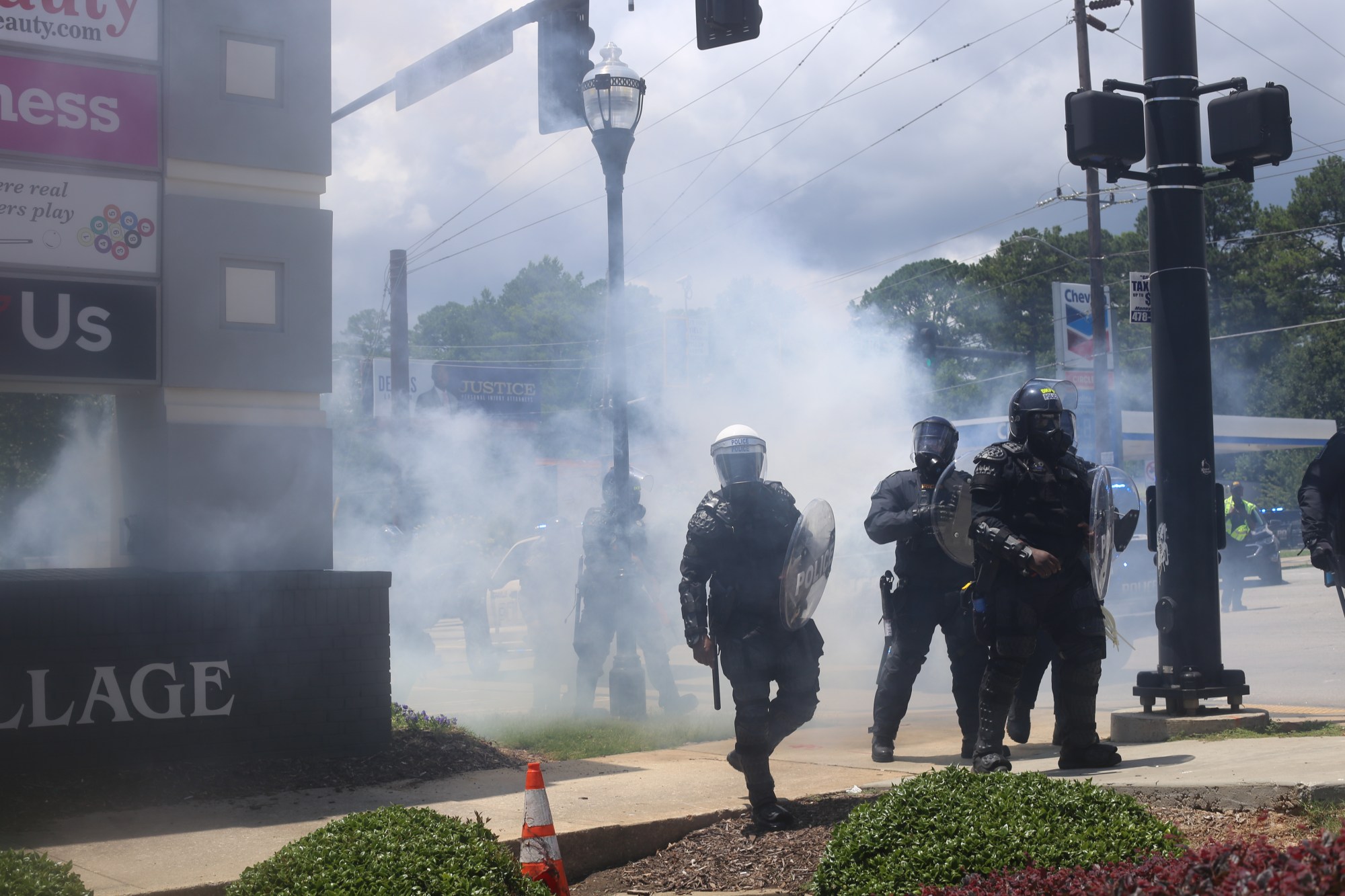


When Atlanta journalist Mario Guevara was arrested while filming an anti-ICE protest on June 14, he repeatedly identified himself as press. He wore a vest marked “PRESS.” And he was recording — not protesting. Even so, Doraville police officers arrested and jailed him on charges of unlawful assembly, improperly entering a roadway, and obstruction of law enforcement.
Guevara’s arrest raises legal questions about First Amendment protections for reporters — and for anyone in the U.S., regardless of citizenship. Specifically, three First Amendment experts raised concerns about prior restraint, which means the government interferes with speech to prevent it from happening, and retaliatory arrest, which means police punish someone for protected expression.
“This is targeting him because he was a member of the press,” said Gerry Weber, a constitutional lawyer and senior staff counsel at the Southern Center for Human Rights. “It’s essentially using law enforcement to silence him. And if he is silenced, others will be.”
For Guevara, a Salvadoran national, his arrest triggered an Immigration and Customs Enforcement (ICE) detainer and deportation proceedings, even though he’s legally authorized to work in the United States while awaiting a green card. After he spent four days in the DeKalb County Jail, ICE took him into custody and locked him up at its facility in Folkston, by the Florida border. Guevara was due to be released on $7500 bond on July 1, but ICE transferred him into the custody of the Gwinnett County Sheriff’s Office due to outstanding traffic charges there, according to his attorney Giovanni Díaz.
DeKalb Solicitor-General Donna Coleman-Stribling dropped the three misdemeanor charges against Guevara on June 25, citing insufficient evidence to prosecute. But she maintained there was “probable cause to support the initial arrest.”
However, Weber and two other First Amendment experts who reviewed police body-camera footage from the arrest and Guevara’s livestream say what happened to Guevara wasn’t just a questionable call by police — it was unconstitutional.
What happened?
The footage from both the Doraville Police Department and Guevara’s livestream show he was at least twice told by police officers to get out of the roadway while filming wide shots of police clashing with protesters. At times, he stepped into the street to avoid tear gas or gain distance from the crowd — but returned to the sidewalk each time after warnings.
Just before his arrest, officers can be heard agreeing to arrest him — knowing he was a journalist — if he stepped off the sidewalk again into a street partially blocked by police.
While filming and retreating from officers, Guevara again stepped into the street. Police rushed him, zip-tied his hands, and arrested him, as the journalist repeated: “Officer, officer, I am a member of the media.”
Prior restraint and press retaliation
Prior restraint means that the government preemptively takes action against someone to suppress their speech, which violates the First Amendment. That appears to be the case with Guevara’s arrest, said Weber and the other media law experts, since he was actively recording and broadcasting the anti-ICE protest, not participating.
What’s more, Weber added, people clearly identified as journalists are typically given “greater latitude” than protesters — a protection Guevara was denied. University of Georgia law professor Katherine Howard argued in a 2017 Georgia Law Review article that even when police have probable cause, arresting a journalist who is actively reporting can constitute retaliatory arrest. That can “also function as a type of prior restraint,” she wrote.
“When a person is arrested because of her speech, that arrest prevents any subsequent speech that might have been broadcast,” Howard explained. “Once under arrest, the journalist cannot use her phone to tweet updates about an unfolding situation, the bystander cannot upload a video of a racially charged traffic stop, and the protester cannot participate in the expressive protest.”

As an example, Howard pointed to journalists arrested during 2014 Black Lives Matter protests in Fergusson, Missouri. Their charges were later dropped and they also won settlements in civil lawsuits against the authorities.
Guevara’s arrest appeared retaliatory to Richard T. Griffiths, president emeritus of the Georgia First Amendment Foundation. After reviewing the footage, he said: “It’s clear that they knew he was a journalist, and it does appear that that’s harassment of a journalist and retaliation for what he was doing as a journalist.”
Griffiths added that stepping into the street for a better view or to stay out of the way of police is “totally normal” for journalists covering protests. He also pointed to Toole v. City of Atlanta, where the 11th Circuit Court of Appeals denied qualified immunity to police who arrested a protester filming in the street.
Nora Benavidez, senior counsel for Free Press, a press freedom nonprofit, said video of Guevara’s arrest makes clear “he was engaging in constitutionally protected activities.”
Guevara’s arrest fits into a broader national pattern of retaliation against journalists, she said. For instance, nine journalists were arrested in Los Angeles anti-ICE protests last month, according to the U.S. Press Freedom Tracker.
“We are in an era of retaliation right now,” Benavidez said. “We’ve seen journalists get attacked with rubber bullets [and] arrested.” She warned that the implications go beyond journalism. “Those potential constitutional violations affect not just journalists but others on site at a protest,” she said.
Note: This story has been updated to reflect that despite posting bond, Guevara remains in custody.
Leave a comment