

What kind of Immigration and Customs Enforcement (ICE) activity is there in Georgia? What can you do if ICE agents come to your home or business? And how can people responsibly report on ICE activity?
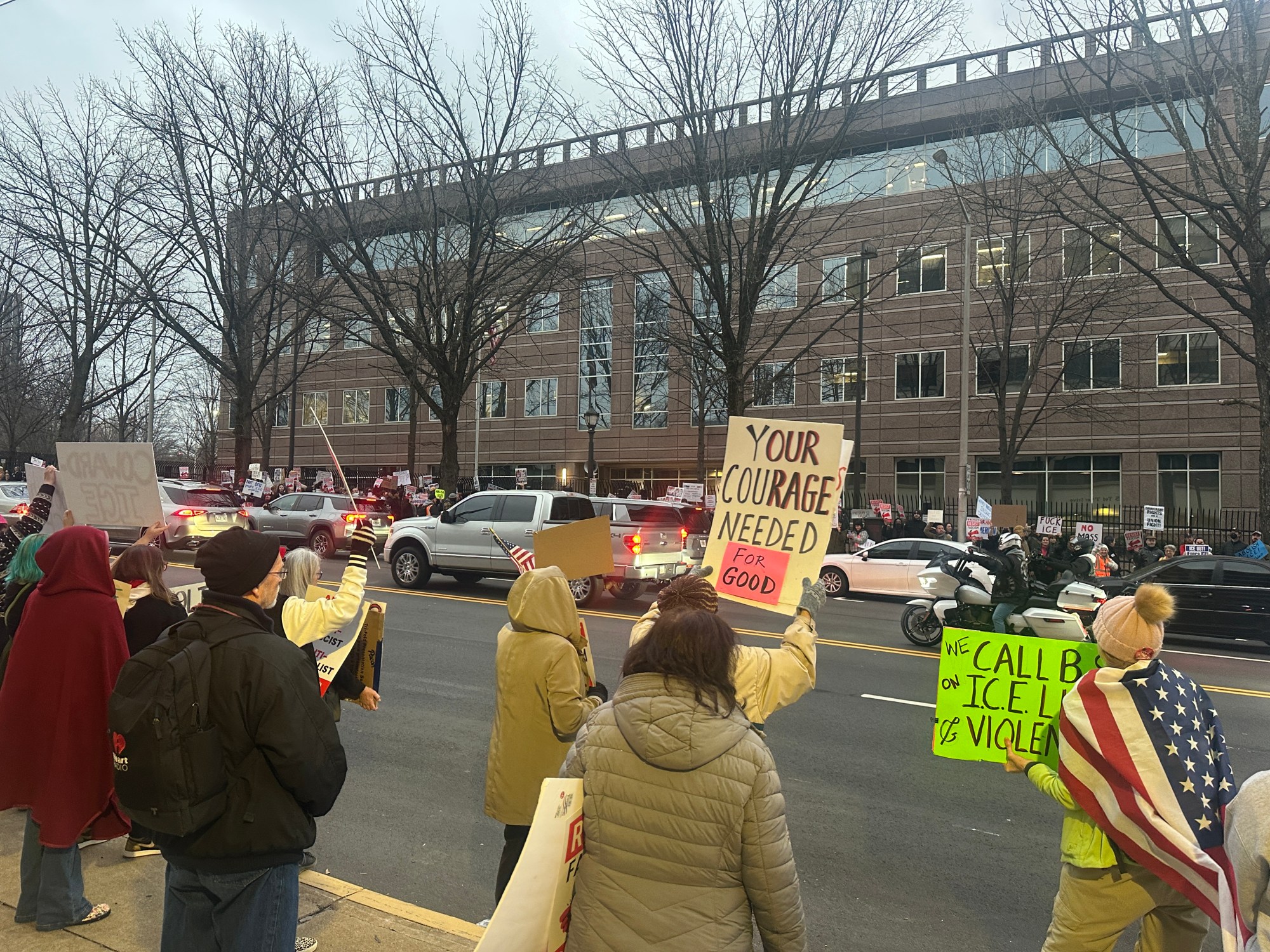
These questions prompted over 75 Atlantans to turn out for a community-response training about ICE activity at the Little Five Points Community Center on March 1, hosted by Atlanta City Councilmember Kelsea Bond.
“Our cities are under attack by our federal government right now, and the most vulnerable people are most likely to be harmed,” Bond said. “We want to make sure that here in Atlanta, we are equipped to fight back [and] defend our neighbors.”
How ICE operates in Georgia
In cities like Minneapolis, Chicago, and Los Angeles, agents from ICE, along with Customs and Border Protection (CPB), have arrested people right off the streets.
Even though Georgia ranks fifth nationally for immigration arrests (behind Texas, Florida, California, and New York), ICE’s presence here has been a lot less visible. That’s because state law requires local law enforcement to collaborate with ICE and turn over immigrants under an ICE detainer order from local jails.
“The tactics we’re seeing in Georgia are really different than other places. A lot of police and ICE collaboration is happening inside jails,” said one of the training leaders from the Georgia Latino Alliance for Human Rights (GLAHR), an immigrant-rights advocacy group.
Consequently, the trainer added, high visibility sweeps, checkpoints and roadblocks are uncommon in Georgia. The GLAHR organizers declined to be named, citing fears of retaliation from the government.
However, ICE and related agencies from the Department of Homeland Security (DHS) are quite active in Atlanta and other Georgia cities. The GLAHR organizers shared some practical information with local residents on how to respond to an ICE encounter.

What if ICE comes to your door?
If ICE agents try to arrest someone on private property, like a home or business, the occupants have a constitutional right to deny entry, unless the agents present a warrant signed by a federal judge. Without a federal judicial warrant, one GLAHR organizer said, “They don’t have any power to force anyone to open doors to private spaces protected by the Fourth Amendment.”
Instead of opening the door, ask the agents to slide the warrant under it, and make sure that it is signed by a federal judge. A judicial warrant should also list the correct name of the person sought and specify where agents are authorized to search. Also check the warrant’s expiration date: A judicial warrant can be executed up to two weeks before the expiration date, but not after it.
One person at the training asked if a hospital is considered a business, saying she works for a nonprofit that operates out of an Atlanta hospital. Hospitals, schools and churches used to be protected from immigration enforcement, but DHS has rescinded their protected status as “sensitive locations” under the Trump administration. Consequently, immigration agents can enter public areas of a hospital without a judicial warrant, but they must have it to enter private areas, such as treatment rooms.
Note that ICE often uses what are called administrative warrants, which are issued and signed by an ICE agent, not a federal judge. These warrants allow federal agents to apprehend the named person in a public space, but they do not grant them the authority to enter privately owned places.
Click here to see the differences between a federal judicial warrant and an administrative ICE warrant.
How to safely support people targeted by ICE
Law enforcement agents are only required to show a warrant to the person they are targeting for arrest or to someone who controls access to a private property. That means agents don’t have to show a warrant to bystanders demanding to see it in public.
When ICE agents have a judicial warrant, a GLAHR organizer added, they usually bring local law enforcement to apprehend the person they’re targeting. “The situation changes in that moment,” he said. Interfering with the operation could risk criminal charges, such as harboring a fugitive.
But bystanders can still use their phones to record the arrest, confirm that the judicial warrant appears valid, and that the person being arrested has invoked their right to remain silent.
How to record and report ICE activity responsibly
When documenting ICE or any other law enforcement activity, the GLAHR trainers recommended turning your phone sideways to record in landscape mode and to use neutral, factual terms to narrate what you see happening.
“We recommend not including your personal opinion,” one trainer said, explaining that the footage could potentially be used in court.
They suggested using the SALUTE model to identify the law enforcement officers, describe what they’re doing – and to whom. Don’t forget to say where and when you are recording.
SALUTE Protocol:
- Size/Strength: number of officers or vehicles
- Activity: what agents are doing
- Location: specific location and movement
- Uniform: clothing or identification
- Time and date
- Equipment: gear or weapons
If law enforcement officers instruct you to step back while recording, the GLAHR organizers suggested filming yourself complying, while narrating the interaction. For instance: “The ICE agent just told me to move back, which is what I am doing right now.”
Under Georgia law, there is no set distance that you have to stand back to record police activity, but the trainers emphasized using your judgment and prioritizing your safety.
They also advised against posting footage immediately on social media. Instead, share it with family members or immigrant-rights groups that can assist the people affected.
Which federal agents can do immigration operations?
To avoid panic and misinformation, make sure to accurately identify DHS agents before reporting a potential ICE sighting to the community, particularly on social media. In November, for instance, photos of armed federal agents at a MARTA station circulated online with claims they were ICE – but it was actually a Transportation Security Administration (TSA) tactical team.
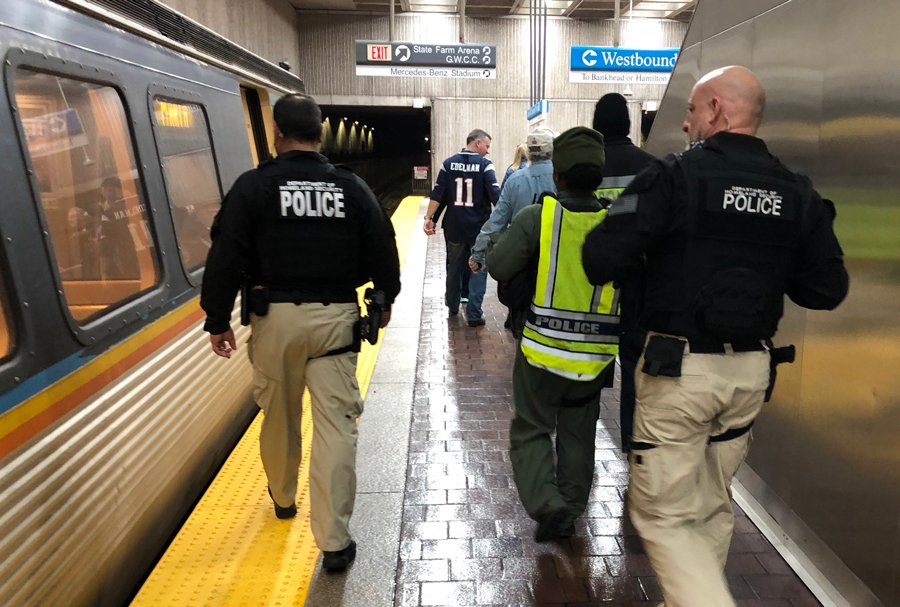
Some DHS agencies, like ICE and CPB, can conduct immigration enforcement operations, but others, like TSA, can’t. “Don’t just share a picture,” a GLAHR organizer said. “Ask what agency they’re with so you can confirm.”
Here are the DHS agencies that can conduct immigration enforcement:
- Enforcement and Removal Operations (ERO): This is the ICE division that actually identifies and removes undocumented immigrants.
- Homeland Security Investigations (HSI): This ICE division has typically focused on investigating crimes like human trafficking and drug smuggling, but now HSI agents are sometimes involved in immigration operations.
- Customs and Border Protection (CBP): This is the largest DHS agency. In Georgia, CBP agents are typically seen at ports and airports, like Hartsfield-Jackson Atlanta International Airport. They can also operate within 100 miles of a U.S. land or sea border which includes Georgia’s coastline.
- U.S. Citizenship and Immigration Services (USCIS): Congress made this agency to serve as the administrative agency for immigration applications and paperwork. But the Trump administration on Sept. 4, 2025 announced a USCIS “special agent” position with arrest powers. So far, their use has not been widespread.
DHS agencies that cannot conduct immigration enforcement include:
- The TSA’s Visible Intermodal Prevention and Response (VIPR) teams: They often patrol airports, transit hubs, like MARTA, or major events.
- Federal Protective Service (FPS): It provides security for federal buildings.


Excellent article I appreciate the straightforward approach providing useful information without cluttering with emotions and opinion.
FYI: VIPR agents (who have a “Department of Homeland Security” marking on front/back of uniform) are, in fact, Federal Air Marshals (which is part of TSA).
These will have a “Federal Air Marshal” patch on one of their arms and if their badge, clipped to their belt, is visible it will be marked “Federal Air Marshal” as well.
Most useful article I have read in a long while. Thank you for the thorough research and specifics.