


In a surprising reversal, Atlanta City Council today postponed an expected committee vote on legislation steered by the Mayor’s Office to extend the city’s eight tax allocation districts (TADs) to 2055.
Bowing to pressure from a growing chorus of critics warning the move would shortchange local public schools and questioning the speed at which the eight-week old proposal is moving, the council tabled the measure until early 2026.
The city of Atlanta’s TADs divert increases in property tax revenue from Atlanta Public Schools, the city, and Fulton County to finance economic development projects in a TAD-designated area over its lifetime. In late September, Mayor Andre Dickens unveiled a proposal to extend all eight TADs for up to 25 years, saying it will generate $5 billion in diverted tax revenue to invest in underserved areas.
The unexpected about-face came after District 2 Councilmember-elect Kelsea Bond rallied the public and advocacy groups to pressure City Hall to delay upcoming TAD extension votes until next year, when newly-elected councilmembers are sworn in. Bond also told Atlanta Civic Circle they had several meetings with the mayor’s chief of staff, Courtney English, and city council members earlier this week.
Bond has questioned whether TADs are the best mechanism to improve neighborhoods, saying in a Nov. 22 Instagram video that they have actually been a “money pot” for developers and a “gentrification engine” for areas like Atlantic Station and the Eastside Beltline. In the video, which racked up over 12,000 views in just three days, they urged Atlantans to tell their council members to vote no on the TAD extension.
Adding to the pressure, the Democratic Socialists of America (DSA) Atlanta chapter organized a “Stop the TAD!” letter-writing campaign that sent 672 letters to the city council.
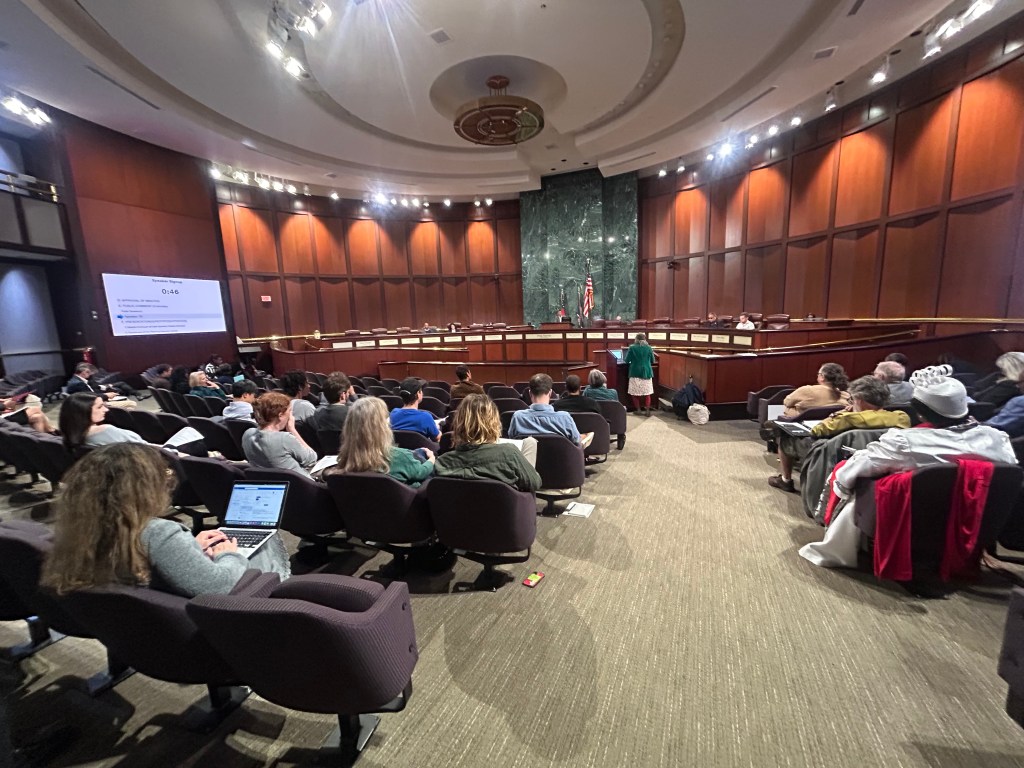
“Voters deserve transparency, community participation, and a detailed plan as to where this money is going.” Bond said at Tuesday’s Community Development and Human Services meeting, where the TAD extension was expected to come up for a committee vote.
But in a surprise visit, English, the mayor’s chief of staff, signed up for the meeting’s first public comment slot. “In the spirit of collaboration, in the spirit of transparency, in the spirit of getting this right, we’re going to wait until next year,” said English, a top proponent of the TAD-extension proposal.
Over 30 Atlantans had lined up behind him to speak against the proposal.

“If you didn’t get the gist of the chief of staff’s comment, council will not be moving forward with any TAD legislation today or this year,” CDHS chair Jason Winston told the public, drawing applause and cheers.
The Dickens administration had hoped to secure the city council’s approval in December, before its winter break. The proposed TAD extensions also require approval from APS, and Fulton County.
“This shows that when working people come together, we can set the agenda at City Hall, not big developers and corporations,” Bond said on Tuesday.
The tenor of Tuesday’s meeting was in stark contrast to the council’s Community Development and Human Services meeting just six weeks ago. During public comment at the Oct. 14 meeting, dozens of speakers, including top nonprofit heads and developers, endorsed extending all of the TADs. “We could not build affordable housing in the city of Atlanta without [TADs],” said one speaker, Joel Reed, who works for developer Gorman & Company.
Full court press
The Mayor’s Office has mounted a full-court press to promote extending the TADs, which currently sunset between 2030 and 2038. It is pitching using the diverted tax revenue to invest in seven target neighborhoods: Thomasville Heights, English Avenue/Vine City, Grove Park/Bankhead, West Hollowell, East Campbellton, West Campbellton, and Downtown.
Opponents, however, contend the TADs have already fulfilled their purpose and sparked sufficient development in neighborhoods around the Beltline, Atlantic Station, Mercedes-Benz Stadium, and the Westside. At this point, they say, the TADs are serving as engines for gentrification and displacement.
The full city council voted on Nov. 17 to create a TAD oversight commission, but Bond and other community activists have criticized it as stacked with pro-TAD interests, such as the Mayor’s Office, Invest Atlanta, the Atlanta Committee for Progress, the Metro Atlanta Chamber of Commerce, and the Arthur M. Blank Foundation.
At the Nov. 25 city council committee meeting, Bond challenged Atlanta’s government to “set the standard for what democracy looks like,” at a time of rising influence from billionaires and corporate interests federally. “Community participation is what democracy looks like, not shadowy boards of CEOs and corporate interests doling out money to for-profit developers that should be going towards our public schools,” they said.
Sean Keenan contributed to this story.
good for DSA! Glad to see coordinated city action.
What good would an oversight committee do? Dickens also opened a vote on Cop City, but when the vote came out to overwhelmingly reject Cop City, he ignored it and went ahead with it regardless. Dickens has been a major disappointment and needs to go. He rarely does anything to help Atlanta’s citizens.