


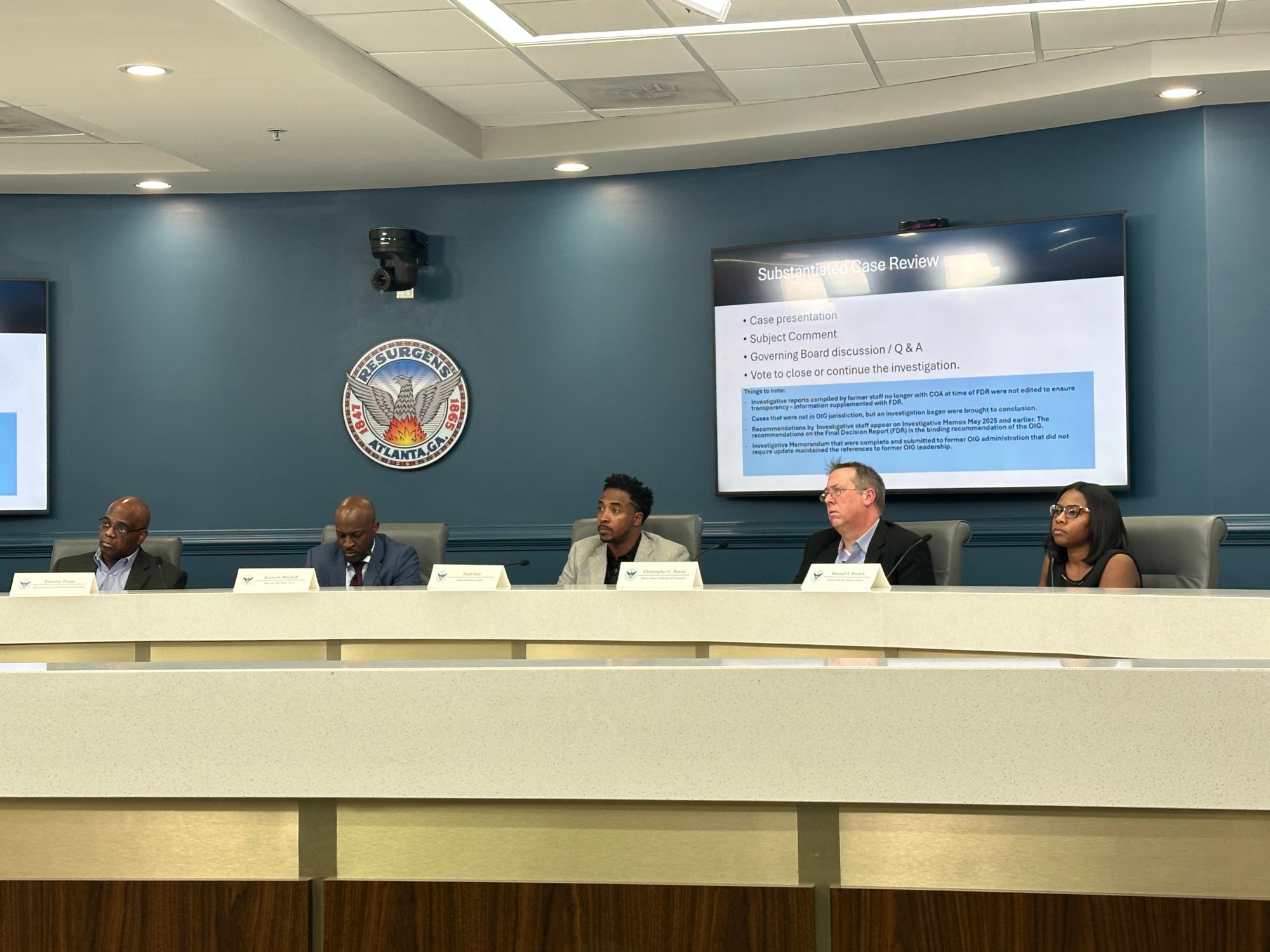

Atlanta’s reconstituted governing board for the Office of the Inspector General (OIG) approved closing 29 still open investigations into potential malfeasance by city employees last month. That’s solely because the clock ran out on the probes after the city imposed a two-year time limit last year, as part of its sweeping reforms to the OIG.
Among the cases under investigation were an alleged $3.9 million cost overrun by United Way of Greater Atlanta to administer COVID-19 relief grants, a city benefits manager who accepted two Braves VIP suite tickets from a bidder on a city contract, and an Oakland Cemetery employee who dug up an old body.
When former Inspector General Shannnon Manigault, along with most of the OIG’s governing board, resigned in protest in February 2025 over the city’s impending overhaul of the OIG, the office had 74 active investigations into waste, fraud, and abuse. When the mayor appointed interim Inspector General LaDawn Blackett later that month, she inherited the caseload.
Of those 74 cases, Blackett resolved 45, announcing in November that the OIG found no wrongdoing in 35 cases and valid waste, fraud, and abuse claims in the other 10. But Blackett administratively closed the remaining 29 open investigations without any determination of wrongdoing — because they exceeded the city’s new two-year time limit. A handful were referred to the city’s Human Resources Department over allegations of sexual harassment or a toxic work environment, which falls outside the OIG’s mandate.

The OIG reforms championed by Atlanta Mayor Andre Dickens and approved by the Atlanta City Council last February also stripped the OIG’s inspector general of the power to close investigations. Instead, it’s the OIG’s seven-member governing board that must sign off – but it wasn’t until January that the new board finally had the quorum it needed and had reviewed the cases. At its Jan. 29 meeting, the board approved Blackett’s case closures and authorized making them public.
Via an open records request, Atlanta Civic Circle obtained 452 pages of case files for the 29 administratively closed cases. Many involved minor infractions, unsubstantiated claims, or issues better suited for human resources. But others revealed incidents of sloppiness, mismanagement, and corruption across multiple city departments.
Here’s a look at what we found in the closed case files.
United Way cost overruns for city grant
A 2021 Atlanta Civic Circle article about the city’s emergency housing assistance program during the COVID-19 pandemic prompted the OIG to probe the fund administrators, according to the case filing. The office found in 2022 that United Way of Greater Atlanta far exceeded the city of Atlanta’s 10% limit on overhead costs to administer a $22 million COVID-19 relief grant. Upon further investigation the OIG found that United Way spent almost $9.2 million, or 17.5%, of $52.5 million in total housing assistance funds from the city on administrative costs — a $3.9 million overrun. The OIG attributed that to “operational deficiencies” and said it could have gone instead toward Atlanta households in need.
Blackett wrote in a memo closing the case that the OIG did not account for “the unique nature of the COVID-19 pandemic.” She added that the probe was outside the OIG’s purview, so it shouldn’t have been brought.
Braves tickets from city contractor
The OIG found in 2022 that a former benefits manager for the Atlanta Department of Human Resources, TaDarol Bates, accepted two Atlanta Braves VIP suite tickets from Kaiser Permanente during a blackout period, while the health insurer was bidding on a city contract for employees’ insurance coverage. However, the city subsequently cancelled the solicitation in 2023, and rebid it. It ultimately awarded the insurance contracts to Kaiser and four other companies.
The OIG concluded the contract to Kaiser was properly awarded because of the rebid, and the Atlanta Ethics Office fined Bates $2,000.
Altered water quality tests
Also in 2022, the Atlanta Ethics Office and the US Environmental Protection Agency (EPA) referred a case to the OIG about the quality of the city’s treated wastewater that’s released into the Chattahoochee River. It alleged employees from the Department of Watershed Management tampered with the ammonia and phosphorus levels in water samples from one of the city’s wastewater treatment plants before submitting them to the Georgia Department of Natural Resources (DNR).
The OIG had partially substantiated the allegations when the case timed out. The employees in question no longer work for the city, according to the case file. Due to the incident, both the EPA and Georgia DNR in 2024 recommended updated procedures to the Department of Watershed Management for how its employees test and report wastewater quality.
An accidental $25,000 withdrawal
In another 2022 case, the city’s Deputy CFO, Tina Wilson, asked the OIG to investigate an allegation that Atlanta’s former director of Grant Services, Lee Hannah, had in 2020 taken $25,000 from the Friendship Club, Inc. a city-run nonprofit to help employees in need. The Atlanta Police Department (APD) and the Fulton County District Attorney’s Office also investigated the case.
According to an APD interview cited in the case filing, Hannah claimed he’d withdrawn the money in error, believing it was from his personal account. Hannah subsequently returned the funds and the Fulton DA chose not to prosecute.
Gravedigging side job
The OIG probed a 2023 complaint against an Oakland Cemetery employee from the Atlanta Parks Department for using his position to disinter and transport the 50-year-old remains of an infant to Louisiana at the request of the family. The employee, who worked on the side as a licensed funeral director and embalmer, admitted he was paid at least $500, plus costs.
The investigator noted the case was five years old and should be referred to the Atlanta Ethics Office to determine whether the employee’s side job as a funeral director created a conflict of interest.