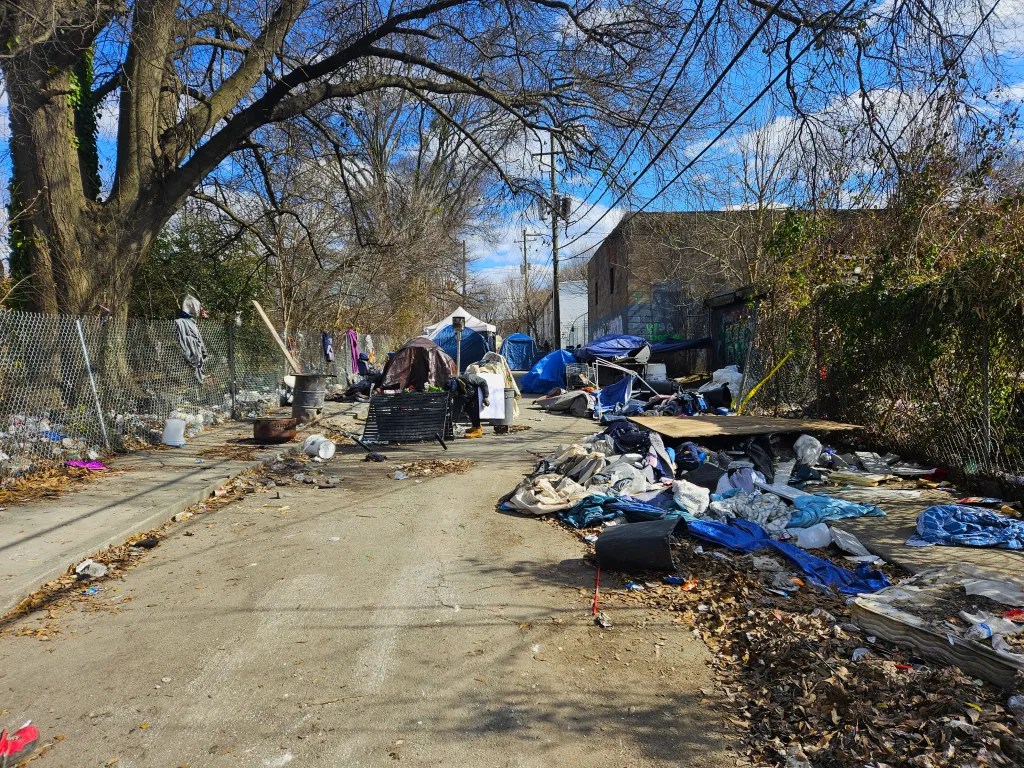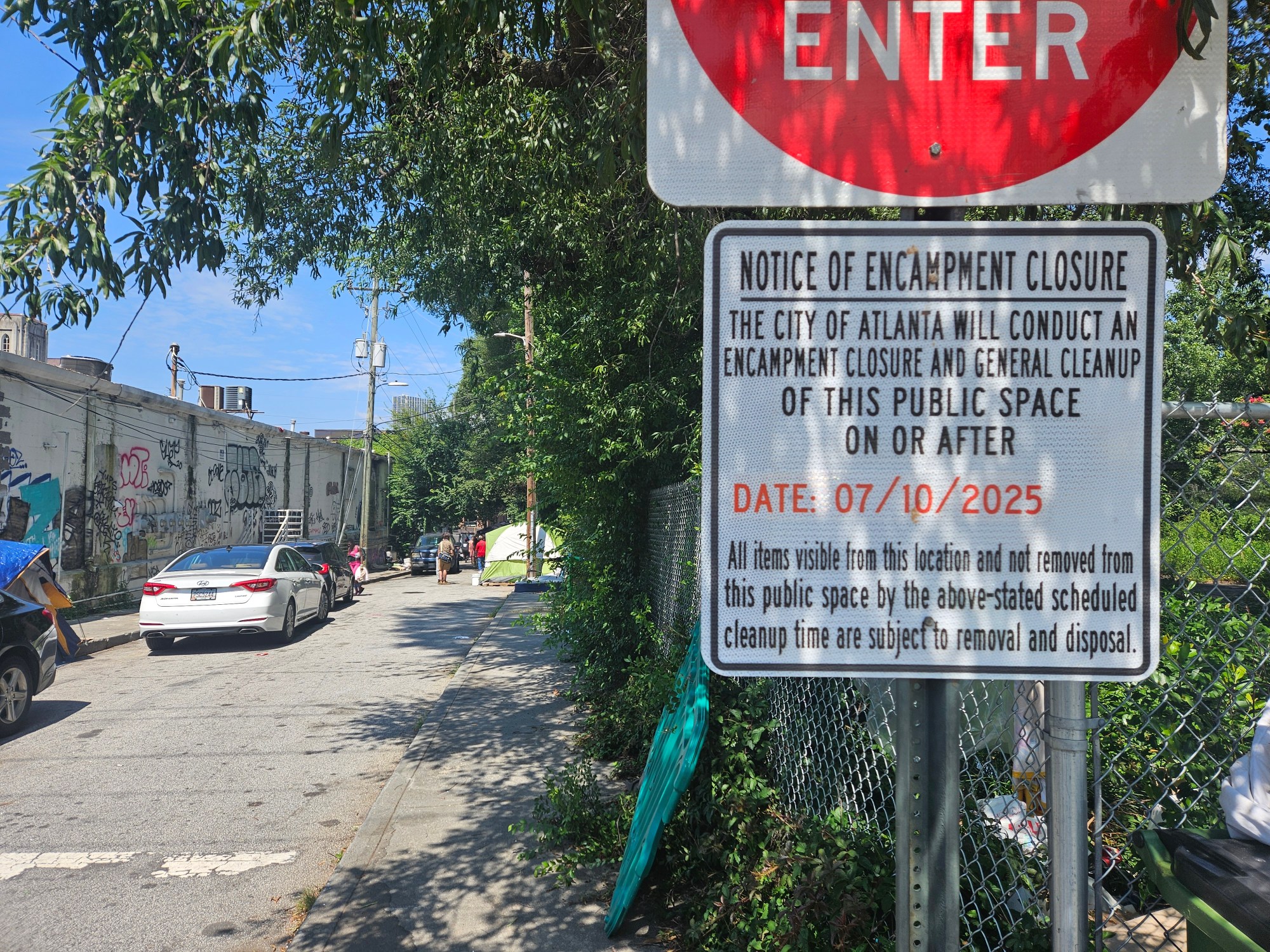
Atlanta officials envision their plan to clear an Old Fourth Ward homeless encampment on Friday and relocate 14 residents as a compassionate rehousing effort — but housing advocates are calling it an “eviction.”
The city’s reactivation of encampment clearances after a temporary moratorium has quickly become a flashpoint in the complicated debate over how to best help Atlanta’s unhoused residents. The city says it will rehouse 14 people from the encampment to a supportive housing complex downtown. But at a protest Monday at City Hall, housing activists called on the city to cancel the clearance plan, saying at least 28 people live there — double the city’s tally.
The city first attempted to clear out the Old Wheat Street tent city in January. The early-morning operation came to an abrupt halt when an Atlanta Public Works employee struck an unhoused man with a bulldozer. Forty-six-year-old Cornelius Taylor, who had been asleep in his tent, died at the hospital hours after the accident.
Taylor’s death prompted the city to convene a Homeless Task Force. It was given 90 days to formulate proper procedures for clearing encampments and relocating residents, with input from municipal leaders, nonprofits, and housing advocates. In June the task force debuted a raft of policies to bolster communication with unhoused people and ensure that Atlanta’s encampment closure procedures are humane.
But to the chagrin of the Justice for Cornelius Taylor Coalition, Housing Justice League, and American Friends Service Committee, the city didn’t budge on the groups’ campaign to “stop the sweeps.”
Equipped with the new clearance guidelines, the city initially planned to shut down the Old Wheat Street encampment early Thursday morning — but after the Monday protest at City Hall, Mayor Andre Dickens’ office postponed the clearance until Friday.
“It’s pretty simple: Let’s not bulldoze people out of there until we have a housing solution for everybody,” said American Friends Service Committee organizer Tim Franzen through a loudspeaker at the City Hall protest.
The operative word was everybody, Franzen said. The city and its go-to homeless services nonprofit, Partners for Home, claim there are 14 people who have made Old Wheat Street home for years. The city has given them the option to relocate to the Welcome House, a supportive housing complex located at 234 Memorial Dr. But activists say there are at least 28 people living at Old Wheat Street who could use that help.

Partners for Home CEO Cathryn Vassell acknowledged that the number of residents at the encampment fluctuates. “There are a lot of folks coming and going,” she said in an interview. But she emphasized that the Friday encampment clearance is focused on rehousing chronically homeless people who’ve been long-term residents there, not those who might live on the streets nearby.
So what happens to the unhoused people who either aren’t on the city’s 14-person list, or who don’t want to go to Welcome House?
“If individuals do not accept the housing offer, we can also offer short-term shelter, while they work on other housing solutions,” Vassell said. “And then we can make another offer down the road as other housing solutions come up.”
But most Old Wheat Street residents — and many unhoused people in general — would rather live in tents than give up their independence for the more restrictive oversight of shelters, said Franzen, who leads the campaign against the encampment clearances. Dismantling the makeshift community on Friday, he said, “would just sweep people into another encampment.”
3Keys, the nonprofit that runs Welcome House, has contracted with the city to place 15 people there. But CEO Scott Walker told Atlanta Civic Circle on Tuesday that Welcome House can house additional people — if the city asks, that is. Vassell and Dickens’ top housing advisors could not be reached for comment on that possibility.
Welcome House typically serves as transitional housing. But there are also five on-site case managers to connect tenants with mental health, medical, and substance use services — and residents in the supportive housing units share communal kitchens and bathrooms.
Walker acknowledges that it isn’t for everyone. “There may be some individuals that feel like, ‘I want a one-bedroom with my own bathroom and my own kitchen,’” he said. “I absolutely get that. Welcome House is not the be-all, end-all for everybody, and it is not the last stop for everybody.”
But it could be an important springboard to more independent housing options, he said.
The prospect of intense oversight was CeCe Chandler’s hangup. She’s lived at Old Wheat Street for roughly a year with her husband, Kenny Pearson. They both want safe, stable housing — but Chandler doesn’t want to feel babysat, and affordable units without restrictions are hard to come by. “I’ve been there,” she said. “I know what it’s like. I don’t want to go back.”
Pearson added: “It’s just monitored, and that’s terrible for my wife.”
After a tour of Welcome House this week, though, Chandler changed her mind. She’s ready to move in there with her husband.
Franzen said the housing activists will continue pressuring the city to relocate the additional 14 Old Wheat Street residents they’ve identified to Welcome House — if those people want to go. Meanwhile, some activists intend to picket the cleanup crew on Friday, hoping to prevent the city from driving out the dozens of people who feel they have nowhere else to go.