
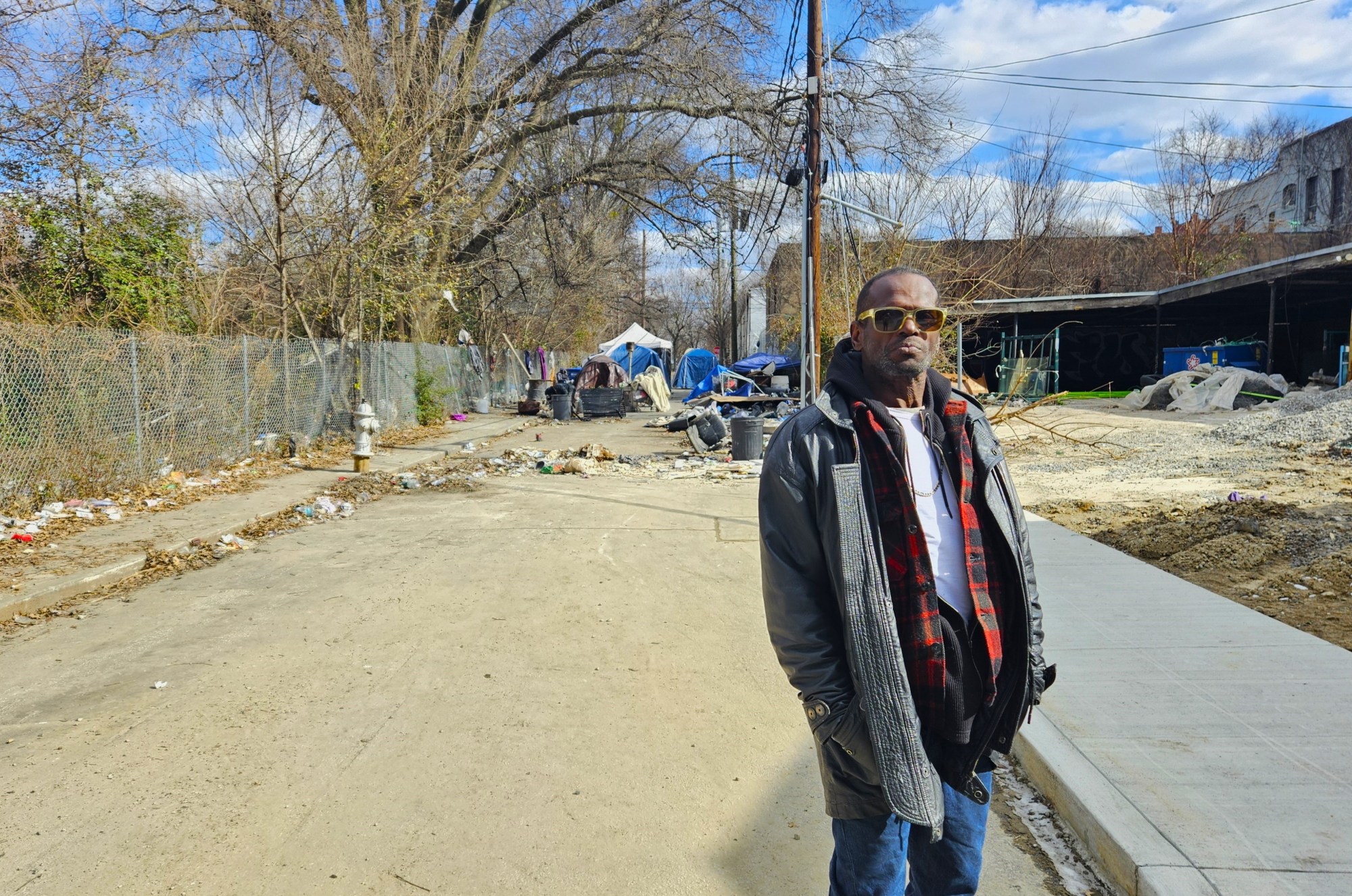

The short stretch of Old Wheat Street jutting west from Ebenezer Baptist Church is more than the mosaic of shattered liquor bottles, takeout boxes, and cigarette butts visible from Jackson Street — more than an eyesore tent-city in fast-evolving Old Fourth Ward, where luxury apartments and high-end restaurants are sprouting like weeds and driving up the cost of living.
For a few dozen Atlantans, this tiny alleyway, just blocks from Martin Luther King Jr.’s birthplace, is home. It is where strangers have become family.
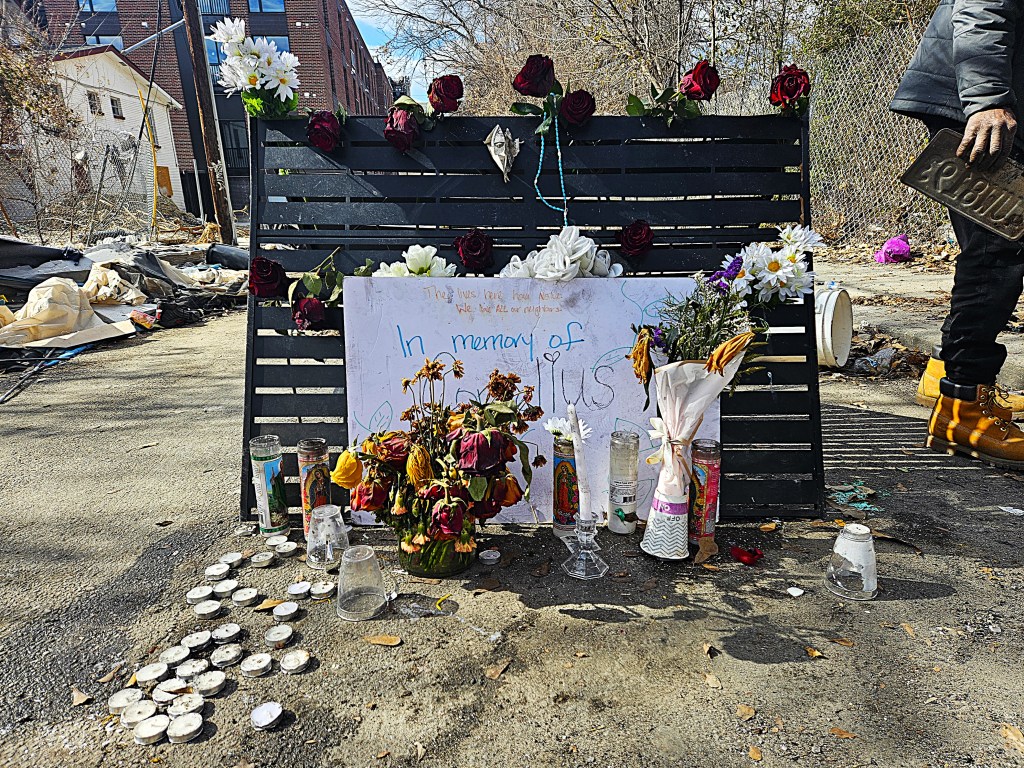
But on Jan. 16, that family lost a loved one, turning the Old Wheat Street encampment into the latest flashpoint in the long-running conversation about how best to approach Atlanta’s seemingly sisyphean battle with homelessness. That afternoon, a municipal effort to clear the encampment left 47-year-old Cornelius Taylor dead. Witnesses claim he was struck by a bulldozer, and officials say he died in a hospital soon after.
The outcry from the tragedy has forced the city to confront its policies on clearing encampments — and also on how it addresses homelessness at large. Atlanta City Council members and the mayor’s office have called to temporarily halt clearance operations, at least until they can find out what exactly went wrong and how to prevent it from happening again.
Housing advocates insist Taylor’s death reflects the city of Atlanta’s insensitivity to the plight of unhoused people, and are urging widespread reform of the city’s policies toward unhoused people and a permanent ban on encampment “sweeps.”
But Gus Hendricks, who said he was Taylor’s best friend and had witnessed some of his final moments, simply wants people to remember what happened, and to recognize his friend as a human being — not a statistic or a headline or an inevitable casualty of his turbulent environment.
“He wanted to go places, just like everybody,” Hendricks said, staring at the crumpled mess of tarp, plywood, and cinder blocks that Taylor had pieced together into a home. “He wanted to be a husband, have a family. He wanted things out of life, and he found open arms here.”
“It could have been any of us,” he added. “He was us.”
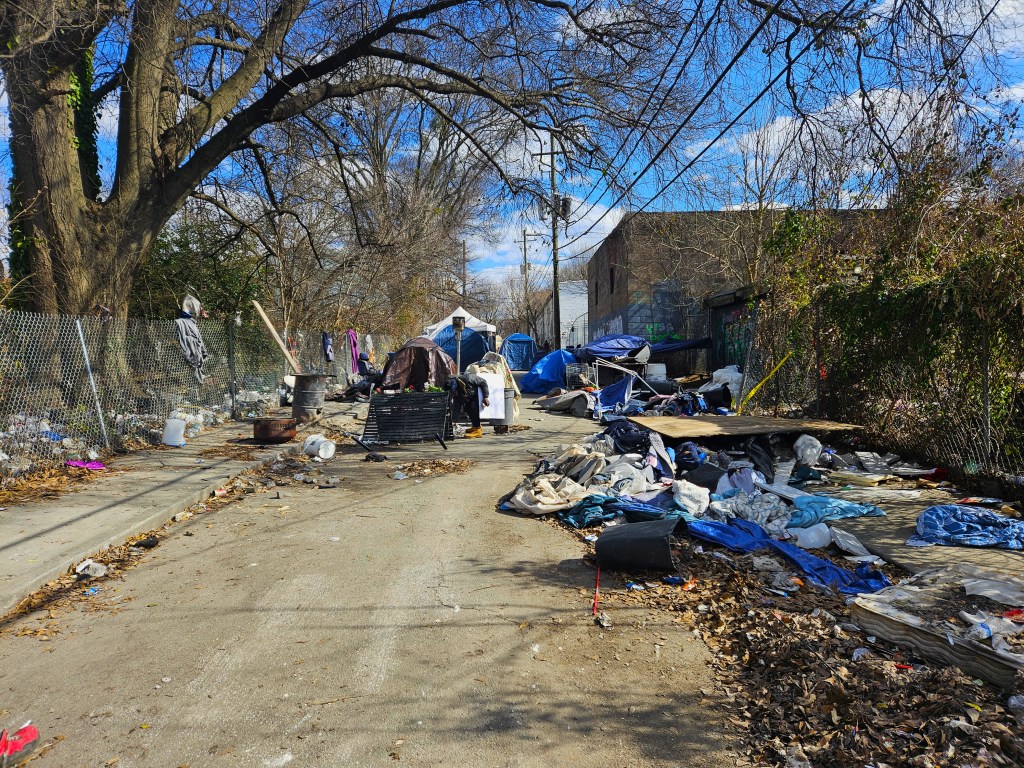
Hendricks said he’d known Taylor for more than a decade. They spent many of those years on Old Wheat Street, shaded by the towering oak trees and warmed by barrel fires behind a cigar store, barber shop, funeral home, and rows of shuttered businesses.
“People have misconceptions about homeless people,” Hendricks said. “They think homeless people are lazy, that they don’t want anything. But that’s a lie.”
When the encampment-clearing crew discovered Taylor in his tent, they halted the operation. Since then, new tents have been erected, and Old Wheat Street remains a makeshift neighborhood — for now.
A peaceful place
Sure, Hendricks and Taylor spent some of their time together drinking and getting high. That’s how they celebrated this past Christmas. But they’d also been engaged community members, taking odd jobs at local businesses to earn money for themselves and their neighbors. Living in an encampment is certainly an alternative lifestyle — one that Hendricks says he adopted “by choice” — but he, like several neighbors, said it’s not an existence that endangers the surrounding neighborhood. Nor does it lend itself to sloth: Surviving on the street is hard work, he explained.
Ryan Young, who works at Havana Cigars, located along Jackson Street between Auburn Avenue and Old Wheat Street, said the camp behind the business, though unsightly, has never been a problem. Taylor used to help Young tidy up the shop, as have other camp residents.
“Cornelius would help me bring in the stools or take out the trash,” Young said. “He was always here to help. He was just a real friendly guy, and he was part of this community.”
“They’re all pretty chill people,” he added. “They just happen to be down on their luck and maybe need a place to stay as they go through their transition.”
Other business owners, church leaders, and even City Councilmember Amir Farokhi, who represents the district, agreed that the Old Wheat Street encampment posed no danger to its environs. “The complaints I’ve received have always been about unsightliness or sanitary conditions, not about crime,” Farokhi said.
Taylor’s cousin, Darlene Chaney, said she saw him as a “big brother.” She shared at a press conference called by Taylor’s family last week that he was a devout Christian, and that they had shared Bible verses with one another “whenever he could get access to a phone.”
“We’d say, ‘Read this one — I’ll call you back and we’ll discuss it,’” Chaney said.
City probe
The city of Atlanta is probing the Jan. 16 clearance operation to piece together how an otherwise routine operation turned deadly, but the circumstances surrounding Taylor’s untimely death remain mysterious. So does the impetus for the clearance action, which occurred just days before the city’s Martin Luther King Day observations and the College Football National Championship game on Jan. 20, which drew thousands from across the country.
The “encampment closure plan” had been scheduled for months, according to Cathryn Vassell, the head of the city’s homeless services nonprofit, Partners For Home. She said her agency’s outreach staff had visited the Old Wheat Street site numerous times ahead of the holiday weekend in a bid to connect residents to stable housing.
“In June 2024, outreach partners supported 11 individuals moving to emergency shelter, and in January 2025, outreach partners supported 10 individuals to move into shelter, one individual to move into permanent housing, and one whose housing placement is imminent,” Vassell added.
“Encampment closings can be a traumatic experience for individuals who live within them,” say Partners For Home materials. “In addition to ongoing requests to relocate, closings can cause residents to lose personal belongings, such as identification documents and medication, as well as reduce their trust in receiving assistance from outreach team members.”
Local advocacy group Housing Justice League reacted with shock to Taylor’s death, releasing a media statement that called the city’s attempted clearance of the Old Wheat Street encampment part of a broader effort “to project a false, sanitized version of Atlanta” for people visiting the city during the event-filled weekend.
Taylor’s friend Hendricks knows what it’s like to feel forgotten or looked down on in the city he calls home. “Nobody gives a shit about us,” he said. “Since he died, we feel empty. A piece of us is missing. We’re in disbelief, angry, hurt.”
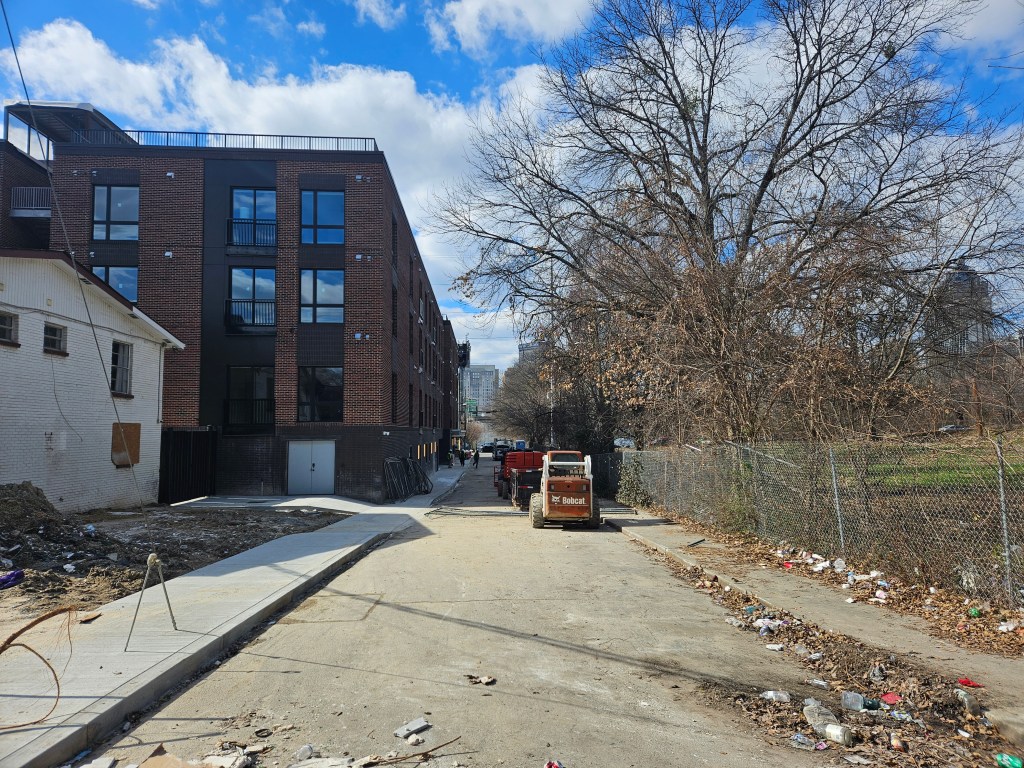
Meanwhile, new apartments and shops are going up on Hilliard Street, at the western edge of the Old Wheat Street alleyway — and Hendricks feels the tides of gentrification creeping in. But he doesn’t consider the interests driving the new development responsible for his friend’s death. “Absolutely not,” he said. “I blame the mayor. I blame the failed policies of the Atlanta Department of Public Works. I blame the people who never looked out for us.”
During the Jan. 23 press conference that Taylor’s family held outside City Hall, his son, Justin Taylor Garrett, pleaded for Atlanta leaders to stop the encampment closures.
“Please, I want justice for my father,” he said. “Stop the sweeps, please.”
MORE FROM SEAN ON HOMELESSNESS IN ATLANTA
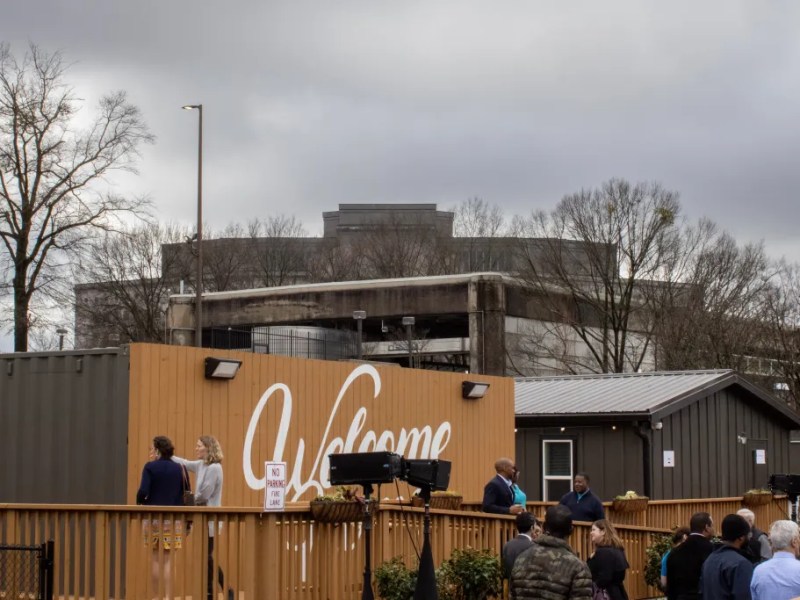
‘Unfortunate inevitabilities’: A reflection on deaths at The Melody, Atlanta’s apartment complex for unhoused people
Three residents have died since the city opened the shipping container village one year ago.


One year in, can Atlanta’s ‘rapid rehousing’ push hit 500 units?
The city is seeking new sites to accommodate more micro-units for chronically unhoused people by year-end.

So they went out there June 2024 then Jan 2025 and they call that an “encampment closure plan.” And the fact that shelters were the only option show the lack of actual supportive and temporary housing units.
How about did they help any of them get their disability benefits, food stamps, VA benefits, housing vouchers, etc.?