

Not a subscriber yet? Sign up for free — Democracy Digest lands in your inbox every other Tuesday.
You’ve got until April 20 to register to vote for the May 19 primary election — also known as 4-20 to cannabis aficionados. Early voting starts April 27. To see if you’re already registered, check the Secretary of State’s My Voter Page.
Whether voting even makes a difference featured heavily in my conversation for this week’s Voter Voice. George R., a forklift operator from Southwest Atlanta, feels disillusioned about voting, but he is also deeply concerned by rising wealth inequality and housing costs. Read what he has to say at the end of the newsletter.
We’ve got several updates on legislative races — and activists at Emory University are taking a stand against its use of controversial Flock license plate readers for campus surveillance.
Emory students, faculty demand university remove license-reader cameras
DeFlock Emory, a new student-faculty coalition, delivered a nearly 1,000-signature petition to Emory University on Friday demanding it stop using Flock Safety cameras to record license plates on campus. The images go into Flock’s national database, which can be accessible to all subscribers, including law enforcement.
The activists raised concerns about the university turning over vehicle data to local and federal law enforcement — including Immigration and Customs Enforcement (ICE) to track undocumented students and staff. They gave Emory until April 20 to respond to their demands or face an “escalation” of activism.
Atlanta House District 90 race heats up, as candidates drop out
Rep. Saira Draper’s (D-Atlanta) run for state Senate opened up a competitive Democratic primary in House District 90. Five Democrats initially qualified for the safe blue seat on March 6, but two, Matthew Nursey and Howard Mosby, have since withdrawn. That leaves Democrats Nicole Horn, Bentley Hudgins, and Leisa Stafford facing off in their May 19 primary. Samantha Boston is the sole Republican candidate.
Nursey, a housing advocate and Democratic Socialist, withdrew last Friday, telling Atlanta Civic Circle he’s endorsing Hudgins, a progressive organizer for LGBTQ+ rights, civil rights and labor. Nursey said he supports Hudgins’ housing platform — with his input — and doesn’t want to split the progressive vote in the Democratic primary.
Mosby, the interim COO of HEAL Collaborative, announced his withdrawal in late March, saying he had too many professional and personal obligations. “I cannot in good conscience pursue this role without the ability to dedicate myself completely to the work,” he said in a March 23 press release.
FROM OUR PARTNERS: Atlanta Civic Circle is partnering with Atlanta Community Press Collective (ACPC) to provide comprehensive primary elections coverage. ACPC editor Matt Scott published a profile on Hudgins last week that is well worth a read. Stay tuned for ACPC’s upcoming coverage of the other candidates in the House District 90 race.
More races to watch: House District 37 and House District 53
We’re adding two more competitive legislative primaries to our list of races to watch.
In House District 53, which extends from Buckhead north to Roswell, Democrats Beth Fuller, a former CDC contractor, and tech entrepreneur Tim Dorr are duking it out for the primary nomination to take on the Republican incumbent, Rep. Deborah Silcox (R-Sandy Springs). Democrats are hoping to flip this swing seat in the general election.
Meanwhile, in Marietta’s House District 37 the Democratic incumbent, Rep. Mary Frances Williams, faces a young progressive challenger, IT professional Graham Bowers, in the primary. No Republican is running, so whoever wins the Democratic primary wins the seat.
Williams, who flipped the seat in 2018 and is now seeking a fifth term, tried to boot Bowers off the ballot by challenging his residency – but a state administrative law judge ruled April 1 that Bowers is qualified to run.
Worth noting: Bowers is backed by Dr. Parin Chheda, who served as a senior campaign staffer for progressive young Democrat Sam Foster’s bid for Marietta mayor last fall. Foster lost to the four-term Republican incumbent, Steve ‘Thunder’ Tumlin, by just 87 votes. Chheda in an Instagram post said Williams’ failure to back Foster for mayor is one reason she’s facing her own progressive challenger.
ON OUR RADAR
WXIA-TV/11Alive is hosting the 2026 Georgia Democratic Gubernatorial Debate live from their Midtown studios on Wednesday, April 15, from 7–8 pm. Confirmed candidates: Keisha Lance Bottoms, Geoff Duncan, and Michael Thurmond. 11Alive's Faith Jessie and Zach Merchant will co-moderate.Watch live on WATL-TV in Atlanta, or stream on 11Alive+ (Roku, Amazon Fire TV, 11Alive app). Pre-debate coverage starts at 6:30 pm with post-debate analysis at 8 pm.90.1FM WABE's Rose Scott launches "Their Voice, Your Vote" — in-depth interviews with Georgia's candidates for governor.The series kicked off with two candidates on opposite sides of the aisle. Republican Attorney General Chris Carr emphasized economic growth, public safety, and maintaining Georgia's current abortion law. Democrat Jason Esteves, a former state senator and Atlanta school board chair, made the case for expanding Medicaid, fighting the maternal mortality crisis, and pushing back on the Trump administration's economic impact on Georgia.
Listen: Chris Carr interview →
Listen: Jason Esteves interview →
VOTER VOICE
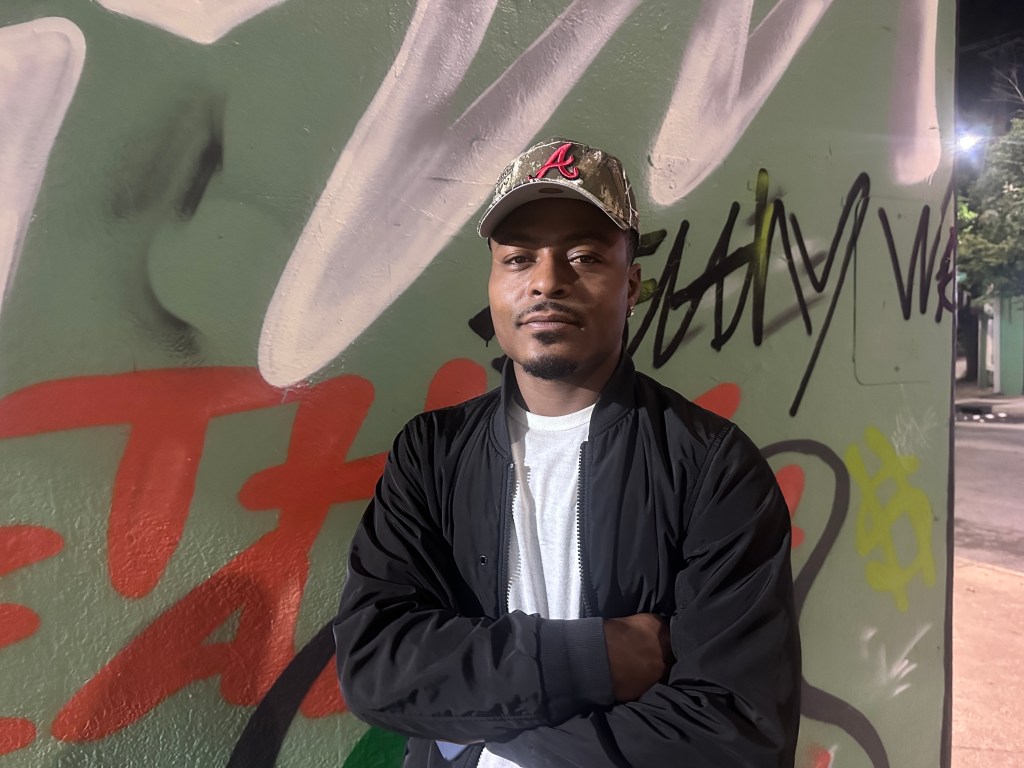
George R.
Age: 32
Neighborhood: Southwest Atlanta
Occupation: Forklift operator
Political Affiliation: None
ACC: What are your top issues when you walk into the voting booth?
George R.: In Atlanta, it will be housing — the housing rates versus the pay rates in the city. There’s a culture of paying people as little as you can. If I could say for the country, I think the wealth gap is really degrading. Atlanta is the most wealth unequal city in the country — so that probably explains why I feel it.
There’s 1000 ways to apply this, but the low-hanging fruit would be the dating market. Women, they don’t want a man unless he’s a big baller — unless he makes a certain amount of money and whatnot. Most people I know who have houses, families, multiple cars make around $50K [about $24 per hour for a 40-hour work week]. I’m making sub-$20 per hour.
Most people, they just don’t have a chance to ever actually do anything other than go to work, go to sleep, and then go to work again. Wealth, it feels unattainable, unless you find those niche ‘pockets’ of society. I think the ‘pocketization’ of society is a real problem. If you don’t find those pockets, you can’t make any headway in life.
What do you wish your elected officials understood about your life?
I would like for [elected] people to remember — if they ever even knew, because a lot of them never knew — what it was like [to be working class]. Because a lot of [elected] people, they get their funding, and it becomes like an exclusive thing – a gang thing, a group thing, a ‘Mean Girls’ clique kind of thing.
The point is, they’ll pull the string out, and then, when they get there, they’ll cut the string. Let’s say the Westside, hypothetically, had Flint water, and you run your campaign on ‘blah, blah, blah, I’m gonna fix it.’ And you get there and [you don’t] and then now what? And now people are stuck with you.
Are you planning to vote in the May 19 primary?
I’ve become quite disillusioned with the whole voting process in general, I believe that it is a non-factor in the results that we see. I reserve the right to be wrong about that. As a human, the way I like saying it is that I’m centrist for a reason: I always reserve the right to be wrong.
Do you identify politically as a centrist then? How would you describe your political affiliation?
I would say none. If you were to try and put it on the spectrum it would be center-right. But, I listen to both sides — because when people get in their pockets, it’s a bad thing.
I have a real problem with pockets. Pockets will be the death of humanity one day. One day there will be a pocket that has all the nukes, all the money, all this, and everyone outside the pocket is working to feed them — just like any other dystopian movie you’ve seen.
Today’s Democracy Digest was written by Alessandro Marazzi Sassoon and edited by Meredith Hobbs. As always, thank you for reading and supporting local journalism. We’re proud that ACC’s election coverage is free for everyone — but it’s not free to produce.
From candidate forums to voter guides to the voter voice you just read, thousands of metro Atlantans count on ACC to help them make informed decisions at the ballot box. Your support keeps that coverage coming — through May 19 and beyond.
