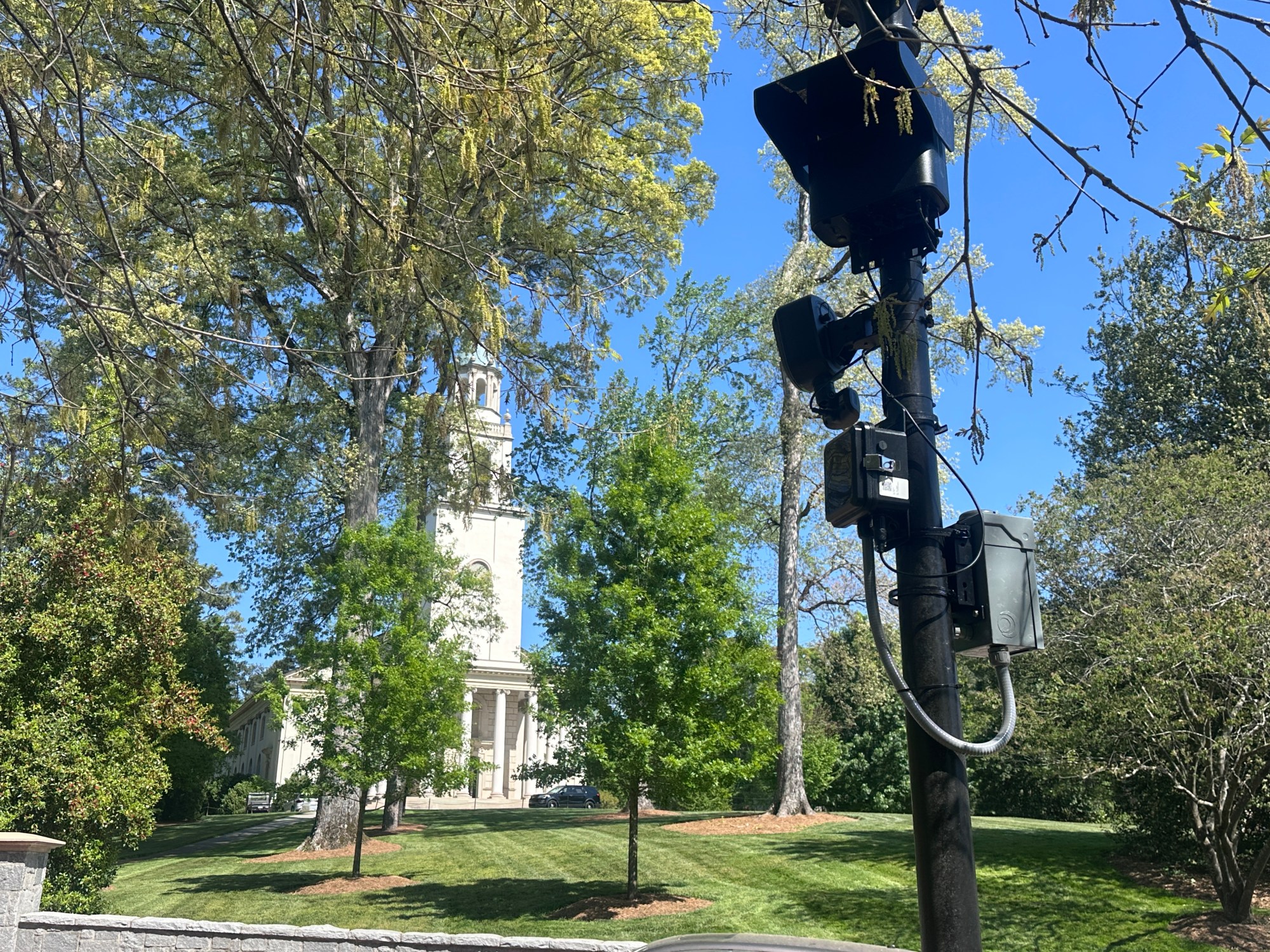
A broad alliance of student and faculty groups delivered a petition with nearly 1,000 signatures to Emory University on Friday, demanding it cease using Flock Safety license-plate readers to record vehicles on campus and initiate a community-led review of campus surveillance practices.
“Our university should NOT be functioning as a node in the national surveillance dragnet,” the petition says.
The DeFlock Emory Coalition said it has identified 10 Flock cameras on Emory property, including Emory University Hospital, which the university said have been present for two years. The student-faculty coalition is raising concerns about Emory and law enforcement agencies — including Immigration and Customs Enforcement (ICE) — using Flock’s vehicle images to target immigrants or activists to suppress free speech.
Flock surveillance cameras record vehicle license plates, along with color, make, model, and other identifying details, like bumper stickers or roof racks, which it stores in its national database for 30 days. Flock customers control with whom they share their license plate data. They can choose not to share it at all, or to share it with specific named law enforcement agencies, or with the entire Flock network nationwide.
Emory contends footage from the campus Flock cameras is only accessible to the Emory Police Department. The university said in a statement that Emory Police use the license plate data “to identify and reduce potential threatening activity and to assist with any incident or investigation involving a vehicle.”
Emory only shares footage with federal agencies, such as ICE, if federal law enforcement officials present a valid criminal warrant or court order from a federal judge, the statement said.
But records obtained by DeFlock Emory and shared with Atlanta Civic Circle show the Emory Police Department has Flock data-sharing agreements with several local police departments and sheriff’s offices. Flock’s database has never been hacked, according to the company, but data from several individual Flock cameras have at times been exposed to the open internet, according to 404 Media.
“I am undocumented and I am terrified,” said Anayancy Ramos, 30, a DACA recipient and Mexican national pursuing a microbiology Ph.D. Emory featured Ramos in 2024 for winning a prestigious fellowship from the Howard Hughes Medical Institute.
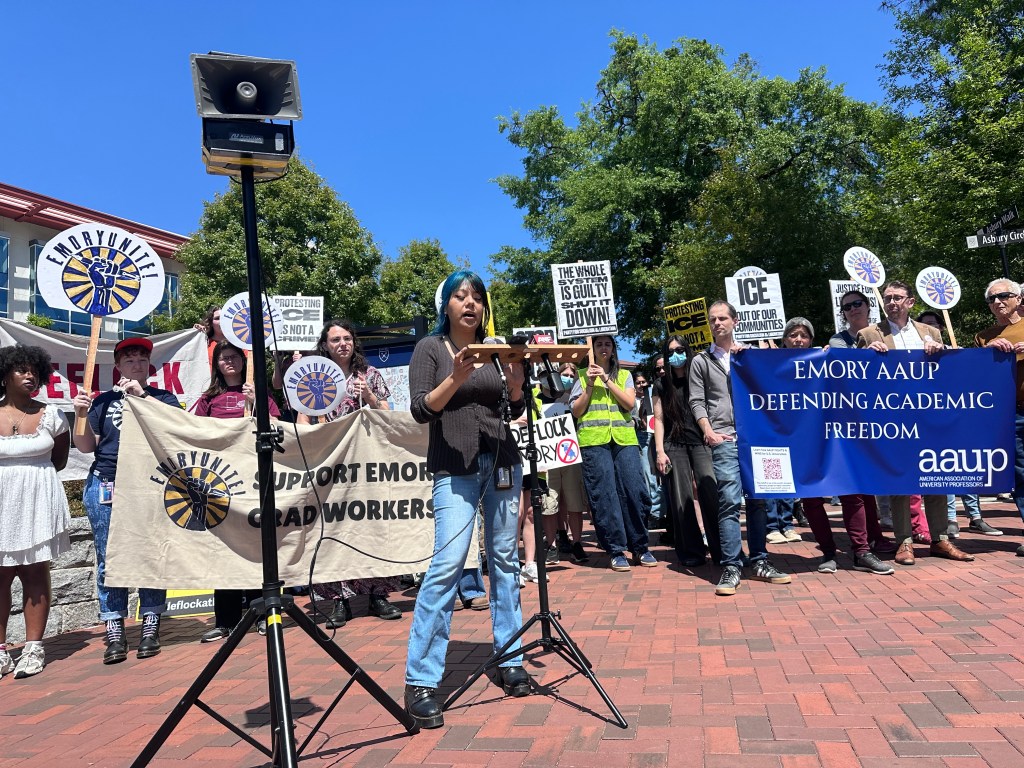
“If I stay silent, who gets saved? Nobody,” said Ramos. “The cameras stay up, the database keeps running, ICE keeps getting fed, and the next undocumented worker at Emory wakes up tomorrow just as scared as I am,” she said, hands trembling, as she addressed a crowd of over 100 students, faculty, and staff protestors at Asbury Circle on Emory’s campus before they delivered their demands to the university.
Ramos belongs to the graduate student union Emory Unite!, which has joined Sunrise Emory, Emory Students for Socialism, the Emory chapter of the American Association of University Professors, Emory National Lawyers Guild, and other campus groups to form the DeFlock Emory Coalition.
“These concerns are not theoretical,” said Jack McKee, 26, an Emory Law student who heads the Emory Free Speech Forum. McKee cited examples of the Atlanta Police Department running Flock database searches on behalf of ICE.
Georgia law requires local law enforcement to cooperate with ICE. Even in localities where ICE cooperation is not authorized, Flock surveillance has raised safety and privacy concerns. The Washington University Center for Human Rights found both ICE and Customs and Border Patrol gained unauthorized access to local law enforcement’s Flock databases with ease.
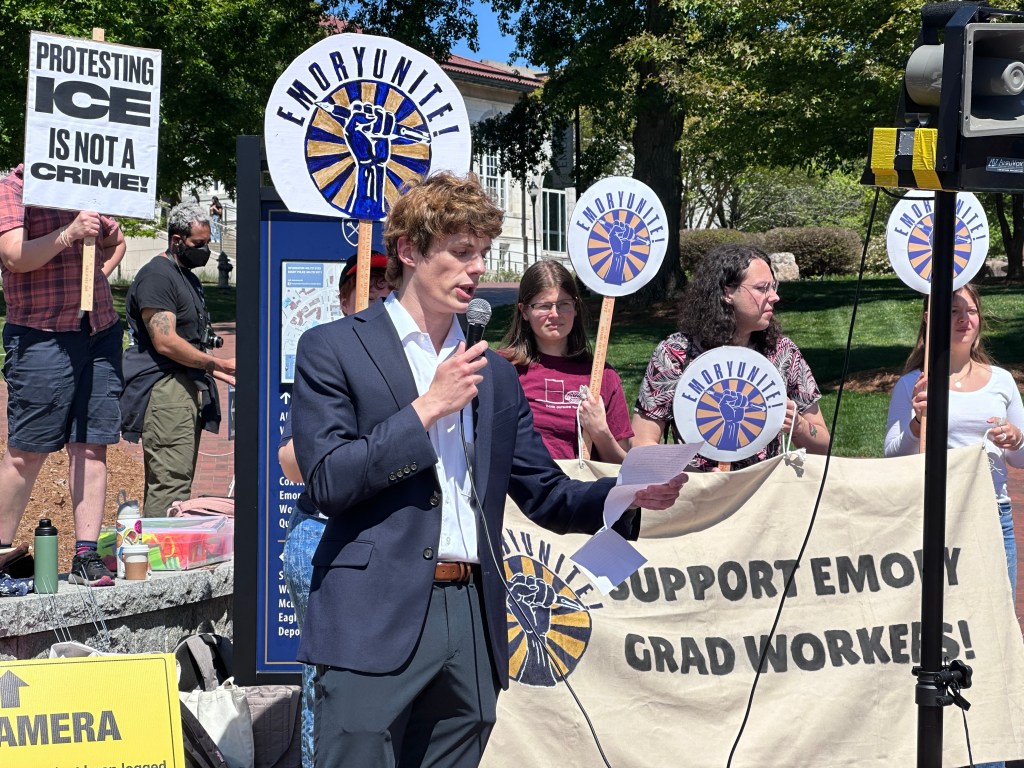
McKee added that the former Braselton Police Chief and a former Echols County Sheriff’s Office deputy were criminally charged for using Flock to stalk and harass people. “There has been no transparency or community involvement,” he said of the university’s implementation of the Flock system.
“We cannot accept any assurances at face value” that Emory Police does not share data with federal law enforcement agencies, said Emory writing instructor Robert Birdwell, who heads the Emory chapter of the American Association of University Professors.
“At a time of fascism, state terror, imperialist war, and the inundating idolatry of profit, it’s hard not to be shell-shocked by what’s happening in the news and in our neighborhoods. Yet we human beings can see far beyond what some security device can monitor,” Birdwell said.
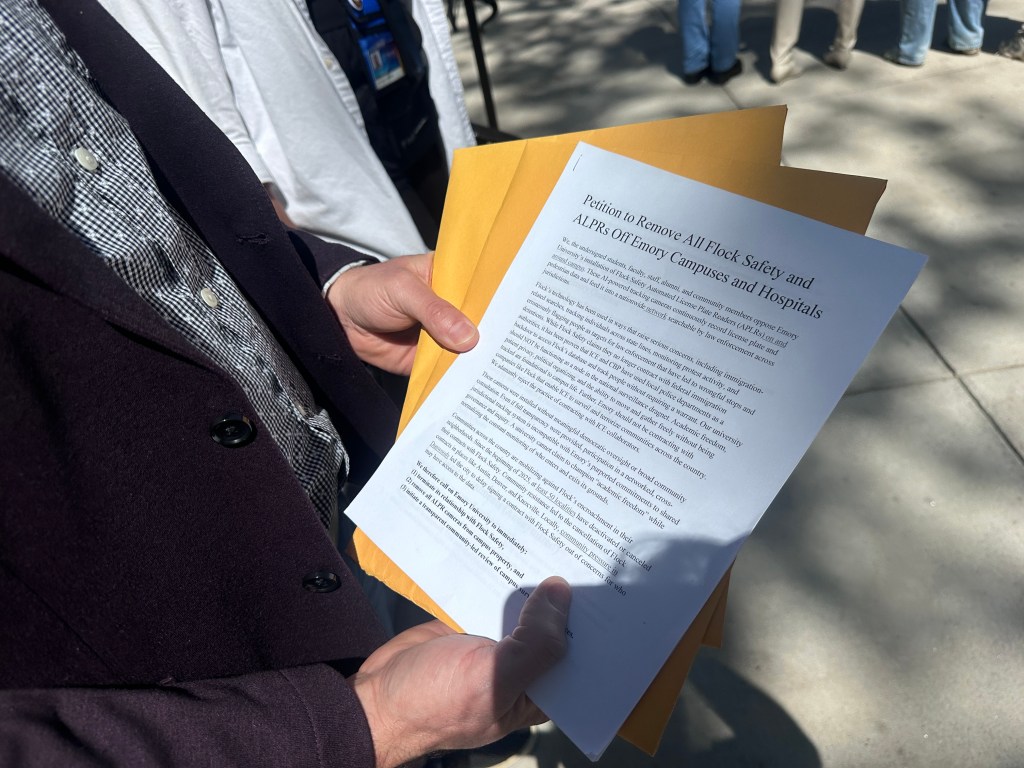
DeFlock Emory representatives, accompanied by the crowd of demonstrators, delivered the petition to Emory Chief Experience Officer Cutler Andrews outside the university president’s office. The coalition gave Emory 10 days to respond or face “an escalation” of activism.
Emory did not respond to Atlanta Civic Circle’s questions about their contract with Flock, or how many cameras are deployed on the university’s campus.
Correction: This story has been updated to clarify that Flock customers choose whether or not to share their Flock license plate data and with whom. It has been corrected to reflect that Flock’s database has never been hacked, but individual Flock camera data have at times been exposed to the open internet, according to news reports. Atlanta Civic Circle regrets the errors.