

Affordable Housing Trust Fund investigation
The city of Atlanta is using its Affordable Housing Trust Fund — created to bankroll housing construction and preservation for low-income Atlantans — for new purposes that are raising questions for housing advocates: paying municipal housing bonds and employee salaries.
The Atlanta City Council created the trust fund in late 2021 “to ensure adequate annual funding for affordable housing initiatives.”
But since late February, Mayor Andre Dickens’ administration has pulled about $9 million from the $17 million dedicated purse for the 2025 fiscal year to pay interest, fees, and principal on city-issued housing and homeless opportunity bonds — primary funding sources for municipal housing efforts — and over $4 million to pay city staff who work on housing-related projects.
The roughly $13 million total accounts for more than two-thirds of the trust’s FY 2025 funding — an especially hefty share for a fund that has never held more than $28 million since its inception in November 2021.
Stay tuned for Atlanta Civic Circle’s full investigation into the trust fund’s new uses.
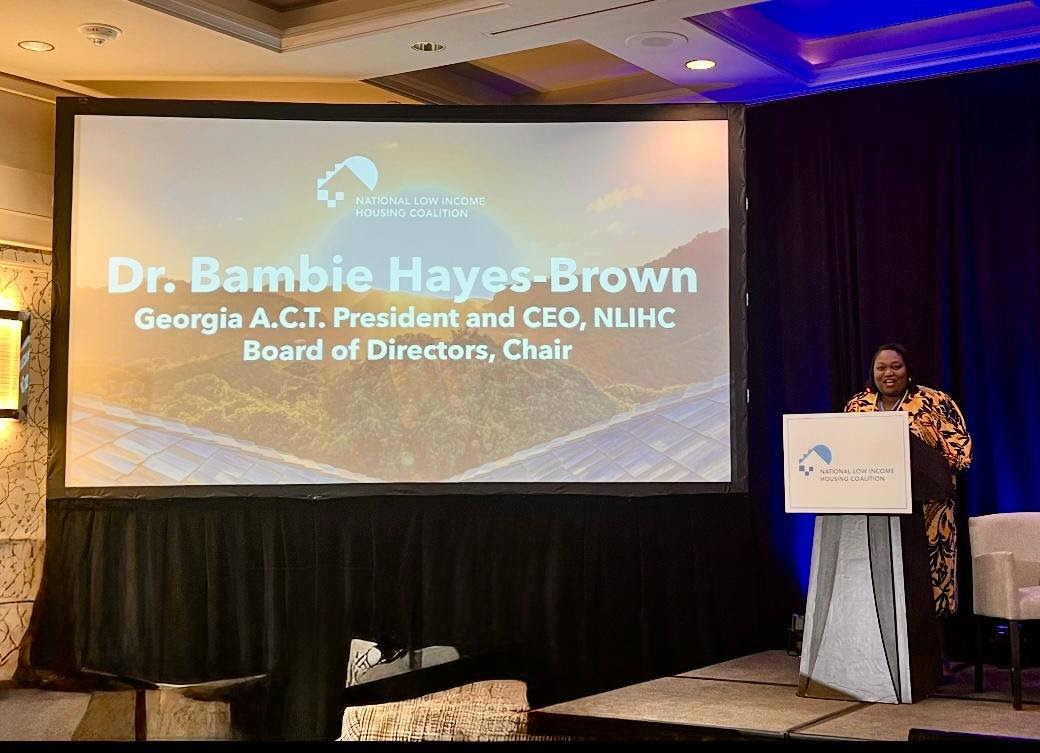
Atlanta housing advocate to chair National Low Income Housing Coalition
Bambie Hayes-Brown, who heads Georgia Advancing Communities Together, a statewide coalition of over 100 affordable housing and community development groups, has been tapped as the new board chair for the National Low Income Housing Coalition (NLIHC).
Hayes-Brown has spent nearly three decades as an activist, organizer, and lobbyist for affordable housing initiatives in metro Atlanta and across Georgia. She also brings to her new role invaluable lived insight into low-income Americans’ struggles to stay housed; Hayes-Brown experienced homelessness herself as a single mother, while in school.
“As chair, Dr. Hayes-Brown will guide NLIHC’s mission to achieve equitable public policy that ensures people with the lowest incomes have quality homes that are accessible and affordable in communities of their choice,” said the NLIHC’s announcement. “Her appointment reflects a commitment to elevating voices from the South and ensuring that policies are informed by those with lived experiences of housing security.”
Hayes-Brown will remain with Georgia ACT while she heads the NLIHC board.
📷: Courtesy photo.
Atlanta City Council urges state to adopt tenant protections
A bill to create eviction-diversion programs for low-income and disabled renters, the Georgia Tenant Protection and Mediation Act, never even reached a vote in the 2024 legislative session. The Atlanta City Council wants state lawmakers to revive — and approve — the measure next January, when the legislature reconvenes.
The council passed an ordinance on Monday urging the state legislature to revisit the Democrat-backed House Bill 1059, which would also give tenants facing dispossessory actions the right to ask for legal mediation within seven days of receiving an eviction notice.
HB 1059 would require landlords trying to evict tenants to notify them in writing that they have the right to participate in an eviction-diversion program. Landlords would also have to provide contact information and instructions on how to do so.
HEADS UP ON HOUSING
Seniors should act fast for property tax relief
Seniors have until May 31 to apply for property-tax assistance from Atlanta’s Anti-Displacement Tax Relief Fund — an initiative aimed at keeping legacy residents in their homes as property values rise.
To be eligible, you must be 60 or older and an Atlanta resident since at least 2015. The program freezes property tax rates at current levels and covers future increases for up to 20 years.
The $10 million fund is administered by Invest Atlanta.
→ Qualified residents can click here to apply.
Federal officials can learn from new book on Atlanta’s working homeless
Local journalist Brian Goldstone’s new book, “There Is No Place For Us,” offers a sober and resolute portrait of five metro Atlanta families thrust into homelessness, even as their household heads — mostly single mothers — worked tirelessly to provide safety and stability for their children.
Goldstone’s book exposes the precarious reality of low-income life in the United States. For over 300 pages, he documents how financial strains, family responsibilities, and systemic neglect leave far too many working families trapped in a cycle of housing insecurity.
“There Is No Place for Us,” released March 25, proves a prescient alarm bell for President Donald Trump’s draft FY 2026 federal budget. Released May 2, it proposes essentially ending Section 8 and other federal housing voucher programs that lower-income families depend on to defray their rents.
Trump’s proposed $33.6 billion — or 44% — gutting of the US Department of Housing and Urban Development (HUD) budget would cut HUD’s rental-aid programs by $26.7 billion (43%) and send that money to the states as block grants for them to design their own rental assistance programs. It also would impose a two-year limit on rental assistance for “able-bodied” adults. It is up to Congress to either reject or approve it.
The Trump administration argues the draconian cuts will save the federal government billions. Goldstone’s work makes clear who will really pay the price. Read our full review here.
Today’s newsletter was written by Sean Keenan and edited by Meredith Hobbs. Your donation makes Housing Happenings and ACC’s housing reporting possible. Support local, nonprofit journalism that empowers Atlantans to improve their communities.

