

To build 5,000 much-needed affordable housing units across the city, Atlanta Housing (AH) must make some big changes, says a new report by the nonprofit Urban Land Institute (ULI).
The agency enlisted ULI to help it find out how to best develop affordable housing for the roughly 300 acres of developable land that it owns.
With AH’s chief executive, Eugene Jones, set to retire at the end of the year—and his successor yet to be named—a national ULI panel of developers, investors, housing experts, and staff recommended a number of organizational tweaks to clarify the agency’s development priorities.
Scattershot approach
AH primarily relies on public-private partnerships for major housing development or redevelopment projects. That approach often yields too much operational control to its partners, according to the ULI panel’s review.
“Timelines and schedules are effectively set by external partners,” such as the U.S. Department of Housing and Urban Development (HUD), private developers, and outside funding agencies, “which dilutes internal accountability for project progress,” their report said.
But the agency should avoid developing projects on its own, the panel added, and instead lead the public-private partnerships.
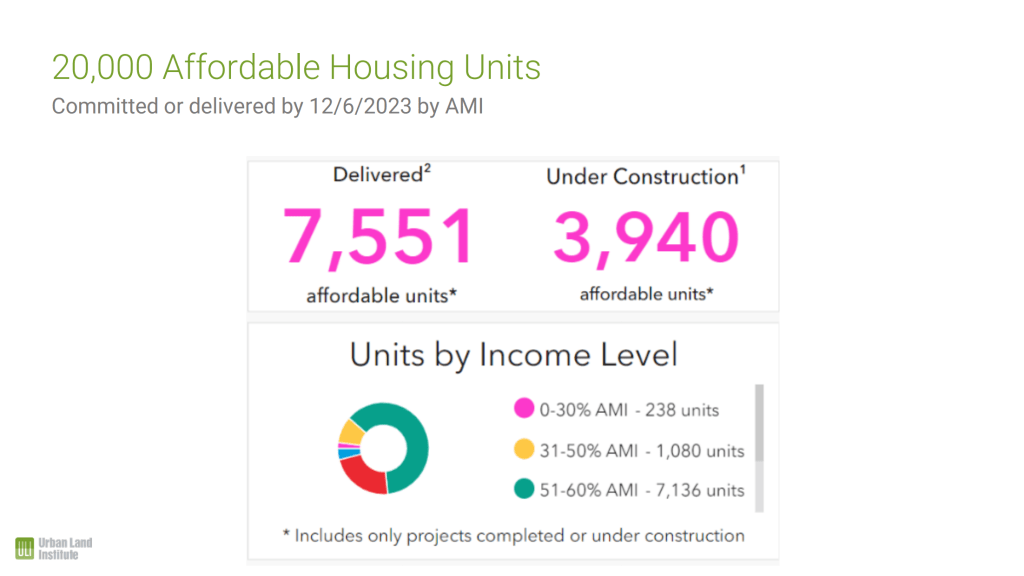
Out of 20,000 affordable housing units promised by Atlanta Mayor Andre Dickens’ administration by 2030, the city has delivered over 7,500, with almost 4,000 more under construction. These are priced for people earning up to 60% of the area median income.
However, ULI’s audit of the agency’s practices found that AH has taken a scattershot approach to development. AH’s requests for qualifications and requests for proposals from private developers, for example, must be overhauled; current RFPs and RFQs leave too much room for interpretation.
“Streamline the RFQ and RFP process by going to a true master developer model, presenting clear minimum standards [for the amount of affordable housing], and sharing the limitations of AH’s funding where applicable,” the ULI report said
The panel added that AH’s typically gives a 30-day deadline when it issues RFQs and RFPs, which is not long enough to garner “fully planned” submissions.
More real estate expertise
The public housing authority’s real estate division, which manages a roughly 300-acre portfolio of AH-owned property, should be “organized more like a private-sector development company,” the ULI report said.
Currently, the real estate group “appears to have a very large development agenda without clear focus on where best to start or concentrate efforts.”
The panel recommended that AH beef up its real estate team by adding in-house expertise or using outside development and financial consultants who are savvy about master planning and project management.
The agency also needs more expertise to help it identify funding gaps and assess the “tradeoffs between subsidy levels, levels of affordability, financial feasibility, and expected returns,” the report said, when it’s determining the right mix of affordable and market-rate housing for each project.
Given AH’s funding limitations, the real estate team should prioritize projects based on “shortest development timeline, fewest funding impediments, [and] most responsive development partner, etc.,” the report said.
Infrastructure funding sources
Another key hurdle: Most of the vacant land AH owns and wants to develop with affordable housing lacks the infrastructure to support new construction—and building it is expensive.
AH traditionally depends on public funding from Invest Atlanta bonds, the Georgia Department of Transportation, and other sources to build the roads, sewage and other infrastructure needed for a housing development. However, that model has left an infrastructure funding gap of roughly $1 million per acre for mixed-income housing.
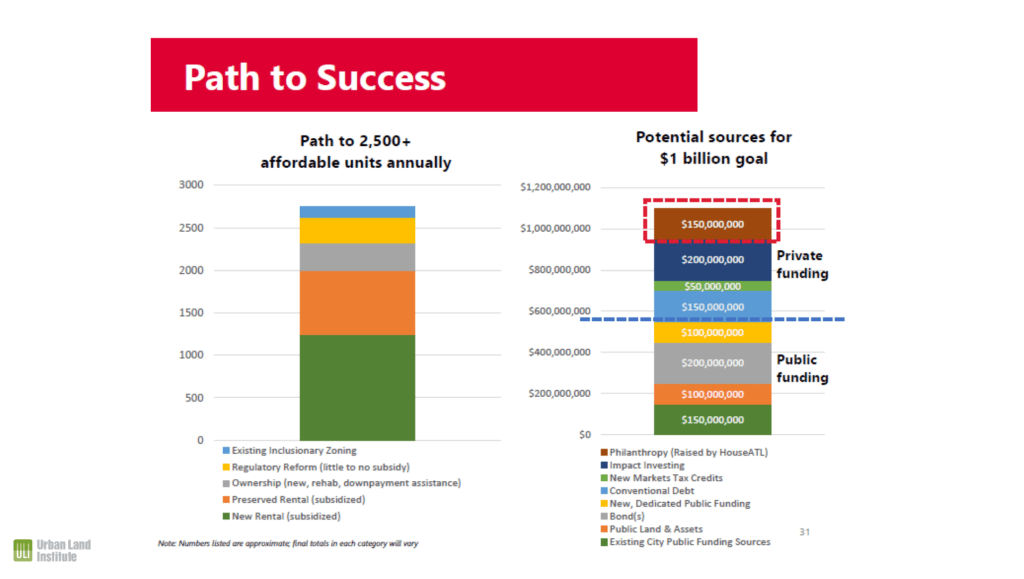
ULI recommended a “non-traditional approach,” saying AH “could pursue a low-interest or interest only loan to finance full infrastructure development” and back it with agency funds.
The nonprofit also suggested securing additional private funding, such as philanthropic dollars from HouseATL, a broad coalition of Atlanta civic leadership from the public, private, and nonprofit sectors. Other options it suggested were engaging in impact investing, applying for federal New Markets Tax Credits, and taking on other debts.
Five-year plan
The ULI panel endorsed the housing authority’s latest five-year plan, released earlier this year, to add or retain 10,000 units of affordable housing to Atlanta. AH aims to do that by building 5,000 new apartments and homes and preserving another 5,000 at risk of disappearing: “AH should maintain its focus on the elements of the strategic plan and the HouseATL plan.” it said.
HouseATL in November released its own updated five-year policy roadmap for metro Atlanta with 23 recommendations to expand affordable housing. That includes stronger tenant protections and increased housing production.
Larry Stewart, the chair of AH’s board of commissioners, said he agrees with ULI’s overarching idea—that the agency should retool aspects of its organizational structure.
“Organizationally, we’ve always been trying to figure out how to right-size the organization so it matches the speed upon which we’re trying to deliver our 10,000 units and provide some leadership and a kind of template for everybody’s development,” he said in an interview.
“The Beltline’s development, Atlanta Public Schools, MARTA—everybody’s got some affordable housing they want to create, but in essence, we are the 800-pound gorilla on that,” he added. “We [at AH] have the most units, the most experience, and we want to use the ULI recommendations to help us continue to stay on the front foot in that regard, and then hopefully provide that as a template to follow.”

typical bs.. never answer the questions or resolves the problem.. Klueless with a K.. lol