
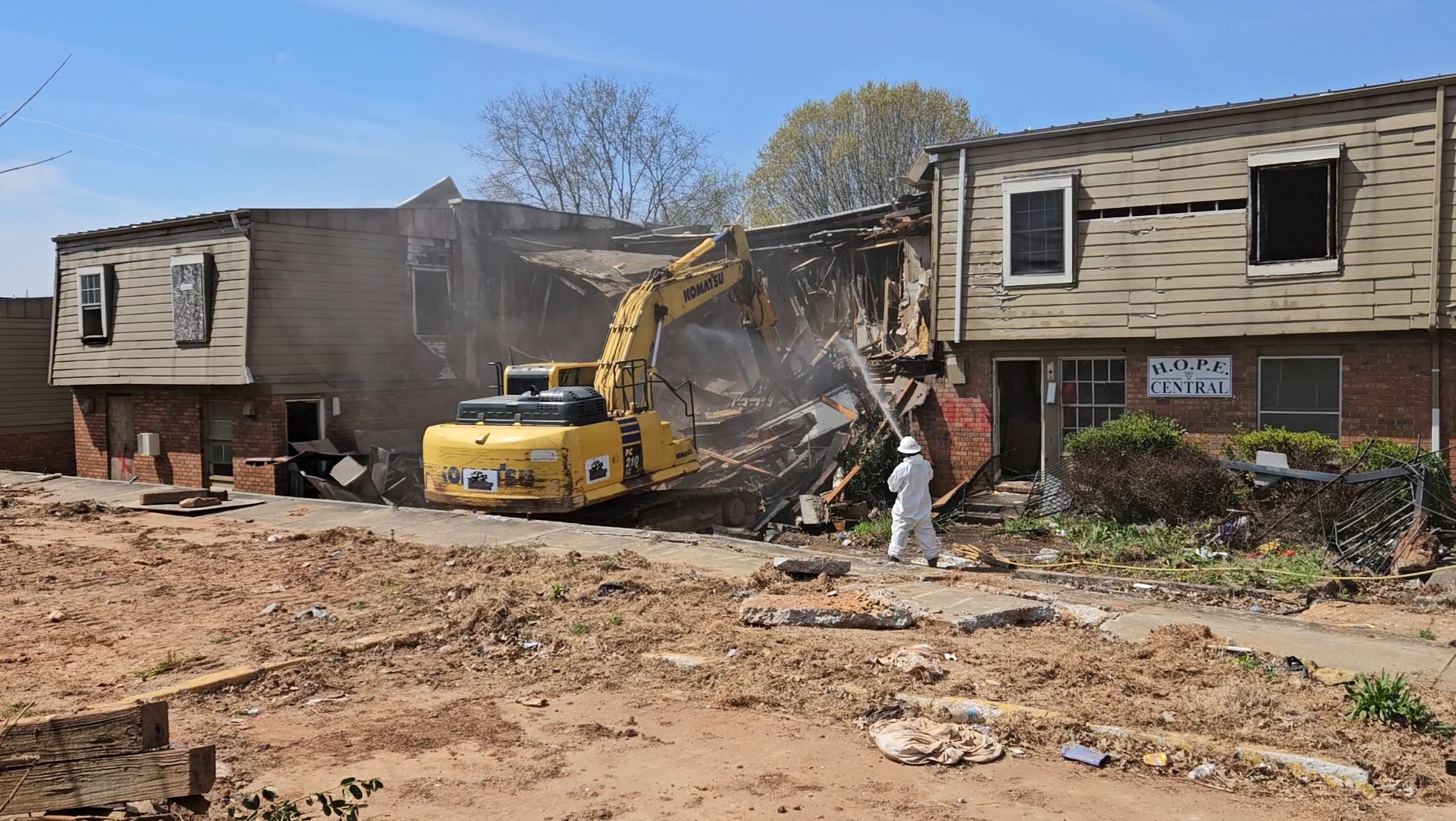

Up against over 50,000 pounds of mustard-yellow earth-moving machinery, the Forest Cove Apartments — already rickety due to years of neglect — didn’t stand a chance.
On Wednesday, a wrecking crew finally started its long-awaited demolition, almost 18 months after the city of Atlanta finished evacuating and rehousing the nearly 200 low-income renters living at the condemned southside apartment complex — and over two years after a municipal judge deemed Forest Cove a public nuisance and ordered it razed.
An excavator pummeled the units in a two-story building beside the leasing office first, and then the office itself, marking the beginning of the end for one of Atlanta’s most infamous Section 8 apartment complexes. It is one of many owned nationally by Ohio-based mega-landlord Millennia Housing Management.
But for former Forest Cove tenants, the story won’t end with their old homes being reduced to rubble. Some residents found themselves rehoused in properties plagued by familiar issues, including rats, roaches, mold, litter, and violent crime. Many of them want to return to the Thomasville Heights neighborhood — if and when the city executes an ambitious neighborhood revitalization plan that promises new subsidized and market-rate housing, along with other mixed-use development.
“It’s great that Forest Cove is finally being torn down,” said Foluke Nunn, a community organizer with the American Friends Service Committee who’s served as a conduit between the renters and the city amid a tumultuous resident relocation effort. “This is the end of an era that was defined by trauma and hardship for many residents.”
But Nunn said the former Forest Cove tenants need some guarantee that they can indeed return to their former community, which included a public elementary school, recreation center — shuttered as the complex was vacated — and park adjacent to the apartments.
“We need the city to commit to a written, enforceable right of return to come back to Thomasville Heights if they wish,” Nunn said in an interview. “Will there be enough affordable housing for everyone who wants to return? When will that happen?”
Atlanta Mayor Andre Dickens’ office has repeatedly assured ex-Forest Cove tenants they’ll be able to return.
“We’re making good communication directly with the previous occupants of Forest Cove, as well as anyone living in dilapidated conditions across the city in apartments [with landlords] that aren’t doing their job,” Dickens told Atlanta Civic Circle during a Wednesday press conference at Forest Cove. “We see you, and we’re here for you.”
The Dickens administration announced last week that the city’s new development arm, the Atlanta Urban Development Corporation, is seeking qualified developers for the first phase of the Thomasville Heights Neighborhood Plan on property across the street from Forest Cove. This initial phase will redevelop eight acres of vacant land owned by Atlanta Housing into 80 to 120 units of subsidized and market-rate housing.
The city expects to take about five months to fully raze Forest Cove, because it must first remediate the asbestos lining the walls in each of the 396 units. The demolition crews on March 20 only knocked down apartment buildings that had previously caught fire, which, ironically, can help deactivate the dangerous carcinogen.
Cause for celebration?
Millennia, which owns Forest Cove under the name Phoenix Ridge, contends that the city is misrepresenting a massive plan to help private developers gentrify Thomasville Heights under the guise of revitalizing the neighborhood for its longtime residents.
“Today the city is not only celebrating the demolition of Forest Cove, but also the success of its plan to steal Forest Cove from its former residents and Phoenix Ridge, in order to hand it over to a developer of their choosing for their vision, which notably excludes the subsidized housing crucial to those residents,” the company said in a statement to Atlanta Civic Circle.
(The Thomasville Heights Neighborhood Plan does indicate residents there would rather have new single-family houses, duplexes, and townhomes than apartments — and that preserving and rehabilitating existing subsidized housing was not a top priority.)
Millennia purchased Forest Cove from Global Ministries Foundation (GMF) in April 2021, after the U.S. Department of Housing and Urban Development (HUD) forced GMF to divest from its entire Section 8 portfolio after years of documented mismanagement.
Millennia said in the statement that the city and Global Ministries were to blame for Forest Cove’s hazardous conditions. The mega-landlord added that it would have undertaken a $58 million renovation for Forest Cove if the city had not instead moved to condemn and now demolish the 50-year old complex.
“Had the city not blocked Phoenix Ridge from doing so, all rightful Forest Cove residents would be living in transformed, subsidized homes today,” Millennia said. It added: “Despite what Mayor Dickens may claim, today is a sad day for Atlanta and the Forest Cove residents who will never return to their community and continue to languish in temporary housing across metro Atlanta.”
Millennia sued the city in federal court in October, alleging that securing the condemnation order had unlawfully deprived the company of its property. That case, still ongoing, was the latest salvo in a long-running legal battle between Millennia and the city that had delayed Forest Cove’s demolition.
Not an anomaly
Forest Cove is one of many low-income Atlanta apartment complexes that have suffered from years of deferred maintenance and dangerous conditions — but Millennia and at least one other Section 8 landlords operating here are now facing serious government scrutiny.
The U.S. Department of Housing and Urban Development (HUD) told Atlanta Civic Circle last week that it had cut off Millennia from future federal contracts for five years, meaning the company can’t seek any more Section 8 rent voucher subsidies.
Likewise, Capital B News Atlanta just reported that HUD had issued notices of default over its Housing Assistance Payment (HAP) contracts with California-based A&B Apartments LLC and Behzad Beroukhai, who own the similarly dilapidated westside complex Fairburn & Gordon. HUD cited “unacceptable physical conditions.”
Dickens said HUD and the city are working in tandem to identify “any bad operator in the city of Atlanta” and put them on notice: “If you are going to operate in a way that is going to cause hurt, harm, or danger to the residents of Atlanta — such as the residents of Forest Cove, owned by Millennia — we will see about you.”
“We’re about to start our process along with HUD on how to either get Fairburn Gordon into compliance, or we will start making provisions to make sure that Fairburn Gordon is no longer operating under the model that they are,” Dickens added.
That might mean another resident relocation effort for the city — a process that’s challenged by the severe lack of affordable apartments whose landlords are willing to accept Section 8 rent vouchers.
Courtney English, the mayor’s top policy advisor, said at the press conference Wednesday that the city’s new Housing Help Center and its partnership with homeless services nonprofit Open Doors Atlanta better equip it to help rehouse people now than in 2022, when Forest Cove residents were resettled.
What’s more, Dickens said, the city is conducting a “deep dive” to identify the top investors backing Atlanta’s most problematic landlords — “and then we start going back and telling the [investors], ‘Don’t invest in these people. Don’t invest in these corporations that are creating a Millennia or a Fairburn Gordon.’”
