



Two separate bench trials this month will determine whether to strike down a new, hotly contested election rule. The rule would allow county election boards to conduct a “reasonable inquiry” of vote tallies before certifying them. The State Election Board’s pro-Trump majority passed the rule in August amid a flurry of other last-minute rule changes.
If the rule stands, its bipartisan opponents fear it could allow any of Georgia’s 159 counties to hold up certifying the statewide election results beyond the deadline mandated by state law.
Fulton County Superior Court Judge Robert McBurney hasn’t yet issued a ruling on the new certification rule after a two-hour bench trial on Oct. 1. That lawsuit was brought by the state and national Democratic Parties. The second bench trial is scheduled for Oct. 16 before Fulton Superior Court Judge Thomas Cox. That separate lawsuit is from Eternal Vigilance Action, which is led by former State Rep. Scot Turner, a Republican.
However, McBurney said at the Oct. 1 trial: “The deadline is the deadline. Get done what you can. What is reasonable to one person might be not reasonable to another. But you make your inquiry and then it’s wheels up at 5 pm. on the 12th of November.”
The judge’s remarks comport with Secretary of State Brad Raffensperger’s comments on the new rule at a Rotary Club of Atlanta event last month. “As it’s written in state law: They shall certify the election by the Monday after the Election Day,” Raffensperger said. “We need to make sure they follow the law, follow the [state] constitution.”
Does that mean a county election board would be breaking the law if it doesn’t certify the vote by Nov. 12? The short answer is yes.
But what happens next is “uncharted territory,” said Ryan Germany, Raffensperger’s general counsel during the contentious 2020 presidential election. He was on the infamous phone call when former President Donald Trump asked the secretary of state to find 11,780 votes – the margin by which he lost in Georgia.
“I read Atlanta Civic Circle to understand why I should care about a particular issue.” – Cheryl
Your donation today helps keep this kind of insightful, nonpartisan reporting available to everyone.

Germany, who’s now in private practice, co-chairs the American Bar Association’s Georgia Democracy Task Force for lawyers aiming to uphold election integrity.
He predicted two possible scenarios in response to a question from Atlanta Civic Circle at a Monday election integrity panel at the Carter Center.
The first would be that the state overrides any county’s refusal to certify its vote and simply certifies the election results statewide.
Germany made clear that the statewide vote count in this scenario would include the holdout county’s vote tally. “I don’t think that a county refusing to certify their election results means that the state should not include those counties’ results in the state-certified results,” he said.
“I don’t think the law anticipates or allows a county [elections] board to essentially disenfranchise their voters,” he added. “I think the state should still certify their election results accurately.”
The second scenario would mean taking any rogue elections board to court. ”County boards refusing to certify by deadline would face judges ordering them to certify in accordance with state law,” Germany said.
Raffensperger played out that scenario in response to a question at the Atlanta Rotary Club event.
If a county superior court judge orders the local elections board to certify the vote, the secretary of state said, “Then your choice will be: You will do it or you will be in jail. It will get done anyway, but you will be sitting in jail for contempt of court.”
“I just don’t believe you should ever want to trifle with a judge,” Raffensperger added.
But the political implications — or at least, the optics — of county election board members being fined or jailed for refusing to certify an election worry some election watchdogs, since that could further fuel doubts about the integrity of Georgia’s presidential election.
A strategy of chaos
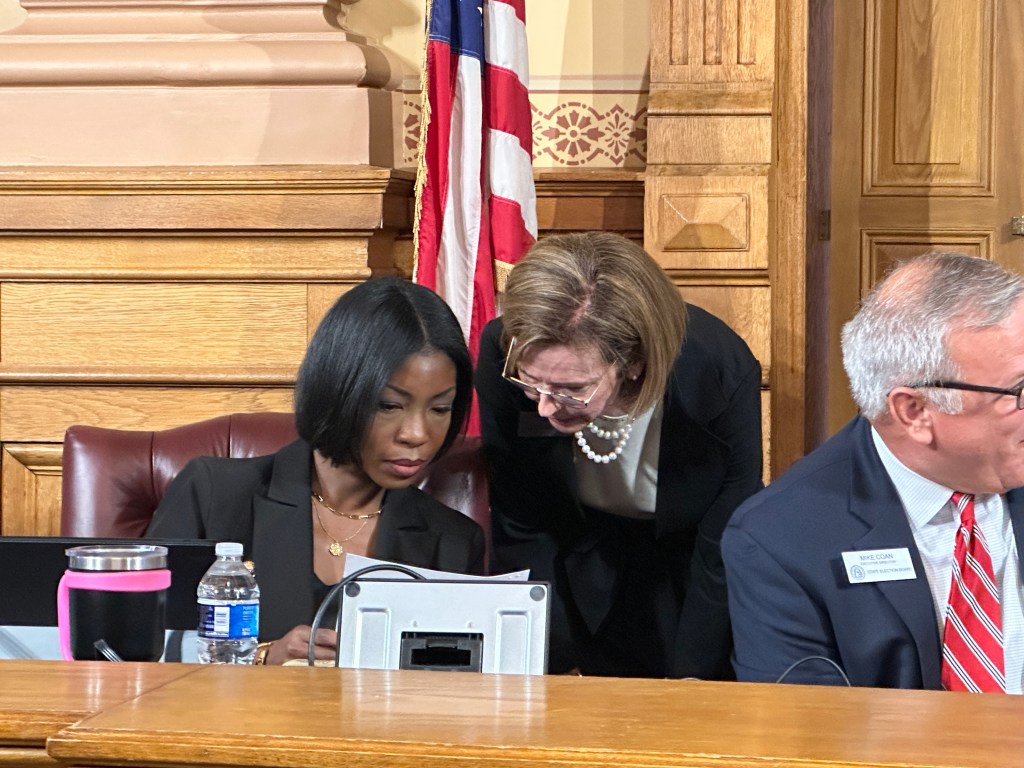
Pro-Trump State Election Board members with a 3-2 voting majority passed the last-minute new rules, like the certification rule and another requiring ballot hand-counts in each county after polls close on Election Day.
Billed as “election integrity” measures, the new rules play on unfounded but persistent doubts among some Trump supporters that Biden “stole” the 2020 presidential election.
Georgia Democrats and some Republicans view the rules as part of a deliberate strategy by Trump partisans to lay the groundwork to sow doubt, chaos and confusion about the Georgia vote count if Trump were to lose by a thin margin, as in 2020.
The chaos could be used as a “pretext to sow seeds of doubt about the election certification process,” says the national and state Democratic parties. In their lawsuit to block the new “reasonable inquiry” rule, they warn it could all but guarantee turmoil in Georgia elections if Democratic presidential candidate Kamala Harris wins.
“Delays in results,” like those that the State Election Board’s new rules could introduce, “create a vacuum that leads to misinformation and disinformation,” the lawsuit adds, quoting an Aug. 15 statement by Raffensperger.
What’s more, such delays would violate Georgia law, the lawsuit says: “Any delays in certification—to say nothing of an outright refusal—would derail the detailed, reticulated scheme embodied in Georgia’s statutes.”
Any ensuing confusion prompted by the “reasonable inquiry” rule could also create “the all-too-real risk of subjecting elections officials across the state to threats of violence” the lawsuit warns.
“They are playing poker with the cards up,” Tolulope Kevin Olasanoye, executive director of the Democratic Party of Georgia told the Washington Post in June. “They are telling us exactly what they are going to do. We would be foolish if we sat on our hands and did nothing and watched this happen.”
Strategy of chaos or not, the Secretary of State’s office told Atlanta Civic Circle that it is planning a legal strategy for any scenario.
“The Secretary of State’s office has been in close communication with the state Attorney General’s office and is confident that the certification process will occur as written in Georgia law,” said spokesperson Robert Sinners.
This article was updated to reflect that the bench trial of Eternal Vigilance Action v. State Election Board was rescheduled from Oct. 4 to Oct 16. – Ed.